





 Português
  Inglês
  Espanhol
  6 min de leitura
  0 comentários


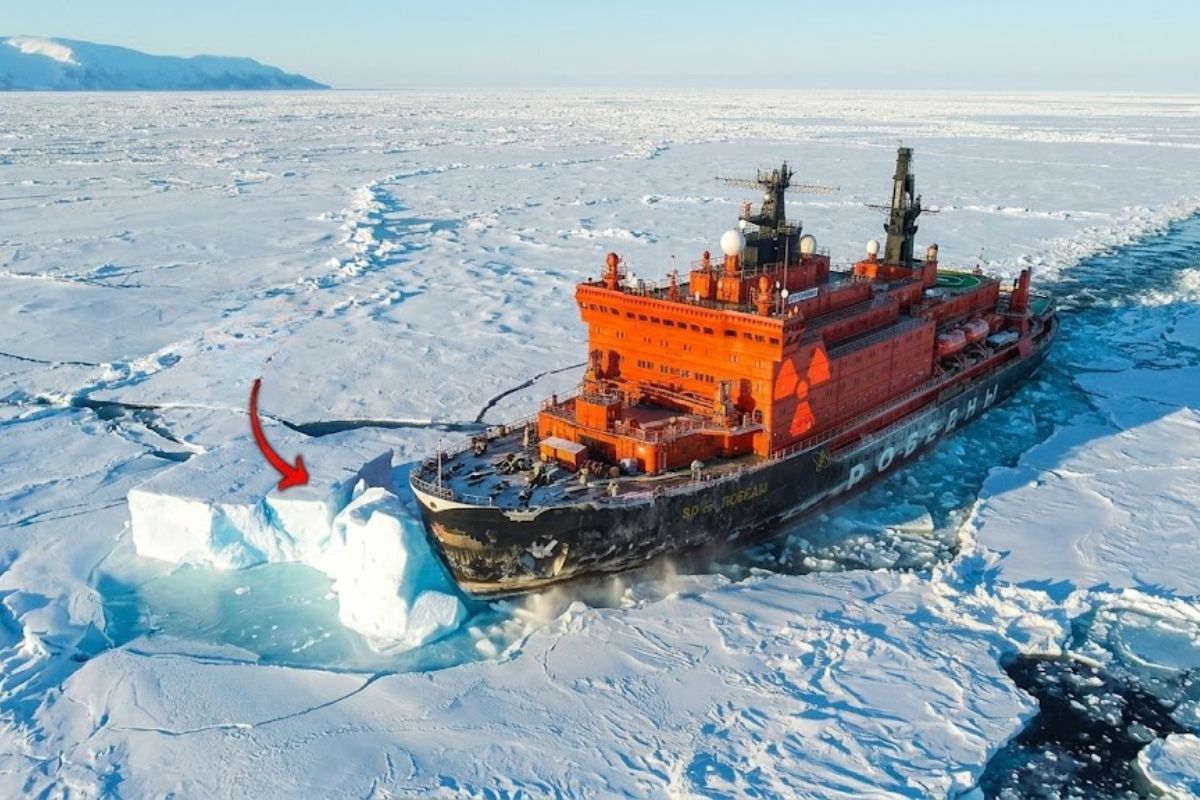
With About 60 Megawatts Of Power, The Largest Nuclear Icebreakers In Russia Are Designed To Ride Over Thick Ice Sheets And Crush Them With Their Own Weight, Opening Navigable Channels In The Arctic Ocean And Allowing Freighters To Cross Frozen Routes Where Regular Ships Would Simply Get Stuck For Months.
The largest icebreakers are designed to operate in an environment where traditional navigation simply doesn’t work. During the winter, the Arctic Ocean can become almost completely covered by ice, with average thicknesses of about 2.5 meters and blocks easily exceeding three meters. In many stretches, these frozen sheets are larger than a house.
Conventional cargo ships cannot navigate this scenario. The traditional bow shape, which includes a bulb designed to reduce hydrodynamic resistance in open water, becomes an obstacle when it encounters thick ice. When colliding with a frozen sheet, a regular freighter simply stops, unable to generate enough force to break the material.
This is precisely where the largest icebreakers come into play. These ships have a bow specifically designed to scale the ice. Instead of trying to crush the frozen sheet directly, the hull climbs over it and uses the weight of the vessel to induce bending and rupture.
-
A bright yellow mushroom imported from Asia escaped from a cultivation farm in the United States in 2010 and is now aggressively spreading across 25 states, destroying entire communities of native fungi in American forests.

-
Buried under China, a colossal machine weighing 20,000 tons began operating as the largest neutrino detector on the planet and, in just 59 days, surpassed results that science took half a century to achieve.

-
Iran enters the center of a climate alert after the war emitted 5.6 million tons of CO2 in two weeks, surpassing the annual pollution of entire countries.

-
Lunar exploration may change after a Chinese probe finds a “cavity” of radiation that reduces the impact on astronauts by up to 20% at certain times on the Moon.


This method requires far less energy than simply pushing the ice head-on. The ice behaves like a brittle material with some elasticity, and when the weight of the ship exceeds that limit, the sheet bends and breaks.
How The Largest Icebreakers Are Able To Destroy Giant Ice Sheets

There are two main processes that allow the largest icebreakers to carve paths through frozen seas.
The first occurs when the bow compresses the ice head-on. This pressure generates internal stresses that cause the sheet to bend vertically. When the elastic limit is exceeded, the ice breaks.
But the second method is the most efficient and also the most impressive. The ship literally climbs over the frozen block and breaks it with its own weight.
This strategy works because much of the ice is submerged. The part underwater can be three or four times larger than the portion visible above the surface. The rounded shape of the bow facilitates this ascent, allowing the vessel to slowly slide over the ice before crushing it.
In some cases, the ship needs to reverse and advance multiple times to complete the break. This repeated movement creates a sequence of fractures until the block finally splits.
The Structural Design Behind These Polar Machines

To withstand this type of effort, the largest icebreakers have very different structures from conventional vessels.
The hull is reinforced with much thicker steel plates made from high-strength alloys. At extremely low temperatures, steel can become more brittle, requiring materials capable of withstanding repeated impacts without fracturing.
The areas near the waterline receive special attention. This area is constantly pressured by ice blocks scraping against the hull as the ship moves forward.
Additionally, the structure often has double walls on the sides and bottom, creating an additional layer of protection against structural damage.
Another fundamental detail is the shape of the hull. It needs to allow broken blocks to slide away from the vessel, preventing them from getting stuck in the propellers or other parts of the propulsion system.
The Enormous Power Of The Largest Nuclear Icebreakers
Among all the vessels of this type, the largest Russian nuclear icebreakers are some of the most powerful ever built.
These ships can generate around 60 megawatts of power at the propulsion shaft, comparable to the force used by gigantic container ships. The difference is that while freighters use this energy to transport enormous volumes of cargo, icebreakers apply it to destroy ice sheets.
Even facing frozen layers of up to three meters thick, these ships can maintain a steady speed.
The use of nuclear propulsion brings an important advantage: autonomy. While a diesel-powered ship would need to consume large amounts of fuel daily, a nuclear icebreaker can operate for years without refueling.
In practice, the limitation becomes merely the supply of food for the crew, which usually lasts about six months.
This energy independence is essential in remote Arctic regions, where ports and support bases are extremely scarce.
Advanced Systems That Help Cross The Ice
In addition to power and reinforced structure, the largest icebreakers utilize specific technologies to reduce ice resistance.
One of the most interesting systems is the generation of air bubbles under the hull. Compressed air is released through holes in the bottom of the ship, forming a layer of water and air between the hull and the ice.
This mixture reduces friction and helps move frozen fragments away from the ship’s structure.
The same system also prevents ice from forming around the hull when the vessel is stationary, avoiding the ship getting stuck for long periods.
Another important technology is the azimuth thrusters, which can rotate 360 degrees. They allow extremely precise maneuvers, something essential when the ship needs to move slowly in densely frozen areas.
Why These Vessels Are Essential On Arctic Routes
The growing interest in maritime routes in the Arctic Ocean has significantly increased the importance of the largest icebreakers.
One of the most strategic routes is the so-called Northern Sea Route, which runs along the northern coast of Russia. This passage can drastically reduce the distance between ports in Asia and Europe.
In some stretches, the difference can reach about 40% compared to traditional routes that pass through the Suez Canal.
Without icebreakers present, however, these routes would be practically unusable for much of the year.
That’s why these ships perform multiple functions simultaneously: escorting commercial vessels, rescuing ships trapped in ice, maritime patrol, scientific support, and even polar tourism.
The Fleet That Dominates The Planet’s Ice
Currently, Russia has the largest fleet of icebreakers in the world. The country operates dozens of these vessels, including several nuclear models.
This fleet surpasses the sum of equivalent vessels from other countries, ensuring a dominant presence on Arctic routes.
Among the most recent models are the ships from the known class 22220, considered the largest nuclear icebreakers currently in operation. They were designed to break thick ice while maintaining a constant speed.
There are also plans for a new generation that is even more powerful, with greater capacity and enough strength to face even thicker sheets.
A Type Of Ship Created For One Of The Most Extreme Environments On The Planet
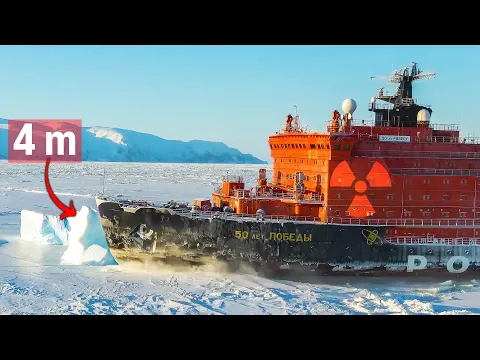

The engineering behind the largest icebreakers represents an extreme adaptation of naval technology.
These vessels must withstand constant impacts, temperatures that can reach dozens of degrees below zero, and months of operation in isolated regions.
Every detail of the design, from the shape of the bow to the propulsion systems, is engineered to face the ice without compromising the safety of the ship and crew.
Without these specialized machines, a large part of the Arctic Ocean would remain nearly inaccessible during the winter.
Spending months sailing through frozen seas, surrounded by giant blocks of ice and extremely low temperatures, is not a common experience.
Still, the largest icebreakers have made it possible to explore and traverse regions that have been nearly inaccessible for centuries.
Would you have the courage to embark on a long journey on one of these giant ships breaking through the Arctic ice?
Let us know in the comments if you would face this journey and what impressed you most about this amazing technology.







-

-

5 pessoas reagiram a isso.