





 Portuguese
  English
  Spanish
  3 min of reading
  0 comments


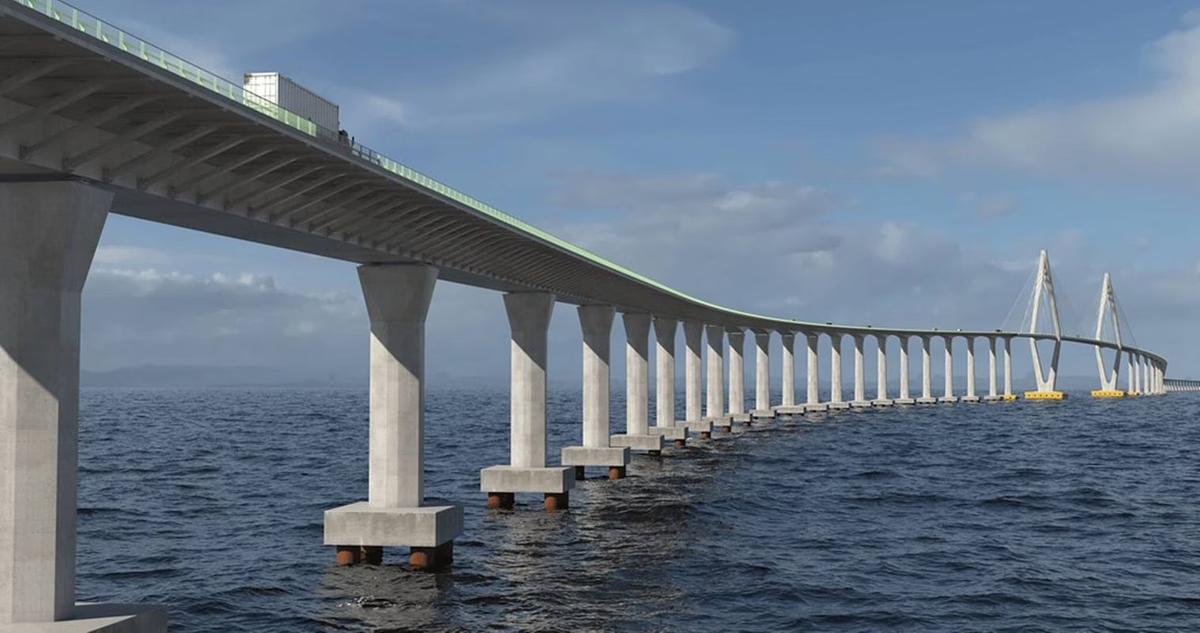
With a Length of 12.4 km Over the Sea, the Salvador-Itaparica Bridge Will Be the Largest in Latin America and Will Reduce Travel Time Between Salvador and Itaparica by 40%, Besides Attracting Billion-Dollar Chinese Investments
Bahia is preparing to welcome the Salvador-Itaparica Bridge, one of the largest projects in the country’s history, according to InfoMoney.
With a length of 12.4 km over water, it will be the largest bridge in Latin America and one of the longest in the world.
The investment amounts to R$ 11 billion. Construction is expected to start in June 2026, following the completion of the executive project and the provisional platform in 2025.
-
The government requests the Federal Revenue Service for a new system to automate the income tax declaration, reducing errors, time, and bureaucracy for millions of Brazilians.

-
Pix in installments, international Pix, and contactless payment without internet: the Central Bank revealed the new features coming to the tool that is already used by almost every adult in Brazil.

-
Mercado Livre has just started selling medications with delivery in up to three hours to your door, and this move could completely change the way Brazilians buy medicines on a daily basis.

-
In Dubai, rising tensions from the war in the Middle East are causing super-rich individuals to leave the Gulf and direct their fortunes to a new financial refuge in Asia.


The construction will be entrusted to a consortium led by the Chinese giants CCECC and CCCC, two of the largest global infrastructure groups.
Global Dimension: Bridge Comparable to the Largest in the World
The bridge has been designed in three segments:
- Itaparica: 4.6 km
- Salvador: 6.9 km
- Stilted Segment: 900 meters, with a height of 85 meters, equivalent to a 28-story building, allowing the passage of transatlantic ships, tankers, and even platforms.
In terms of size, it will be close to the Vasco da Gama Bridge (Portugal, 12.3 km) and only behind structures like the Incheon Bridge in South Korea (21.3 km).
Furthermore, it will have dual lanes in both directions, three traffic lanes, and scenic lighting, fundamentally changing the logistics and tourism of the region.
More Than a Bridge: New Highways and Tunnels in Bahia
The project is not limited to the bridge. It includes complementary roadworks:
- In Salvador, there will be 4 km of new roads, overpasses, and two tunnels parallel to the Expressway.
- In Itaparica, an expressway of 22 km to Cacha Pregos and the duplication of 8 km of the BA-001 to the Funil Bridge.
These interventions are expected to reduce the distance between Salvador and the Recôncavo by 250 km and shorten travel time to southern Bahia by 40%.
Economic and Social Impacts: Jobs, Tourism, and Logistics
According to the concessionaire, the bridge will benefit 10 million people in 250 municipalities.
The expectation is for 7,000 job openings during construction, prioritizing local workers.
In the survey phase, 17 Bahia-based companies have already been contracted, responsible for 300 direct and indirect jobs.
In addition to the economic impact, the bridge is expected to boost tourism, facilitate freight transport, and open a new access corridor to BR-101, BR-116, and BR-242.
Amid Controversies and Advances: Project Comes to Life
Despite its grandeur, the project faced years of debate.
The contract was only signed after mediation by TCE-BA, which approved an agreement between the government and the concessionaire.
The Senate also released a billion-dollar injection in guarantees to ensure the project’s execution.
The preparatory process included studies on bathymetry, geophysics, archaeology, traffic, and cultural impact, in addition to environmental research and engagement with traditional communities.
In March 2025, the survey phase in the Bay of All Saints was completed, with an investment of R$ 200 million.
And you, do you believe that the largest bridge in Latin America will be a game-changer for the development of Bahia or will it bring more challenges than solutions?








-

-

-

-

-

15 pessoas reagiram a isso.