





 Portuguese
  English
  Spanish
  5 min of reading
  0 comments


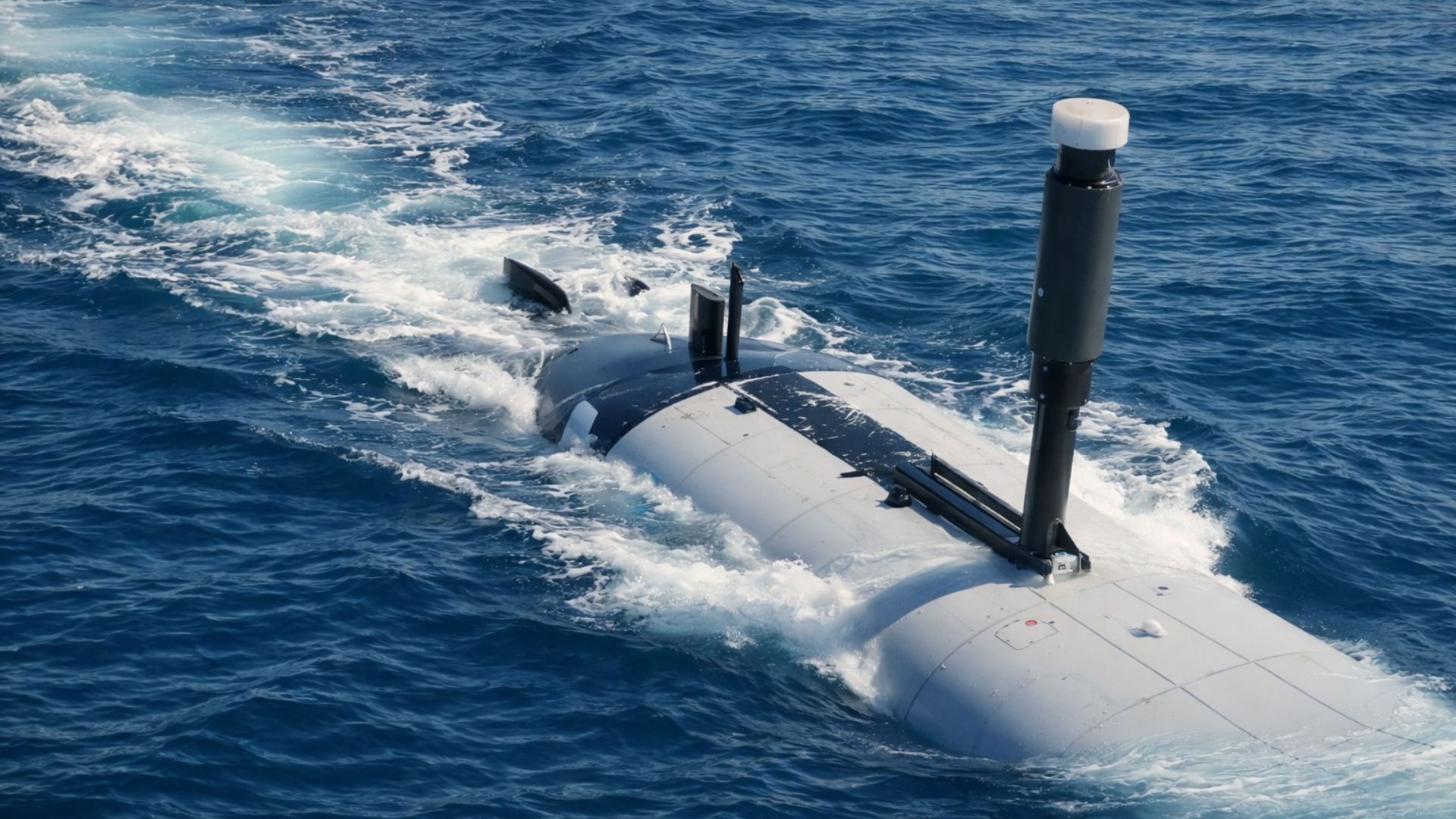
French Submarine Drone UCUV Combines Mini-Submarine Dimensions and Focus on Autonomy to Operate on the Seafloor with Limited Communication, in a Project Linked to DGA and Naval Group. Demonstrator Was Announced with Eye-Catching Numbers and Goals Aimed at Long-Lasting Missions.
A “drone” submarine the size of a mini-submarine, over 10 meters long and weighing more than 10 tons, has entered the public radar as one of France’s bets to expand its presence on the seafloor without relying on onboard crew.
The initiative revolves around the UCUV, an acronym for Unmanned Combat Underwater Vehicle, a demonstrator of a large underwater vehicle that, according to information released by the agencies and companies involved in the program, was designed to operate with high autonomy in environments where communication is limited and where remote command may be unfeasible.
UCUV and the Concept of a Large-Scale Submarine Drone
The project has been associated with a framework agreement granted by the French defense acquisitions agency, the DGA, to Naval Group to design, produce, and test a UCUV demonstrator, according to an official statement from the company itself.
-
A “silent skill” is allowing Brazilians to earn up to R$ 22,000 per month without a degree and become indispensable for companies that rely on millions of data to survive.

-
Researchers at the Toyota Research Institute found that if a human uses robotic arms to flip a pancake 300 times in an afternoon, the robot learns to do it on its own the next morning, and this is currently the most promising method to solve the biggest bottleneck in modern robotics.

-
Goodbye iron: a common item in households is starting to lose space to technology that smooths clothes in minutes without an ironing board and with less energy consumption.

-
Antarctica reveals an unusual clue high in the Hudson Mountains, and what appeared to be just an isolated rock began to expose a secret hidden under the ice for ages.


In addition to the vehicle design and conducting tests, the announced scope includes a supplementary contract for the development of an autonomous decision-making process and safe autonomous navigation, elements regarded as central to long-lasting and discreet missions below the surface.
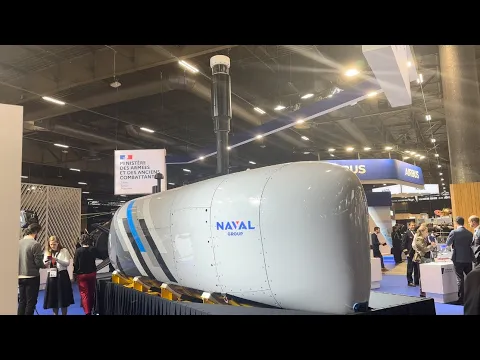

DGA, Naval Group, and the Demonstrator Framework Agreement
The scale parameters are part of what turns the UCUV into a topic of global curiosity, as they deviate from the standard of smaller autonomous underwater vehicles used in research or short-duration inspections.
In public material related to the program, the UCUV is described as a platform with a weight exceeding 10,000 kg, an approximate width of 2 meters, an approximate height of 2 meters, and a length greater than 10 meters, dimensions that place it in a range close to that of compact manned vessels.
Naval Group categorizes the UCUV as a demonstrator and describes the initiative as part of an effort to assess technologies and architectures aimed at an autonomous, durable, and multi-mission system, with functions that require planning, monitoring, and safe operation both on the surface and submerged.
The same statement highlights that the framework agreement granted by the DGA was accompanied by a first additional contract aimed at the development of the Autonomous Decision-Making Process, referred to as ADMP, and mechanisms for safe autonomous navigation, presented as requirements for the vehicle to carry out tasks without remote control.
Over 10 Meters and Above 10 Tons: Numbers That Explain the “Colossal”

The emphasis on autonomy is linked to a physical problem of the underwater environment: seawater complicates data transmission and limits the use of electromagnetic waves, making continuous communication a technical challenge even in civil operations such as oceanographic research and infrastructure inspection.
In this scenario, the proposal highlighted by Naval Group is that the ADMP functions as a “embedded brain” capable of allowing the platform to achieve mission objectives based on orders defined by operators, respecting rules and margins of freedom assigned to the system.
In the text of the statement, the company states that, in an environment where communications may be limited, impossible, or undesirable, the ability to execute missions without remote control becomes a differentiator and an operational requirement.
The description also indicates that the autonomy system relies on continuous replanning based on the analysis of the situation and environment, aiming to adapt the vehicle’s behavior to tactical risks, operational conditions, and potential damages, while maintaining the fulfillment of defined objectives.
Embedded Autonomy ADMP and Navigation without Remote Control
The announcement of the UCUV was presented as a continuation of previous work, referencing a contract for the study of use cases and system architecture, cited by Naval Group as a foundational step for the evolution of the demonstrator.
In the statement, the company notes that the framework agreement granted by the DGA was awarded on December 28, 2023, and that it is based on a previous contract, dated May 4, 2023, dedicated to studying main use cases and the architecture of the future system.
The described strategy involves evaluating identified technologies to meet the needs of the French Navy and, with that, designing and developing the UCUV demonstrator, keeping the proposal in the testing and validation phase.

XL UUV Demonstrator and Sea Tests Cited by the Company
To support this approach, Naval Group mentions the existence of its own XL UUV Demonstrator, qualified in sea tests by the end of the European summer of 2023, presented as a key component of the project.
This demonstrator, according to the company, would serve as a platform for integrating and evaluating technologies in short cycles, including elements of autonomy and energy, allowing for guiding technical choices associated with the design of the future UCUV.
The idea of “short cycles” is directly related to the challenge of safely operating a large autonomous vehicle, as the underwater environment demands strict control of navigation, energy management, and sensor integration for environmental perception.
In parallel, the program has been mentioned in third-party communications as a basis for testing technologies aimed at safe navigation, including acoustic detection components designed to operate autonomously and support ascent and emergence with greater situational awareness.
Underwater Technology and Navigation Safety on the Seafloor
This set of public information helps explain why the UCUV fits into the category of “colossal machine” that draws attention beyond the defense niche: the vehicle combines unusual dimensions for an uncrewed system with an advanced autonomy proposal, designed to work in an environment where connectivity is inherently limited.
By treating the UCUV as a demonstrator, the responsible parties associate the project with a technological and operational evaluation process where the priority is the validation of critical blocks, such as supervised autonomous decision-making, safe navigation, and system integration for long-duration missions.
How does a subaquatic platform over 10 tons change the way of operating and monitoring the seafloor when the mission needs to continue without remote control?






-

-

-

8 pessoas reagiram a isso.