





 Portuguese
  English
  Spanish
  5 min of reading
  0 comments


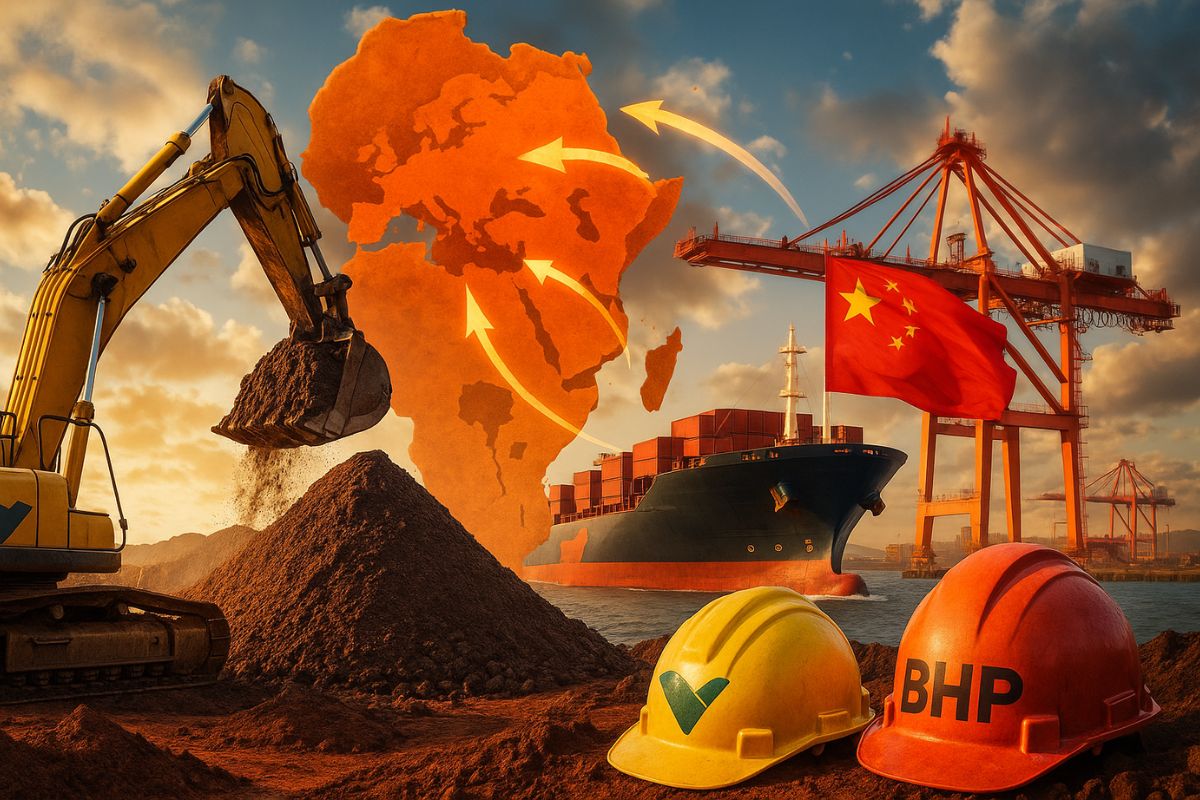
With Projected Production of 120 Million Tons Annually in Simandou, Guinea, China Reduces Dependence on Brazil and Australia, Gains Bargaining Power, and Reconfigures the Global Iron Ore Landscape.
The China took a strategic step in the global iron ore market by starting production of the mega project in Simandou, Guinea, in Africa, in 2025. The mine, considered the largest iron ore operation to come online this decade, is seen as a milestone for the sector, especially because it strengthens those who dominate worldwide demand for the input: China itself. Although located in African territory, the corporate structure and investments put Chinese companies at the decision-making center of the project.
In practice, Simandou creates a new supply route for China and reduces the weight of dependence on the two historical suppliers, Brazil and Australia. With the potential to reach 120 million tons annually from the second half of 2028, the African complex gives the country more alternatives, more flexibility in price negotiations, and more room to pressure giants like Vale and BHP without breaking commercial relations. It does not dismantle the current model all at once but alters the balance of power at the negotiation table.
China Still Buys the Most Iron Ore in the World
The magnitude of the move becomes clearer when looking at recent numbers. According to data compiled by specialized sources, China imported about 1.2 billion tons of iron ore in 2024, which represents approximately 71.3 percent of all global exports of the product. Of this volume, about 60 percent comes from Australia and 21 percent from Brazil.
-
Unemployment rises again to 5.8% at the beginning of 2026, raising alarms about the end of temporary positions and its impact on the Brazilian job market.

-
Document organization can cut invisible costs in small businesses, a simple step that prevents waste, rework, and losses in daily operations.

-
Chinese giant worth nearly R$ 4 billion that manufactures cables for electric cars, solar energy, and robotics wants to open a factory in SC.

-
Many employers do not know, but the law guarantees domestic workers a 25% increase in salary during trips, 50% for overtime, 20% for night shifts, and 17 additional benefits that can lead to labor lawsuits if not paid.


With Simandou fully operational, China will have an additional source of up to 120 million tons per year, something close to 10 percent of its demand.
It is not enough to replace Brazil and Australia, but it is enough to reduce absolute dependence and create room to renegotiate contracts more firmly.
Vale and BHP Under Direct Pressure from China
The immediate big losers in this scenario of greater supply diversification are Brazil’s Vale and Anglo-Australian BHP, which for years have surfed the position of central suppliers to China.
The Asian country is responsible for over 60 percent of the iron ore sales from both mining companies, which already showed a significant degree of concentration.
With the new African route, China gains an additional argument to harden its stance at the negotiating tables.
An example of this bargaining power appeared in 2025, when the state-owned CMRG, created to organize and monitor the Chinese mineral sector, instructed local companies to suspend new shipments from BHP during a pricing dispute.
The deadlock was only resolved after the mining company agreed to receive 30 percent of payments in yuan, the Chinese currency.
It was a symbolic and practical victory for China, which partially distances itself from the dollar in pricing iron ore.
CMRG: China’s Arm to Coordinate the Mineral Sector
The creation of CMRG in 2022 is part of China’s strategy to be not only the largest buyer but also a more organized and influential player in supply chains.
The state agency was designed to strengthen dialogue with global mining companies, monitor the market, and coordinate actions in a sector considered critical for the Chinese industry.
In the context of Simandou, CMRG’s actions demonstrate how China combines direct investments in strategic assets with market decisions that impact prices, currencies, and contracts.
Having a significant stake in a mega-mine while controlling a large part of global demand puts the country in a unique position within this chain.
Simandou: 30 Years of Disputes Until the First Shipment to China
The Simandou mine took about 30 years to come to fruition. The project faced disputes among mining companies, changes in control, and even coup d’états in Guinea.
Vale had a stake in the area in 2010, but the deal did not progress and ultimately fell behind in the final configuration.
In October 2025, the complex made its first delivery: about 10,000 tons of iron ore sent to China.
The shipment traveled 552 kilometers on a railway that traverses the interior of Guinea to the port of Morebaya, from where it was shipped by cargo ship to the Asian country.
This first shipment serves as a symbol that the project, after decades of deadlocks, has finally entered the operational phase.
New Silk Road and Investment of US$ 20 Billion
To bring Simandou to life, the entry of China through its infrastructure expansion strategy known as the New Silk Road was decisive.
The plan involves establishing partnerships with various countries to finance and construct large-scale projects, particularly in transport and energy.
In Guinea, the investments linked to the Simandou complex included the construction of the railway cutting through the country and associated logistical structures. The total amount allocated to the project is estimated at around 20 billion dollars.
Chinese capital firms hold approximately 70 percent of the ownership stake, consolidating China as the main protagonist of the undertaking.
Another major partner is Rio Tinto, an Anglo-Australian conglomerate that ranks at the top globally along with Vale and BHP.
Guinea Gains Prominence and China Expands Options
When Simandou’s production reaches 120 million tons annually, projected for the second half of 2028, Guinea is expected to position itself among the world’s largest iron ore powers. In total capacity, the complex is likely to rank as the fifth largest global producer, surpassing countries such as Russia and Canada.
For China, this means having a substantial source of iron ore in African territory, under strong influence from companies in the country, within a long-term geopolitical program.
Instead of relying almost exclusively on established routes in Brazil and Australia, China will have a supply triangle with more room to maneuver.
What China’s Strategy Signals for Brazil and Australia
The start of operations at Simandou does not mean an immediate break with traditional suppliers, but it sends a clear message.
China signals that it wants to reduce concentration risks, gain bargaining power, diversify sources, and, when possible, bring part of the governance of strategic projects in-house, even in other continents.
For Brazil and Australia, this move demands heightened attention to competitiveness, logistics quality, and long-term commercial relations.
In a scenario where China accounts for over 70 percent of global iron ore imports, each new relevant route alters the balance of power, even without a sudden rupture.
Do you think this bet by China on Simandou will durably change the weight of Brazil and Australia in the iron ore market, or will the Asian country continue to depend on traditional routes for many years?









Seja o primeiro a reagir!