





 Portuguese
  English
  Spanish
  5 min of reading
  0 comments


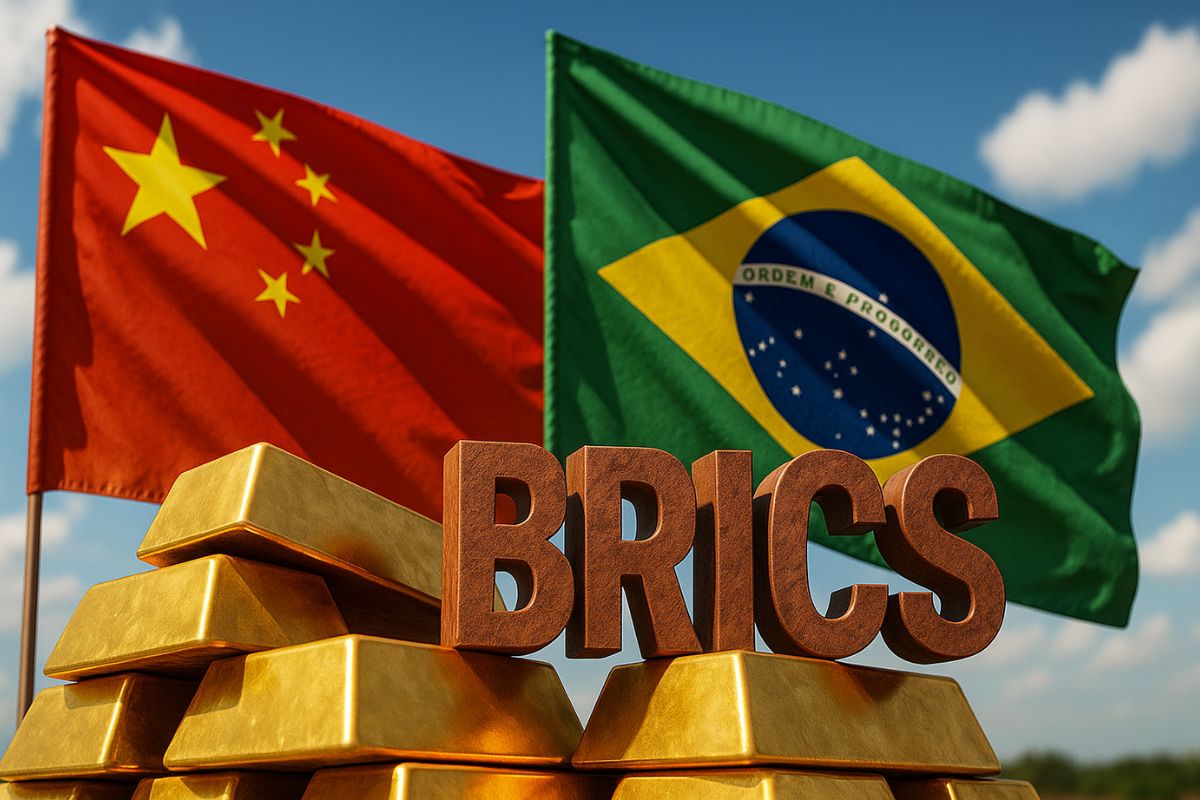
While China and BRICS Remonetize Gold, Test Metal-Backed Yuan, and Explore the Gold Corridor, the Dollar-Based System Loses Exclusivity and Opens Real Space for Brazil to Negotiate Power, Credit, and Alliances in a New Financial Order, with Impacts on Reserves, Trade, Infrastructure, and Democracy.
The discussion about gold, Basel III, and the so-called gold corridor is often treated as a technical detail, but China and BRICS are building, piece by piece, a functional alternative to the dollarized system. This is not just about accumulating metal for “protection” or “diversification,” but rather about redefining what counts as money, collateral, and power on a global scale.
For Brazil, this is not an abstract theme of distant geopolitics. It is a decades-long chance to move from being a rule-taker to becoming a rule-maker, leveraging its relevance in commodities, its industrial base, and its position in BRICS to access financing in new currencies, with less dependence on conditions imposed by the dollar, U.S. Treasury, and IMF.
China and BRICS After the Freezing of Russian Reserves

The turning point came in 2022, when Russian reserves in dollars and Western assets were frozen.
-
50 viaducts, 4 tunnels, 28 bridges, and 40 kilometers of bike paths: BR-262 in Espírito Santo will receive 8.6 billion reais for the largest engineering project in the state’s history, inspired by the Immigrant Highway in São Paulo.

-
Brazil produces too much clean energy and doesn’t know what to do with it: over 20% of solar and wind capacity was wasted in 2025 while investors flee and 509 renewable generation projects were abandoned in the last year.

-
Piauí will produce a new fuel that replaces diesel without needing to change anything in the truck’s engine and reduces pollutant gas emissions by half: truck drivers from all over the Northeast are already celebrating the news that will arrive later this decade.

-
A new Brazilian shopping center worth R$ 400 million will be built in an area equivalent to more than 4 football fields, featuring 90 stores, 5 cinemas, a supermarket, a college, and parking for 1,700 cars, potentially generating 3,000 jobs.


The message sent to the world was brutally simple: if your reserves are in dollars, they can politically be blocked.
In Beijing, Moscow, and the capitals of China and BRICS, this was read as an existential risk.
From then on, the strategy changed scale.
China intensified purchases of physical gold, not as a fetish, but as state policy.
Other countries in China and BRICS followed the same path, aware that in a scenario of sanctions and fragmentation, gold reserves are hard to confiscate, track, and block.
At the same time, the accumulation of metal was accompanied by another silent change: the reconfiguration of the infrastructure for gold settlement, custody, and pricing, with more weight on venues like the Shanghai Gold Exchange and less dependence on traditional centers like London.
Basel III and the Return of Gold to the Top of the Banking Hierarchy
Basel III effectively repositioned gold to another level.
The metal began to be treated as a Tier 1 asset, meaning first-rate money on the bank balance sheet, without the accounting discount it suffered before.
The next step in this logic is to transform it into HQLA, High-Quality Liquid Asset.
If this consolidates, gold will directly compete with U.S. Treasuries for the position of main global collateral.
In practice, this means that banks and states in China and BRICS could, instead of stacking Treasuries, use physical gold as standard collateral in large-scale operations.
The higher gold rises in the regulatory hierarchy, the more space opens up for a financial architecture not anchored in the dollar.
The Gold Corridor: From Yuan to the BRICS System
The most strategic piece of this engineering is the so-called “gold corridor.”
The idea is to create a mechanism where those holding yuan can, directly and predictably, convert it into physical gold in venues like the Shanghai Gold Exchange or in the future, in other infrastructures of China and BRICS.
In terms of trust, this changes everything.
If the holder of yuan knows that ultimately they can exit in physical gold, the currency gains an anchor that pure paper money lost.
It is a way to give the yuan (and potentially other currencies in the bloc) credibility that does not depend on the assessment of Western markets.
On the horizon, this gold corridor could be expanded:
use of gold as collateral in development banks of China and BRICS
distributed custody networks in different countries in the bloc
foreign trade operations settled in local currency with the option of conversion into gold for large institutional players
How China and BRICS Can Finance Infrastructure Without Using the Dollar
If physical gold consolidates as an eligible high-quality collateral, China and BRICS gain a direct channel to finance ports, roads, energy, and telecom using their own gold reserves.
Instead of turning to dollars, Treasuries, and the intermediation of Washington-based institutions, the flow would become:
countries of China and BRICS contribute gold to a common vehicle
development bank or consortium issues credit in yuan or another currency of the bloc
strategic projects are financed with less exposure to sanctions and shifts in U.S. market sentiment
This does not eliminate the dollar nor replace the current system overnight, but creates a second operational track, robust enough for countries in the Global South to have a real margin of choice.
The Window of Opportunity for Brazil Within China and BRICS
For Brazil, the movement of China and BRICS opens a rare window. The country combines:
weight in food, energy, and minerals
relevant internal market
active presence in the BRICS bloc
chronic need for investment in infrastructure and reindustrialization
If the gold corridor and the reclassification of the metal gain traction, Brazil can:
negotiate access to internal credit lines from China and BRICS, backed by gold, for logistics projects, grain ports, railways, clean energy, and digitalization
reduce vulnerability to U.S. interest rate shocks, using bloc currencies and gold-linked contracts as a partial alternative to the dollar
strengthen its position as a mediator between North and South, participating in both systems rather than relying exclusively on one
But none of this is automatic.
Without a coordinated strategy among the Central Bank, Treasury, Itamaraty, and BNDES, Brazil runs the risk of watching the redesign of the financial architecture as a mere spectator, while other countries in China and BRICS capture the largest bargaining power gains.
Risks, Limits, and the Transition to a Multicurrency Era
This is not about announcing the “end of the dollar” tomorrow. What is underway is the end of the absolute monopoly of the dollar as the unique language of global finance. And this comes with risks:
fragmentation of liquidity among different systems
regulatory conflicts over standards of collateral and custody
geopolitical tensions around chains of gold, energy, and data
At the same time, the multicurrency era opens an intense competition for credibility, transparency, and governance.
Whoever manages to combine gold reserves, institutional stability, and regional coordination capacity will have more voice in defining the new rules.
China and BRICS have already taken the first step by remonetizing gold and testing the gold corridor.
The next chapter depends on how each country, especially large economies like Brazil, positions themselves in this moving chessboard.
In the end, the important question is simple: does Brazil want to be the author or merely a reader of this new chapter in global financial history?
And you, do you believe that Brazil will take advantage of the movement of China and BRICS around gold and the gold corridor, or will it remain stuck to the dollar and diplomatic inertia?









-

-

-

-

-

10 pessoas reagiram a isso.