





 Portuguese
  English
  Spanish
  6 min of reading
  4 comments





The Perseu Abramo Foundation’s Handbook Proposes to Create a Permanent Civil National Guard, Replace the National Force in Crises, Limit GLO, Recreate the Ministry of Public Security, and Reduce the Use of Armed Forces in Public Security Operations Nationwide
The creation of a Civil National Guard to gradually replace Guarantee of Law and Order operations and reduce the role of the Armed Forces in internal security is the central focus of a new handbook from the Perseu Abramo Foundation, linked to the PT. The document suggests a permanent, civilian-based force, operating across the national territory, especially in sensitive areas such as borders and the Legal Amazon.
At the same time, the text proposes the recreation of a separate Ministry of Public Security from the Ministry of Justice, with its own structure to command the Federal Police, Federal Highway Police, Federal Railway Police, Penitentiary Police, National Force, and the National Secretariat for Public Security. The combination of a new Civil National Guard and an exclusive ministry effectively outlines a model where the federal government has more direct instruments to coordinate and intervene in security policy throughout the country.
What the Handbook Proposes That is New
The handbook “Safe Brazil, Protected Family,” developed by the Perseu Abramo Foundation, details an institutional redesign of public security from the PT’s perspective.
-
With 11,000 tons and sensors capable of hunting submarines at long distances, the Type 055 has become one of the most feared floating arsenals of the Chinese navy.

-
With over 15,000 tons, radars capable of tracking hundreds of targets simultaneously, and more than 120 missiles ready for launch in seconds, modern destroyers cease to be escorts and begin to dominate the naval battlefield.

-
With over 15,000 tons, radars capable of tracking hundreds of targets simultaneously, and more than 120 missiles ready for launch in seconds, modern destroyers cease to be escorts and begin to dominate the naval battlefield.

-
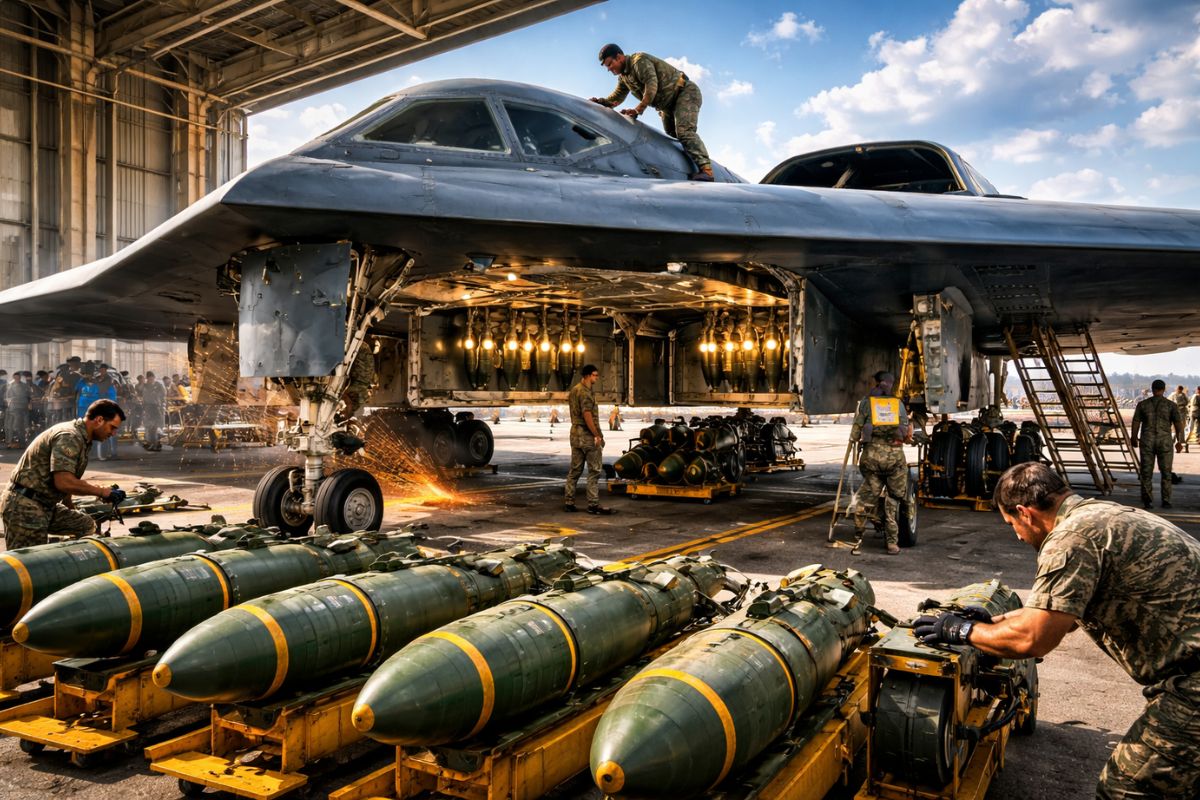
Valued at over $2 billion, the B-2 Spirit bomber requires meticulous inspection, bombs calibrated in a controlled environment, and extreme preparation to disappear from radar and launch attacks with lethal precision.

The central diagnosis is that the National Force, as it exists today, is not a structured institution, but a program that gathers police officers seconded by States and the Federal District, without their own career, without a consolidated hierarchy, without their own code of conduct, and without a dedicated oversight body.
In this context, the document argues that it is necessary to transition from an emergency model, based on temporary convocations, to a permanent Union police institution.
It is at this point that the proposal for the creation of a Civil National Guard appears, conceived as a replacement for the current National Force and as the federal government’s main response to security crises, disasters, and large operations on national territory.
How the Civil National Guard Would Function
According to the handbook, the Civil National Guard would be created through a Constitutional Amendment Proposal.
That is to say, it is not just about reorganizing an existing program, but about inserting a new security force into the constitutional text itself, alongside the other bodies that make up the Public Security System.
The document describes this Guard as a Union police institution with operations across the national territory, with a special focus on areas considered strategic: land borders, the Legal Amazon, and regions with high criminal complexity.
The idea is for this force to be permanent, with its own personnel, structured career, specific disciplinary regime, and mechanisms for internal and external control.
The handbook emphasizes that, with a permanent Civil National Guard, the federal government would have the capacity for rapid response to crises without relying on military deployments or ad hoc agreements with States.
In the authors’ view, the professionalization of this force would reduce improvisation and the emergency use of Armed Forces troops in public security situations.
Ministry of Public Security Back at the Center
Another key element of the proposal is the recreation of a Ministry of Public Security, separate from the Ministry of Justice.
The handbook argues that the security agenda, due to its complexity and the level of social conflict involved, needs its own political and administrative command, with budget, planning, and specific indicators.
The text lists which bodies should be incorporated into the new ministry: Federal Police, Federal Highway Police, Federal Railway Police, Penitentiary Police, National Force, and Senasp.
In practice, this would concentrate the backbone of federal public security under a single ministry, creating a center of power capable of formulating national policies, coordinating interstate operations, and discussing in a more structured manner with state security departments.
This reorganization would also reposition the National Force itself in the institutional design.
With the creation of the Civil National Guard, the Force as it exists today would tend to lose centrality, making way for a more professionalized federal force with a clear constitutional framework.
GLO and Armed Forces: Increasingly Exceptional Use
One of the declared objectives of the handbook is to reduce reliance on Guarantee of Law and Order operations.
The text states that, with the consolidation of the Civil National Guard, “gradually the use of the Armed Forces will no longer be necessary” for this type of mission.
In practice, this means that the Army, Navy, and Air Force would return to having a more circumscribed role focused on external defense tasks and classic constitutional assignments, while situations of internal crises, prison conflicts, border operations, and increased policing in major centers would primarily pass to the new federal civil force.
For the proposal formulators, this movement responds to historical criticisms of the repeated use of the Armed Forces in policing roles, seen by many analysts as a deviation from the military’s primary mission and a risk factor for the relationship between defense and politics itself.
The Civil National Guard, in this design, acts as a buffer between the day-to-day of public security and the deployment of military troops.
More Federal Power Over State Security
The handbook also makes it clear that the Civil National Guard would have national operations and that the future Ministry of Public Security would concentrate coordination with the States and the Federal District.
This means, in practice, greater coordination power for the Union over local policing policies, even though military and civil police continue to be formally subordinate to governors.
By proposing a federal institution with a presence in borders, the Legal Amazon, and areas of national interest, the text indicates a model where Brasília gains instruments to intervene in strategic regions, especially on issues such as international trafficking, environmental crimes, and large interstate operations.
The combination of an exclusive ministry and a new civil force tends to further nationalize the debate on security, reducing the fragmentation of responses among different federal entities.
At the same time, the handbook maintains the logic that the Civil National Guard should be a police force, not military, bringing its institutional design closer to the rest of the public security system and reinforcing the formal separation between defense and internal policing.
Electoral Agenda and Congressional Disputes
Although presented as a programmatic handbook, the proposal has a strong electoral component.
The Perseu Abramo Foundation acts as a center for idea formulation for the PT, and the text is seen as a possible foundation for the party’s program in the 2026 elections.
Turning the Civil National Guard into reality, however, depends on a constitutional majority in Congress, as the creation of the institution would require a PEC.
This places the discussion in a highly contentious arena among the federal government, opposition, and governors.
On one side, supporters of the project argue that a stronger federal command and a permanent Civil National Guard can provide quicker and more technical responses to crises that currently burden state police and Armed Forces.
On the other side, critics will likely highlight the risk of concentration of power in Brasília, disputes over state autonomy, and discussions about the limits of Union action in internal security.
For the reader, a direct question remains: do you think that the creation of a Civil National Guard and an exclusive Ministry of Public Security would make security in the country more efficient or merely concentrate even more power in Brasília?









Vide milícia bolivariana
Projeto ditatorial claro. Após controlar o judiciário, partido visa controlar a segurança pública e só atuar conforme interesses partidários, inclusive no controle da legislação e dos recursos. Se as ideias do PT sobre segurança fossem boas, a Bahia, governada pelo partido há 20 anos, não seria o pior estado do Brasil em termos de segurança, com índices de homicídios por 100.000 habitantes cerca de 10 vezes superiores aos de estados como São Paulo e Santa Catarina.
Onde estão os ******, leia-se d_ita_du_ra.