





 Portuguese
  English
  Spanish
 8 min of reading
  0 comments


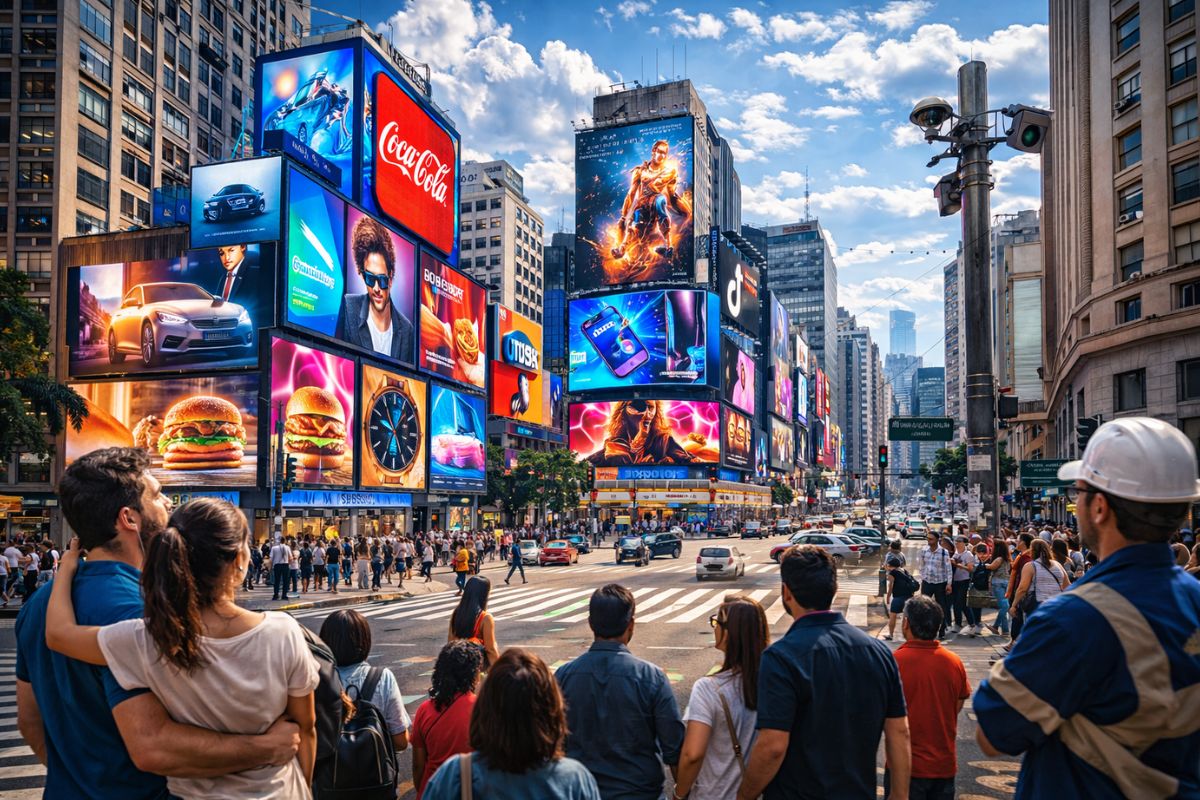
The Billboards Reignite A Debate in Downtown São Paulo About Advertising, Revitalization, and the Clean City Law.
In theory, the project promises to attract visitors, reinforce the sense of security, and boost improvements in nearby areas. In practice, however, the billboards shine light on a deeper conflict: what type of city does São Paulo want to build for its historical center and who will really benefit from this transformation.
The discussion about the billboards is not limited to liking or disliking a brighter and more eye-catching landscape. What is at stake is how urban space is used, regulated, and valued. When a symbolic intersection of the city starts to be treated as a visual showcase and economic asset, the inevitable question arises: does this improve the daily life of those who live and circulate there or merely change the packaging of the problem?
The controversy grows because the project arises in an area loaded with memory, infrastructure, popular commerce, intense circulation, and urban vulnerabilities. Therefore, the billboards end up functioning as a symbol of a dispute between two models of city: one centered on image, consumption, and land valuation, and another focused on housing, transportation, permanence, and environmental quality.
-
50 viaducts, 4 tunnels, 28 bridges, and 40 kilometers of bike paths: BR-262 in Espírito Santo will receive 8.6 billion reais for the largest engineering project in the state’s history, inspired by the Immigrant Highway in São Paulo.

-
Brazil produces too much clean energy and doesn’t know what to do with it: over 20% of solar and wind capacity was wasted in 2025 while investors flee and 509 renewable generation projects were abandoned in the last year.

-
Piauí will produce a new fuel that replaces diesel without needing to change anything in the truck’s engine and reduces pollutant gas emissions by half: truck drivers from all over the Northeast are already celebrating the news that will arrive later this decade.

-
A new Brazilian shopping center worth R$ 400 million will be built in an area equivalent to more than 4 football fields, featuring 90 stores, 5 cinemas, a supermarket, a college, and parking for 1,700 cars, potentially generating 3,000 jobs.

How It Works The Billboard Project in the Central Region
The approved proposal foresees the installation of five large billboards made of LED on buildings located at the intersection of Ipiranga and São João.
According to the attached base, these panels can only be placed on buildings that are not protected as historical heritage.
In the case of the Bar Brahma building, for example, the proposed solution would be to project light onto the facade, rather than the direct installation of the equipment.
The model presented operates on a compensatory basis. The involved company committed to invest R$ 2 million per year for three years in improvements in the central region.
The total estimated cost of the project, including the implementation and humanization of the panels, is R$ 53 million. This is not a simple visual intervention, but an urban operation with relevant economic and political effects.
Among the included spaces for improvements are Praça Júlio Mesquita, Largo do Paiçandu, Igreja Nossa Senhora do Rosário dos Homens Pretos, and the clock in the area.
The official argument is that the billboards would help drive broader urban renewal, benefiting the historical center.
The Content Displayed on the Billboards Is One of the Most Sensitive Points
One of the most controversial aspects of the project concerns what can be shown on the billboards. Initially, according to the base, the city hall stated that there would be no direct commercial advertising. Later, the final formatting indicated another design.
Under the approved arrangement, 70% of the displayed content must be cultural and institutional. The remaining 30% can be allocated to project supporters, which in practice opens space for business advertising.
This is precisely where the tension increases, because the proposal ceases to be just an urban communication experiment and directly confronts the logic of the Clean City Law.
Clean City Law Enters the Center of the Controversy
The billboards reignite the debate about one of São Paulo’s most known urban legislations. Created in 2006, the Clean City Law is marked by restricting billboards and limiting advertising on facades, drastically reducing the visual pollution of the city.
The new proposal raises concerns because it may open a symbolic and practical loophole in this legislation. If today the billboards appear as an exception in a specific point with justification for revitalization, tomorrow other areas may claim the same treatment.
This is why the discussion does not stay confined to the corner of Ipiranga with São João. What is feared is the creation of a precedent.
The base also mentions Bill 239 of 2023, which proposes changes to the Clean City Law and expands advertising installation possibilities in certain situations.
Among the points raised are changes to rules regarding reflection, brightness, visibility of culturally valuable assets, and allowed size of advertisements. In this context, the billboards appear as a piece of a larger movement for flexibility.
The Urban Dispute Goes Beyond Advertising


The critical reaction to the project does not stem only from the defense of heritage or legislation. The problem, for many urbanists and specialists, is that the billboards may act as catalysts for a broader process of real estate appreciation and transformation of the center into a visual product.
When a degraded or underutilized area receives investments that make it more attractive to tourists, brands, and new businesses, it starts to be seen as a profit opportunity as well. This is when revitalization can trigger gentrification.
Land values increase, rents rise, taxes weigh heavier, and the original population begins to be pressured to leave.
In the case of downtown São Paulo, this concern is even greater because the area is home to low-income residents, small business owners, informal occupations, and people in vulnerable situations.
The billboards, in this scenario, would not just be instruments of visual modernization, but part of a deeper social and economic reconfiguration.
Historical Center Is Already Living a Dispute for Valorization
The base reminds us that downtown São Paulo has gone through various cycles over time. For much of the last century, it concentrated banks, companies, political power, and high-value services.
Later, with the migration of investments to other regions like Paulista, Faria Lima, and Berrini, the area lost some of its economic prominence.
This change opened up space for new urban occupations, with residents attracted by the existing infrastructure, transportation network, and proximity to work. Today, downtown hosts an intense mix of uses, conflicts, and interests.
In this context, the billboards appear as a potential chapter of a new wave of revaluation, now anchored in tourism, spectacle, and consumption.
The base also links the case to the PIU Setor Central project, which aims to attract around 220,000 new residents and raise revenue through urban instruments.
The critical point is that, although there are provisions for social housing, there would be few concrete guarantees to protect those who already live in the area.
Without this protection, any revitalization runs the risk of expelling precisely those who kept the center alive during periods of neglect.
Light Pollution and Environmental Impact Come Into the Debate
Another point raised is the effect of the billboards on the nighttime landscape and urban environment. The criticism is not limited to visual taste.
The base mentions impacts related to light pollution, such as sleep disturbances, increased stress, disorientation of birds, alteration in pollinating insects, and changes in plant behavior.
There is also a thermal concern. The billboards add light and heat emission in an area already marked by asphalt, hard surfaces, air conditioning, and little greenery in various stretches.
In a city that already suffers from heat islands, adding more light and thermal load does not seem like a minor detail.
In this sense, the proposal clashes with a more contemporary view of urbanism that values shading, green areas, permeability, environmental comfort, and daily permanence. The risk is to exchange real urban quality for short-term visual impact.
The Ghost of Spectacle Urbanism
The broader critique present in the base is that the billboards fit into a model of spectacle urbanism.
In this type of logic, the city is treated as a showcase, tourist product, and visual commodity, organized to attract visitors, investors, and consumption.
The problem is that when this happens, public space may cease to be planned primarily for those who live in and enjoy the city daily. It begins to function more as a backdrop than a place for coexistence.
The landscape becomes a platform for advertising and entertainment, while structural needs remain unanswered.
The mention of Vale do Anhangabaú reinforces this mistrust. The base notes that a large recent revitalization ended up being seen as overly concrete, with less vegetation and a stronger focus on events than on daily permanence.
For those who look on with caution, the billboards may repeat this logic of visual transformation with limited urban outcomes.
There Are Deeper Alternatives to Revitalize the Center
Instead of relying solely on billboards and media impact, the base suggests looking at urban models that reorganize the city based on coexistence, pedestrian use, and reduced car traffic.
An example cited is Barcelona’s superblocks, which limit traffic in internal areas, expand public spaces, and promote greenery, communal use, and well-being.
The logic is different. Instead of turning the city into a spectacle, the proposal is to transform it into a higher quality place for daily use.
Less noise, less pollution, more green areas, more daily safety, and more interaction among residents. This is a revitalization idea that acts on concrete urban life, not just on the city’s image.
If something similar were applied in parts of downtown São Paulo, the benefits could arise from walkability, reduced heavy traffic, the creation of communal spaces, and a more inclusive infrastructure.
In this type of approach, the billboards cease to be the main solution and appear to be a rather limited resource in the face of the scale of the problems.
What the Billboards Really Reveal About São Paulo
In the end, the controversy is not just about LED, advertising, or visual reference to Times Square. The billboards reveal a dispute over urban priorities.
They pit the city as an exchange value, driven by the market, tourism, and visibility, against the city as a use value, focused on housing, well-being, transportation, and permanence.
This does not mean rejecting any private intervention or dismissing all attempts at visual requalification. It means asking whether the chosen path addresses the real problems of the region or merely creates a new layer of marketing over old contradictions. Revitalization is not the same as just adding more light.
If the goal is indeed to strengthen the historical center, perhaps São Paulo needs to discuss less the allure of the billboards and more the type of city it wants to offer to those who live, work, and circulate there every day.
Do you think the billboards can really revitalize downtown São Paulo, or will they just accelerate advertising and gentrification?








Seja o primeiro a reagir!