





 Portuguese
  English
  Spanish
  2 min of reading


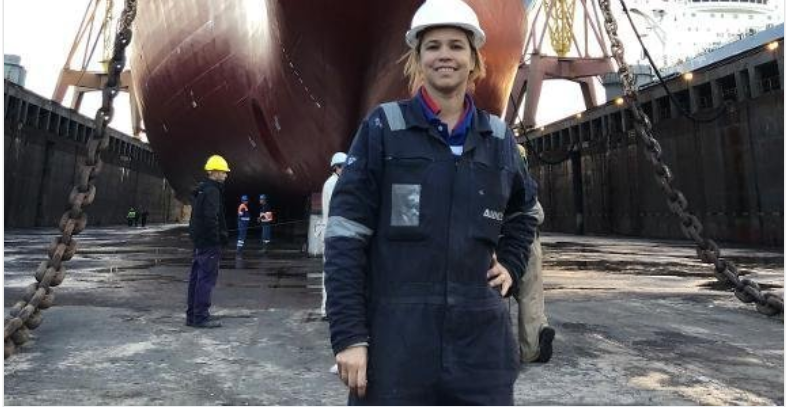
Being a Woman, Especially in the Oil and Gas Maritime Environment, Has Its Challenges, But What Daisy Had to Face to Reach This Position Will Surprise You
Daisy Lima da Silva, 37, never had family members working on vessels, but she became interested in the competition for the Merchant Marine Officer Training School, which trains bachelor’s degrees in nautical sciences – the degree required for those who want to climb the nautical hierarchy. Today, she is the captain of a cargo transport vessel, leading a crew of 19 men.
“When I started, there was still some skepticism about our ability to do the work. We had to work harder than our male colleagues to prove our worth,” she says, who, three years ago, became the only captain at Aliança Navegação e Logística. Daisy graduated in 2003, in the third class with women from the school. From the same institution, three years earlier, Hildelene Lobato Bahia graduated, the first female captain of the Brazilian Merchant Marine.
-
Government unlocks R$ 554 million for a highway that has been requested for decades and accelerates the duplication of BR.
-
Without bricks, without cement, and without endless construction: the cardboard house that is assembled in modules and can be moved.

-
Billions of barrels on the equatorial margin could lead Amapá to double its oil production in Brazil — the state aims to enter the route of companies in the Campos Basin, attract investments, and boost jobs and businesses in the oil and gas sector.

-
Without bricks, without cement, and without endless construction: the cardboard house that is assembled in modules and can be moved.

Fragile Sex?
“Although I was encouraged from the beginning by captains and colleagues, there were small jokes regarding the fragility of women,” she says.
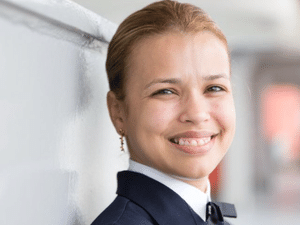 When called to be the immediate superior (the position below the captain) of a ship specialized in large dimension cargoes, which require careful loading and unloading, Daisy felt the stigma of the “fragile sex.”
“We would carry a load of 340 tons. As soon as I arrived, the captain looked me up and down,” she says.
But it was on that ship that she became a captain. “I don’t need to be Wonder Woman or the Hulk to perform my role; I need to engage with my team on the best strategies to load the cargo on the ship, secure it, transport it, and unload it. We have machinery that does the physical effort.”
When she started working in the field, the captain heard from more experienced friends that they masculinized themselves during work to speak the same language as their subordinates. But she decided to do it differently. “I maintained my language, which has always been serious. I speak louder when necessary, but I never acted in a masculine way,” she says.
The emotional aspect is a challenge for everyone who stays on board for 56 days, as is the case with Daisy. “With us, there’s no option to get upset at work, go home, and cool off. We have to solve our problems right there,” she says. Source Universa









Seja o primeiro a reagir!