





 Portuguese
  English
  Spanish
  5 min of reading
  0 comments


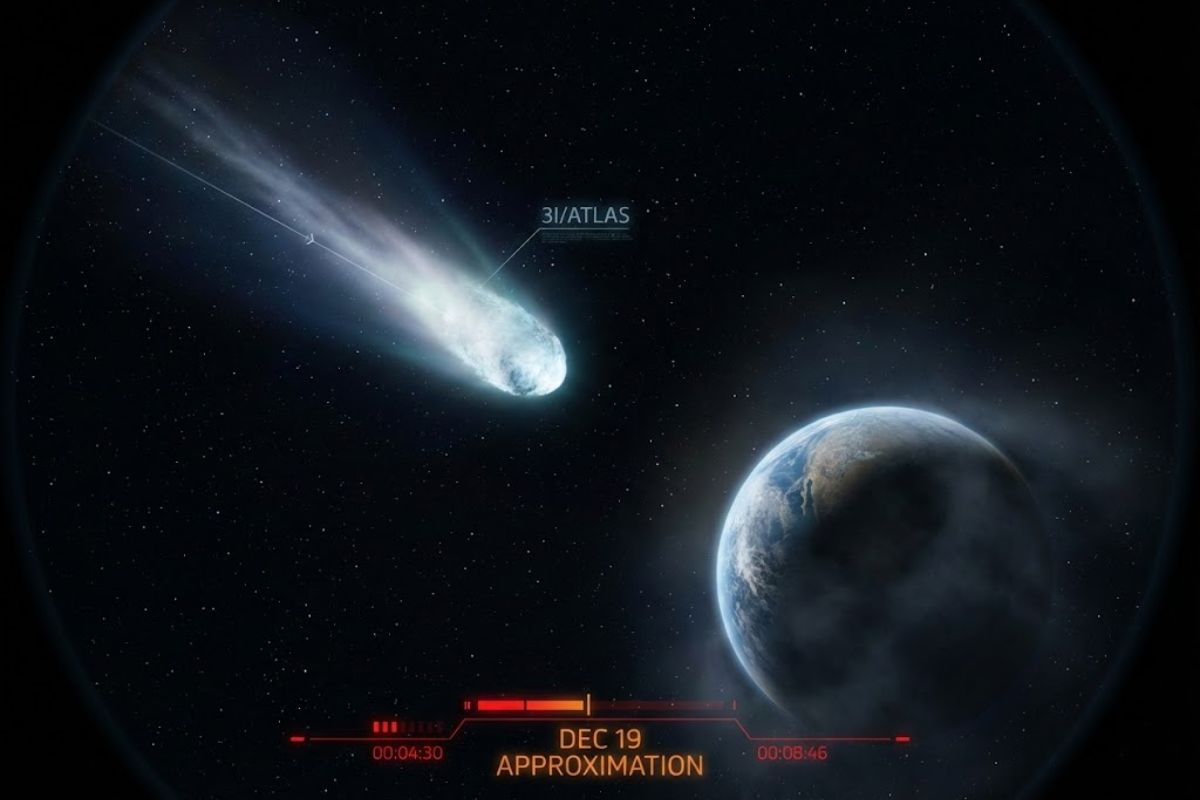
Interstellar Comet 3I/ATLAS Makes Its Closest Approach to Earth on December 19, 2025, Dispels Impact Rumors, Mobilizes Scientists Worldwide, and Puts Observers on High Alert Due to the Rarity of the Cosmic Phenomenon
As the interstellar comet 3I/ATLAS makes its closest approach to Earth at about 270 million kilometers early on December 19, 2025, astronomers rush to measure brightness, composition, speed, and trajectory, debunk alarmist theories, and explain why there is no risk of collision with the planet.
In practice, the interstellar comet 3I/ATLAS makes its closest approach to Earth on December 19, 2025 much farther than the orbit of Mars, yet still at a distance considered valuable for detailed observations. It is only the third confirmed interstellar object crossing the Solar System, turning a distant passage into a rare opportunity to study a visitor from another star, while social media insists on exaggerated risk rumors.
What Is the Interstellar Comet 3I/ATLAS

The 3I/ATLAS is classified as an object of external origin to the Solar System, identified by its open, inclined orbit that is incompatible with objects formed alongside the Sun.
-
What can really trigger large volcanic eruptions? Research suggests that gas returning to the magma may be more dangerous than gas escaping from it.

-
Found in one of the most radioactive places on Earth, this Chernobyl fungus may be doing something with radiation that no one has been able to explain to this day.

-
A bright yellow mushroom imported from Asia escaped from a cultivation farm in the United States in 2010 and is now aggressively spreading across 25 states, destroying entire communities of native fungi in American forests.

-
Buried under China, a colossal machine weighing 20,000 tons began operating as the largest neutrino detector on the planet and, in just 59 days, surpassed results that science took half a century to achieve.

Therefore, in technical catalogs, it appears as interstellar comet 3I/ATLAS makes its closest approach to Earth as a “unique visitor”, with no periodic return like classical comets.
Its structure is consistent with that of other comets: a frozen nucleus of still estimated dimensions, surrounded by a coma of gases and dust that expands as it approaches the Sun.
The tail is formed by particles swept by solar wind and radiation, revealing volatile materials typical of deep ice blocks that drifted for millions of years in interstellar space before crossing our neighborhood.
Timeline to December 19, 2025
The object was detected in July 2025 by an automated sky-scanning program that registers moving points of light and calculates their orbits.
With new measurements, it became clear that it was an interstellar body on a one-time trajectory, renamed as interstellar comet 3I/ATLAS makes its closest approach to Earth in December.
The perihelion, the point of closest approach to the Sun, occurred at the end of October 2025.
After that moment, the comet began to gradually move away from the Sun, entering the geometric configuration in which Earth, the Sun, and 3I/ATLAS form the alignment responsible for the minimum distance between the comet and the planet on December 19, 2025.
There is no sudden change in route, just the natural evolution of a previously calculated orbit.
Actual Distance and Why There Is No Risk of Impact
When it is said that the interstellar comet 3I/ATLAS makes its closest approach to Earth, the term “approach” may suggest danger for those not accustomed to astronomical scales.
The predicted minimum distance is around 1.8 astronomical units, approximately 270 million kilometers, far beyond any planetary orbit that represents an immediate threat to us.
The orbital calculations are refined based on dozens of positional observations in the sky.
The equations show that the trajectory of the interstellar comet 3I/ATLAS makes its closest approach to Earth without crossing the planet’s path, with a comfortable margin even considering uncertainties.
For this reason, scientific institutions repeat that there is no physical scenario in which this passage becomes an impact, despite videos and rumors talking about a “secret route” or “inevitable collision.”
Speed, Brightness, and Limits of Observation in Brazil
The 3I/ATLAS travels through the inner Solar System at speeds of hundreds of thousands of kilometers per hour, making the encounter relatively quick on an astronomical scale.
This speed, combined with the great distance, means that the interstellar comet 3I/ATLAS makes its closest approach to Earth without becoming a “show” visible to the naked eye, unlike major historical comets.
For the average observer in Brazil, the expectation is that the object will remain restricted to medium or large telescopes, appearing as a diffuse and discrete spot in the sky.
Visual observation requires dark skies, good atmospheric transparency, and equipment with generous aperture.
For this reason, the recommendation for the general public is to follow live streams from observatories and simulations in real-time, rather than waiting for a clear flash on the horizon.
What Telescopes and Space Missions Have Already Observed
Even before the interstellar comet 3I/ATLAS makes its closest approach to Earth, space telescopes and probes took advantage of the passage to collect data.
Images in different wavelengths recorded the coma and the tail, allowing estimates of the emission rates of gases and dust as the comet approached and then began to move away from the Sun.
Spectra obtained by sensitive instruments indicate the presence of molecules typical of comets, such as water and carbon dioxide, as well as traces of carbon and nitrogen compounds.
These measurements are fundamental for comparing the “chemistry” of the interstellar comet 3I/ATLAS makes its closest approach to Earth with that of native comets of the Solar System, helping to answer whether the formation of icy blocks around other stars follows similar patterns or not with ours.
Rumors, Alien Spaceship Theories, and Scientific Response
Just as with Oumuamua, the combination of an unusual trajectory and interstellar origin led groups on social media to suggest that the interstellar comet 3I/ATLAS makes its closest approach to Earth could be some type of advanced ship disguised.
However, the observational behavior follows the pattern of a common comet, with no sudden changes in speed, no maneuvers, and no detectable artificial signals.
Astronomers and research institutions emphasize that there is no evidence of technology or controlled emissions associated with the interstellar comet 3I/ATLAS makes its closest approach to Earth, just what is expected from a block of ice and dust heated by sunlight.
Official messages also emphasize that alarms about “the end of the world” or “imminent impact” are misinformation, and that the best response is to seek reliable sources when it comes to near-Earth objects.
What Happens After the Passage on December 19
After the moment when the interstellar comet 3I/ATLAS makes its closest approach to Earth, the object continues to move away from both the Sun and the planet, gaining distance and losing brightness.
In the long term, it leaves behind the region of the giant planets and returns to deep interstellar space, following a trajectory that does not bring the comet back to the Solar System.
The scientific legacy remains in databases, articles, and models that will compare 3I/ATLAS to other interstellar visitors already observed.
Each new object of this type helps estimate how many interstellar fragments cross our neighborhood in a decade and how common the exchange of debris is between planetary systems.
For the public, the episode serves as a reminder that most space phenomena that make headlines are much more an opportunity for knowledge than a real cause for fear.
Do you plan to follow, through broadcasts or simulators, the moment when the interstellar comet 3I/ATLAS makes its closest approach to Earth on December 19, 2025, or does this type of astronomical event still go unnoticed in your routine?









-

-

2 pessoas reagiram a isso.