





 Portuguese
  English
  Spanish
  5 min of reading
  0 comments


Discover How to Master the Tools of the Job Market and Achieve Professional Distinction with Practice, Updates, and Technical Knowledge in Any Field.
The job market is constantly changing. Therefore, with each technological advancement, new tools and machines emerge that require professionals to have not only technical knowledge but also adaptability skills.
Thus, mastering the equipment in each sector becomes essential for those who seek to stand out and secure good opportunities.
Since ancient times, equipment has directly influenced the development of professions. Initially, in the agricultural era, rudimentary tools facilitated planting and harvesting.
Nowadays, however, smart machines and automated systems require workers to understand their resources and know how to operate them accurately.
-
Employee Fired After Accumulating 114 Days of Medical Leave in One Year, Labor Court Upholds Company’s Decision

-
Employee Fired While Treating Depression Wins in Court and Vale Is Required to Rehire Him Following Decision Based on the CLT and INSS Benefits

-
Workers Should Be Aware! March 6 Will Be The Fifth Business Day Of March And The Final Deadline For Companies To Pay Salaries According To The CLT

-
2026 FGTS Anniversary Withdrawal Is Released According to Birth Month, Sets Amounts by Balance Range, Establishes Deadlines for March and April, and Changes Rules in Case of Dismissal


The Evolution of Equipment at Work
First of all, it’s important to understand that, in Antiquity, work was mostly done by hand. Simple tools assisted in agriculture, fishing, and construction.
However, the Industrial Revolution, which began around 1760 in England, transformed this scenario. From that point on, steam engines and assembly lines forced workers to learn new roles, now focused on the control and maintenance of equipment.
Over time, electricity and computing became part of the professional environment. According to the International Labour Organization (ILO), the 20th century marked the beginning of a digital transformation in the job market, with the emergence of equipment based on industrial automation and, later, personal computers (1980s).
Thus, more complex machines emerged. The modern worker began to depend on logical reasoning, familiarity with systems, and the ability to solve technical problems swiftly.
Current Equipment and Functions
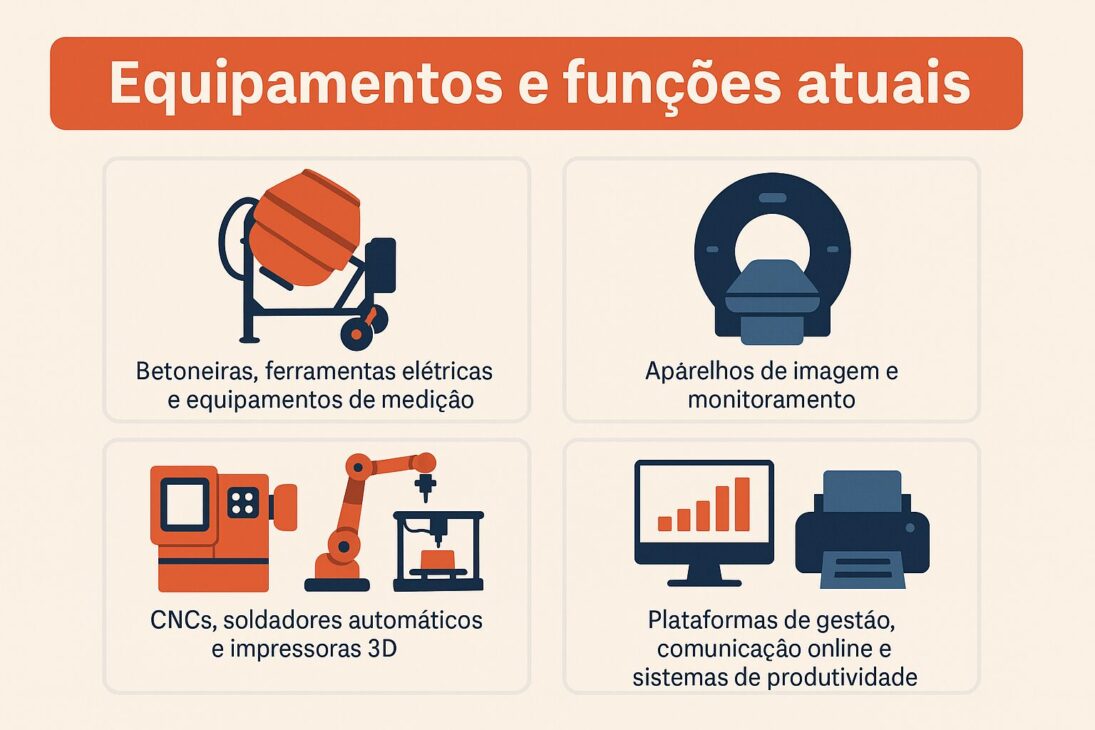
Currently, equipment in the job market includes everything from software to industrial machines. Each sector demands specific expertise.
For instance, in construction, the professional must know how to handle concrete mixers, power tools, and measuring equipment.
On the other hand, in the health sector, it is necessary to understand the operation of imaging and monitoring devices.
According to data from SENAI (2023), over 80% of technical courses offered in the fields of industry and technology involve training for the use of specific equipment, such as CNCs (Computer Numerical Controls), automated welders, and 3D printers.
In the corporate environment, equipment goes beyond computers and printers. Management platforms, online communication tools, and digital productivity systems are part of daily life.
Therefore, knowing how to use them efficiently ensures agility and improves the team’s results.
Difference Between the Common and Qualified Professional
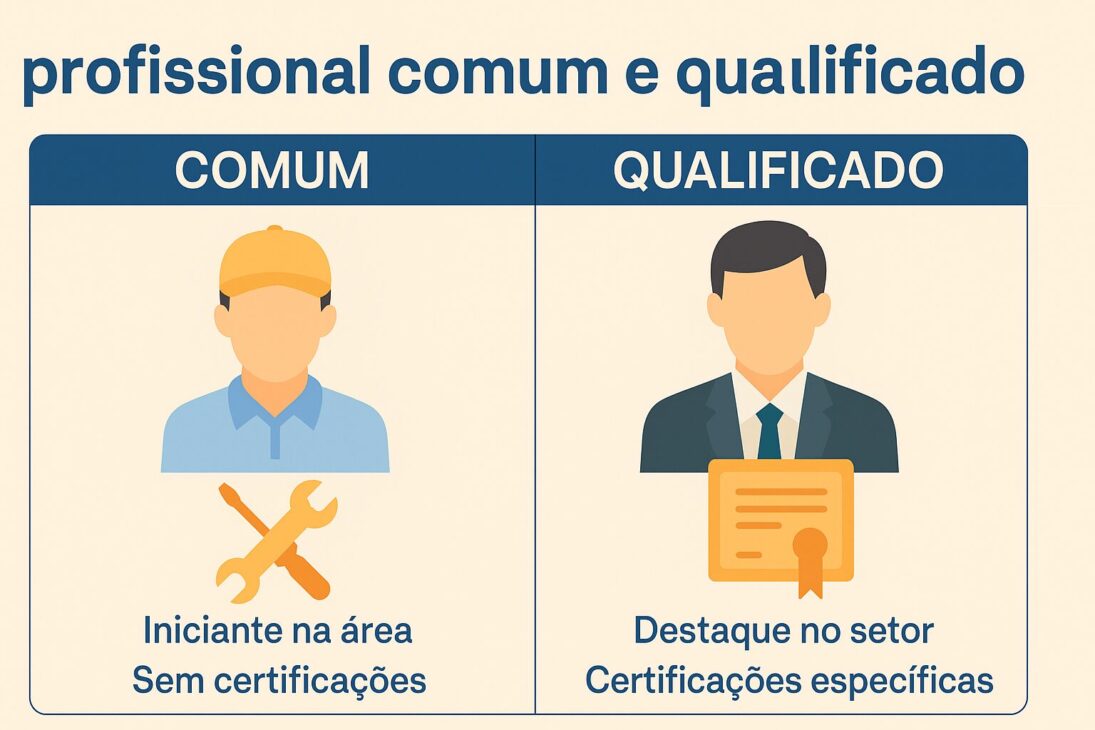
In sectors like agriculture, logistics, audiovisual, and technology, mastering equipment distinguishes the novice professional from one who stands out.
Additionally, in many areas, legislation requires specific certifications for the use of certain machines, further reinforcing the importance of qualifications.
According to the Ministry of Labor and Employment (MTE), the Regulatory Norms — such as NR-12, updated in 2021 — establish minimum requirements for the safe use of industrial equipment in Brazil.
Thus, anyone looking to grow must understand which tools are most used in their field.
Therefore, talking to experienced professionals, studying job vacancy announcements, and keeping up with trends are actions that help identify what to learn.
Training, Practice, and Learning
After identifying important equipment, the next step is to seek training.
Fortunately, many technical courses, whether in-person or online, teach the proper use of equipment, from the most basic to the most advanced.
Additionally, companies also offer in-house training, utilized by those seeking advancement in their role.
According to the official website of SENAI, initial and continued education courses increased by 25% between 2020 and 2022, especially in areas involving machine operation.
Practice is fundamental. For instance, those working in graphic design can practice with editing software and explore features of printing and visual composition.
Meanwhile, those working in industrial sectors must be familiar with safety regulations and the operation of machines to ensure a safe and efficient operation.
Constant Updating is Essential
Technology advances rapidly. Consequently, what works today can become outdated in a few years.
Therefore, professionals need to stay updated on sector innovations, learn about new models of equipment, and adapt their practices.
Moreover, companies value those who seek constant updating.
Reading manuals, watching tutorials, attending technical events, and sharing experiences with colleagues are habits that help keep professionals always prepared.
According to the Brazilian Institute of Geography and Statistics (IBGE), 32% of Brazilian workers work in sectors with high technological turnover, further emphasizing the need for continuous updating (Continuous PNAD, 2022).
Equipment and Productivity in Daily Life
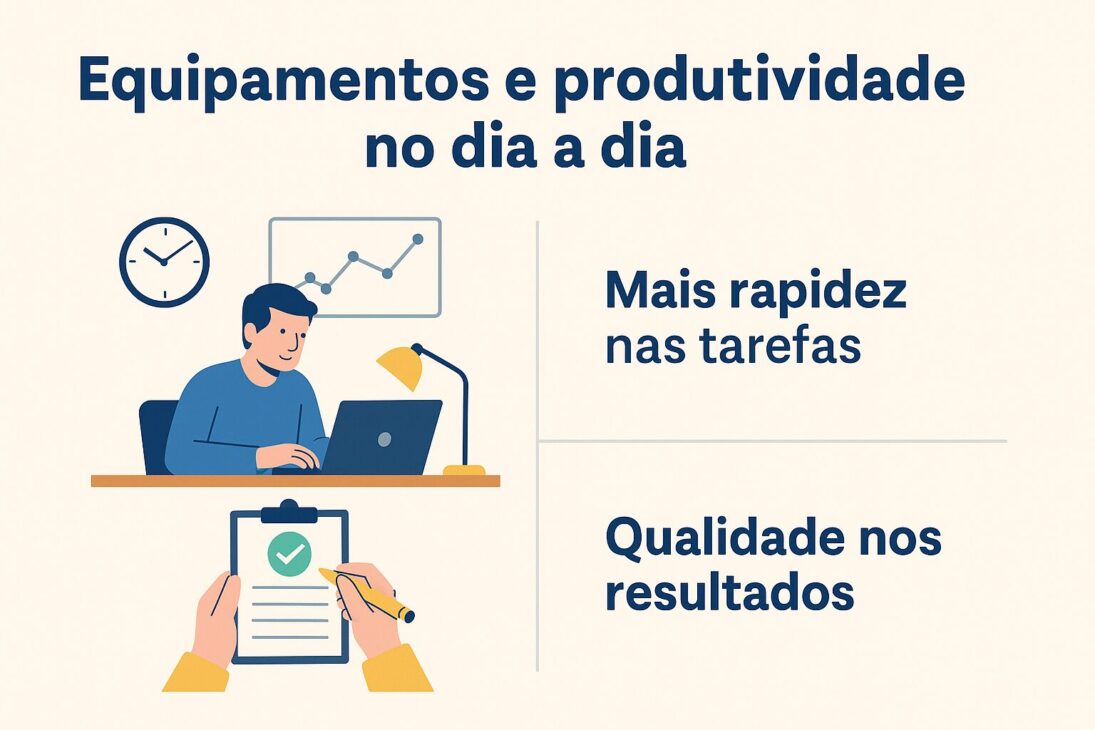
Mastering equipment increases productivity. After all, when a worker understands how to use their tools, they accomplish tasks more quickly, reduce errors, and make better use of available resources.
Moreover, quality also improves. A camera operator who masters their equipment captures images with greater clarity.
Similarly, a lab technician who knows every detail of the apparatus ensures precision in results.
This type of efficiency, therefore, attracts the attention of leaders and managers.
Safety and Responsibility
Using equipment responsibly is essential. By following operational instructions, the professional protects their own life and that of their colleagues, while also avoiding losses to the company.
As a result, a safer and more efficient work environment is created.
Additionally, when identifying faults or risks, the professional must immediately inform the responsible parties.
This type of action demonstrates care, commitment, and respect for regulations in the workplace.
According to the federal government, in a report by eSocial 2023, accidents related to the improper use of machines accounted for 17% of workplace leave records in Brazil.
The Future of Equipment in the Market
With the advancement of artificial intelligence, the Internet of Things (IoT), and automation, future equipment will be even more connected and autonomous.
This, therefore, requires a new stance from professionals, who will need to act as operators, supervisors, and strategists for these technologies.
Even with so much advancement, the human factor remains essential. After all, creativity, empathy, and critical thinking are traits that no machine can replace.
Therefore, the ideal professional will be the one who masters their equipment while also developing human skills.
The ILO (2022) states that by 2030, over 60% of occupations will require mastery of digital technologies and equipment.
Mastering the tools of the job market is an essential differential.
From the past to the present, professional success has always been linked to the ability to understand and effectively use the tools of the trade.
With study, practice, and updates, anyone can stand out.
Therefore, invest in technical knowledge, seek training, and stay attentive to the news in your field.
This combination guarantees not only good opportunities but also a safer, more productive, and valued performance in the workplace.










Seja o primeiro a reagir!