





 Portuguese
  English
  Spanish
  4 min of reading
  0 comments


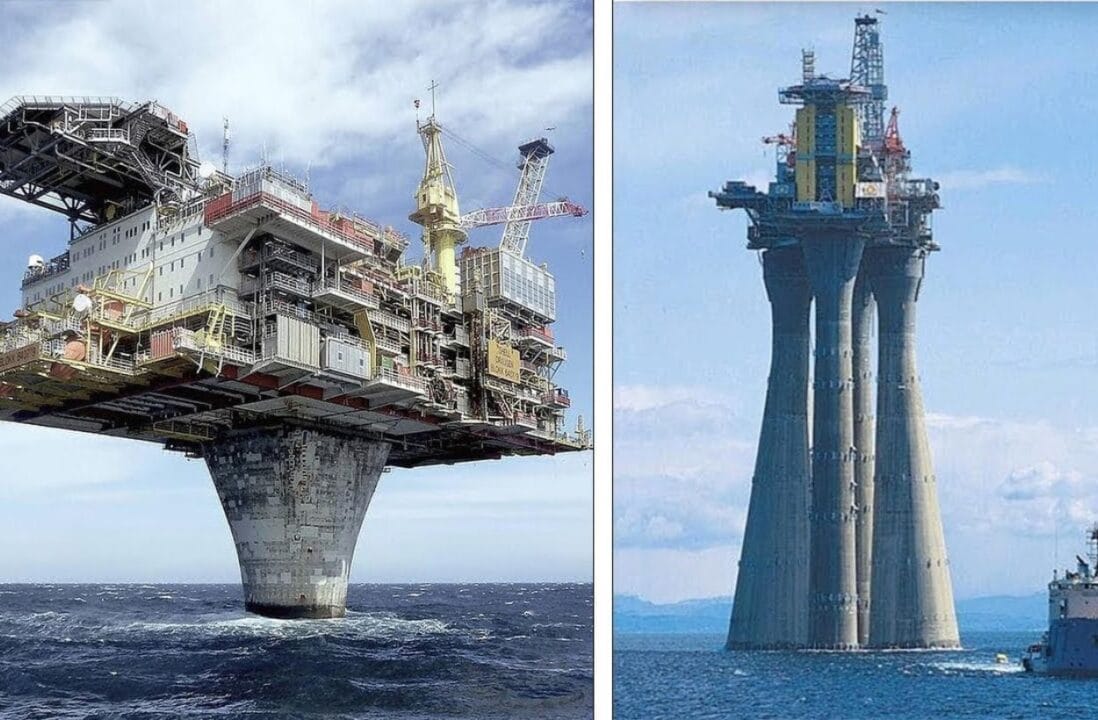
Offshore Oil Exploration Reaches New Heights with the Construction of Floating Oil Platforms and Advances in Safety and Technology, Marking a Significant Progress from the First Simple Structures to the Current Giants Capable of Operating at Depths of Up to 8,000 Meters.
In the relentless quest for “black gold” that has fueled the global economy for over a century, the development of oil platforms has been a journey of innovation and overcoming technical challenges. From the first modest structures in the Great Lake in Ohio to the gigantic constructions that now rise above deep waters, the path traveled reflects a remarkable advancement in engineering and technology.
Initially, oil extraction was limited to land reserves, but the growing demand and search for new resources led to offshore exploration. The construction of oil platforms evolved from simple structures in shallow waters to complex installations capable of operating at depths that now reach up to 3,000 meters. This advancement was marked by important innovations, such as the platform anchored to the seabed at a depth of 80 meters in 1947, and the monumental “Beryl Alpha”, which in 1973 used concrete instead of steel to reach 120 meters.
Construction of Oil Platforms


A milestone in the history of oil platform construction was the introduction of floating platforms. This innovation allowed for oil exploration in areas that were previously inaccessible due to extreme depth. The stabilization of these floating structures was achieved through metal cylinders that function under pressure, counterbalancing the vertical oscillations caused by the sea. Firmly anchored to the seabed by suction pipes, these platforms represent an ingenious solution for oil extraction in deep waters.
-
Offshore industrial demand in Macaé skyrockets with the recovery of oil and gas and could grow by up to 396% by 2026 in the Campos Basin.
-
Offshore industrial demand in Macaé surges with the recovery of oil and gas and could grow by up to 396% by 2026 in the Campos Basin.
-
Historic bankruptcy of Centauro shocks the market, and the century-old company puts more than 500,000 products, machines, and complete infrastructure up for online auction.
-
Brazilian giant expands borders in the Southeast: Petrobras confirms new oil discovery in ultra-deep waters in the pre-salt of the Campos Basin.

The complexity of building and operating offshore oil platforms is not limited to structural challenges. The risk of fires and the need to protect the crew have driven the development of safety technologies, such as intumescent paints that insulate the structure in case of excessive heat and shielded walls that separate risk areas.
Brazilian Technological Leadership
Brazil has been a key player in advancing the technology of oil exploration in deep waters. The exploration of the pre-salt layer, which requires technology to operate at depths of up to 8,000 meters, places the Brazilian industry at the forefront of the global oil sector. Brazilian platforms are exploring new horizons, demonstrating the country’s capacity to develop technologies that challenge the limits of engineering.
The construction of oil platforms is a saga of human ingenuity, facing the challenges posed by nature to access the precious resources that lie beneath the seabed. Each technological advancement not only increases the capacity for oil extraction but also reinforces the importance of continuous innovation to overcome obstacles. As the industry advances, the construction of oil platforms will continue to be a testament to human skill in adapting and innovating in the face of nature’s challenges.
What is the Investment Value for Building Oil Platforms?
Building an oil platform is a monumental undertaking, involving figures that can vary dramatically, ranging from around US$ 100 million for simpler structures in shallow waters to exceeding US$ 5 billion for advanced floating platforms, such as FPSOs, located in deep waters and designed for adverse weather conditions. This variation reflects the complexity, operational depth, type of platform, and specific climate challenges of each project.
Regarding the time required to take an oil platform from conception to operation, we are looking at a process that can take from 3 to 7 years. This period encompasses everything from initial planning and design, through actual construction, to installation and startup operations at the designated site. Factors such as design complexity, challenging weather conditions, and resource availability can influence this timeline.
And in Brazil, What are the Largest Oil Platforms Currently?
The largest oil platforms currently in operation in Brazil reflect the advancement and capacity of the country to explore its vast oil resources, especially in deep water areas like the pre-salt. Leading this ranking is the:
FPSO Guanabara (MV31): Located in the Mero field, part of the Libra project in the pre-salt Santos Basin, this floating production, storage, and offloading unit (FPSO) has an impressive daily production capacity of 179,340 barrels of oil and 11.567 million m³ of natural gas. With a total production of 252,096 barrels of oil equivalent (boe) per day, the FPSO Guanabara stands out as the largest platform in terms of total production, operating with 4 producing wells in the Anc_Mero/Mero field.
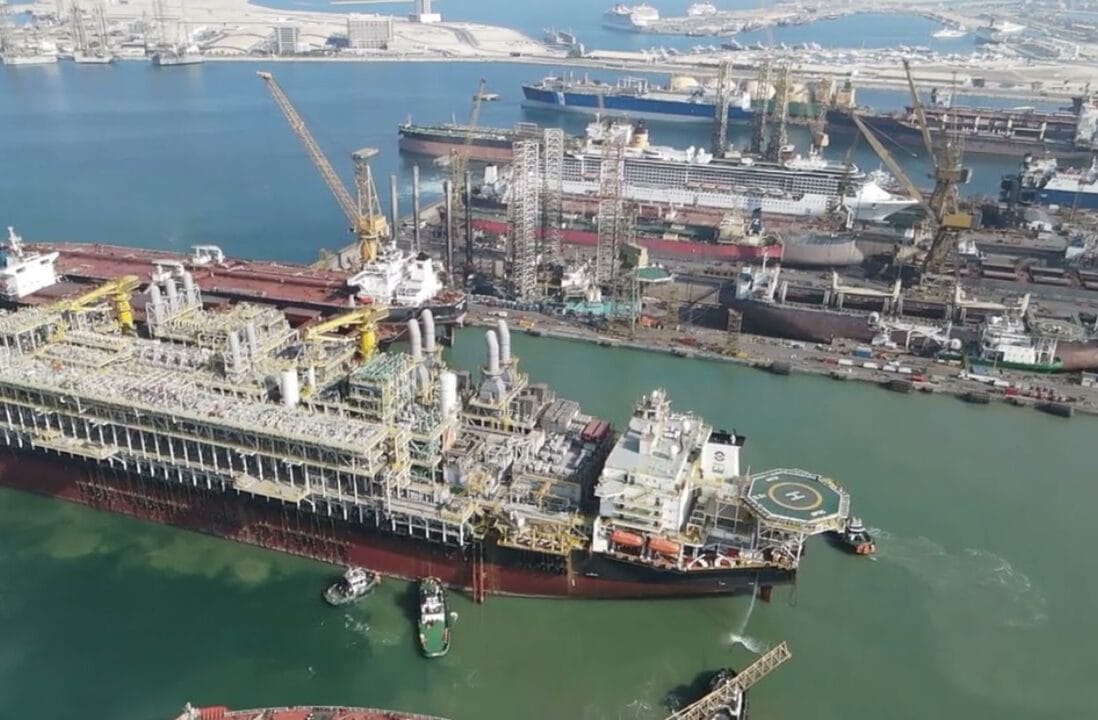
Petrobras 75 (P-75): Located in the prolific Búzios field in the Santos Basin, the P-75 is one of the pioneering platforms in the exploration of Brazilian pre-salt. With a daily production of 158,689 barrels of oil and 7.809 million m³ of natural gas, totaling a production of 207,807 boe per day, the P-75 operates with 4 producing wells in the Búzios/Búzios_Eco/Tambuatá fields, contributing significantly to national oil and gas production.
Petrobras 70 (P-70): Also situated in the Santos Basin, the P-70 explores the Atapu field, achieving a daily production of 155,256 barrels of oil and 5.692 million m³ of natural gas. This results in a total production of 191,057 boe per day. With 5 producing wells, the P-70 operates in the Atapu/Atapu_Eco/Anc_Norte_Atapu/West of Atapu fields, highlighting Brazil’s technological and operational capacity in ultra-deep water oil exploration.
As Petrobras and other operators in Brazil continue to expand their operations in the pre-salt and other areas, new platforms are being planned and built, some with even more impressive production capacities, surpassing 2 million barrels of oil per day. These developments underline Brazil’s leadership position in the offshore energy sector and reinforce the country’s crucial role in the global oil market.









-

2 pessoas reagiram a isso.