





 Portuguese
  English
  Spanish
  7 min of reading
  8 comments


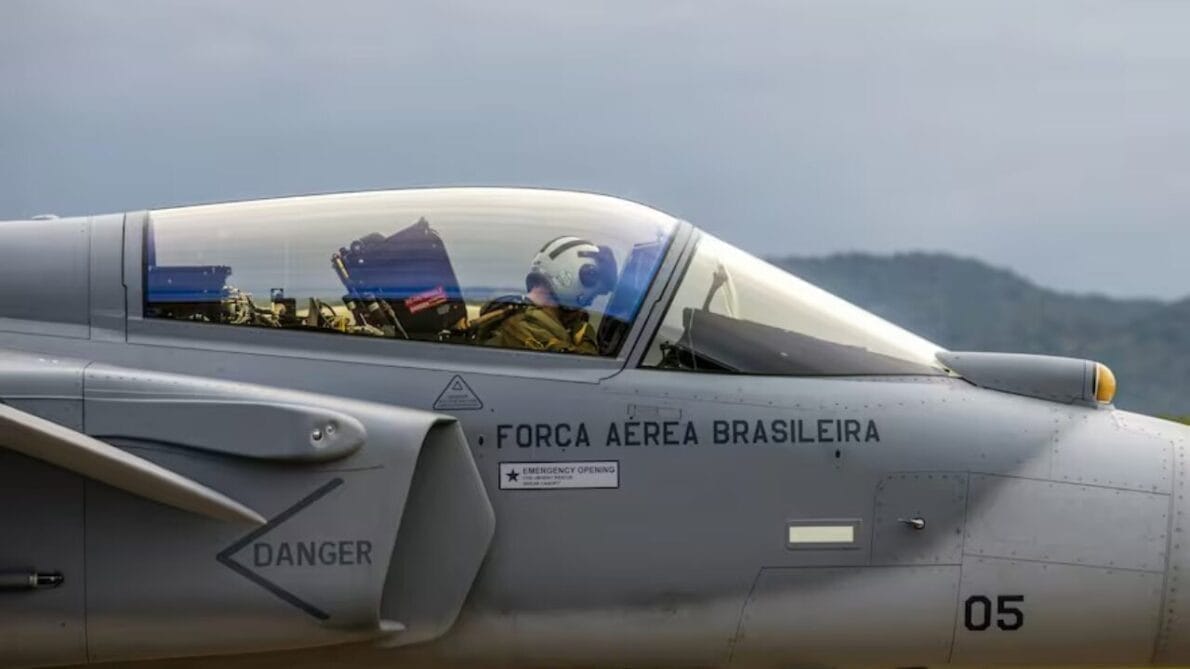


Learn Everything About the F-39 Gripen, the Supersonic Aircraft Developed in Brazil with Cutting-Edge Technology. See How Embraer and Saab Are Revolutionizing National Air Defense
The Swedish Saab, which manufactures the Brazilian supersonic combat aircraft Gripen in collaboration with Embraer, near São Paulo, anticipates its maiden flight in 2025 while seeking contracts to renew the fleet of Colombia and other Latin American countries.
The assembly of a supersonic combat fighter is a curious combination of technology and the care and meticulousness of a lifelong craftsman. The task requires high doses of patience and a thousand checks before and after tightening each screw delicately.
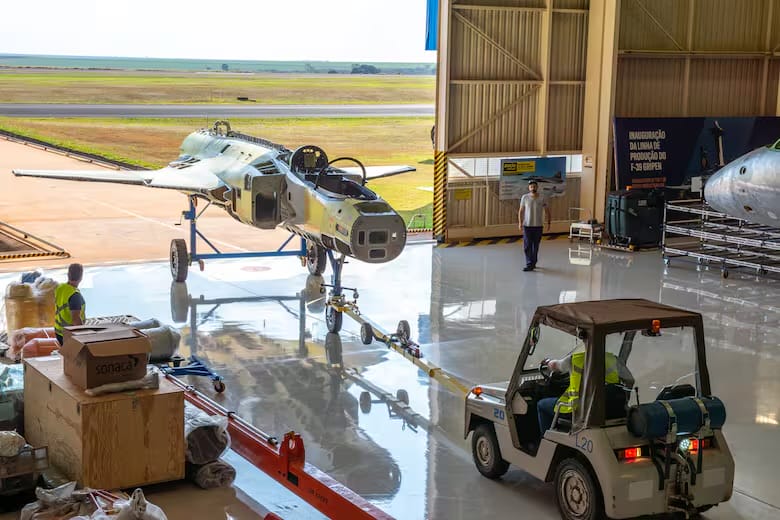
The Assembly Process of the Supersonic Combat Aircraft F-39 Gripen
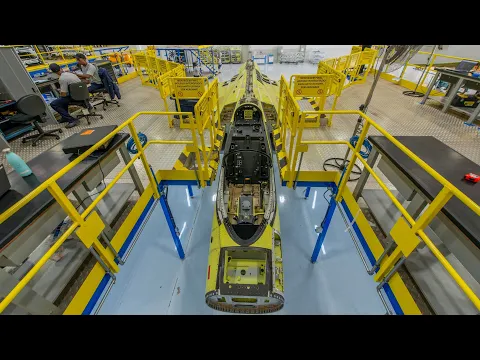
The first “made in Brazil” fighter jet, an F-39 Gripen manufactured by the Swedish Saab in collaboration with the Brazilian aerospace company Embraer, already has the appearance of an aircraft. Although a few months remain in this hangar in the city of Gavião Peixoto, 300 kilometers from São Paulo, mobile phones, computers, and smartwatches are prohibited inside the aircraft. It’s military secrecy.
-
Motorola launched the Signature with a gold seal from DxOMark, tying with the iPhone 17 Pro in camera performance, Snapdragon 8 Gen 5 that surpassed 3 million in benchmarks, and a zoom that impresses even at night.

-
Satellites reveal beneath the Sahara a giant river buried for thousands of kilometers: study shows that the largest hot desert on the planet was once traversed by a river system comparable to the largest on Earth.

-
With 74% of companies facing difficulties in hiring, technicians and engineers in renewable energy are becoming scarce in Brazil and are essential to support the expansion of solar, wind, and green hydrogen projects.

-
Scientists have captured something never seen in space: newly born stars are creating gigantic rings of light a thousand times larger than the distance between the Earth and the Sun, and this changes everything we knew about stellar birth.


The local defense industry reached a milestone last Wednesday, starting the final assembly phase of the Brazilian combat aircraft, which in the aerospace sector is called “giving life” to what is now the fuselage, painted light yellow and embedded in a structure that embraces the body and wings. Now begins the process of installing the nervous system, the 35 kilometers of cables, the 300 kilometers of tubes, the electronic brain, the engine… Subsequently will come the landing gear, camouflage paint, final tests, and finally, loading missiles under the wings and belly. Then it will be ready to patrol the Amazon – the largest rainforest in the world – or wherever the Brazilian Air Force decides to deploy it.
The baptismal flight is scheduled for 2025, as explained on Wednesday by Swedish Häns Sjöblom, general manager of the Gavião Peixoto plant, to a group of journalists invited by Saab to visit the “first F-39 production line outside Sweden.”
When, in 2013, Brazil closed its contract with Saab to purchase 36 combat aircraft, it imposed a condition for technology transfer and that 15 of the Gripen be manufactured on Brazilian soil.
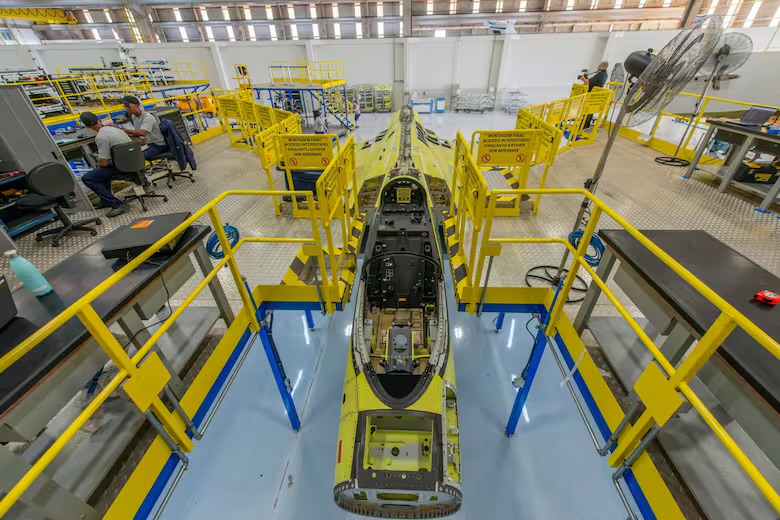
Technology Transfer and Brazilian Workforce Training
This means that 350 professionals from Embraer received training and interned in Linköping (Sweden) and returned home to manufacture the F-39 under Swedish supervision. “We know how to do it, we are efficient, and we make a good product at a competitive cost,” highlighted Walter Pinto, vice president of defense programs at Embraer.
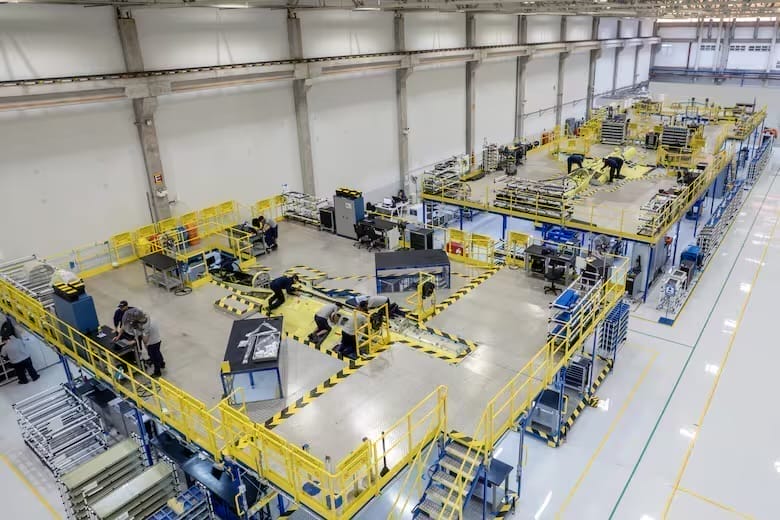
The production line in Brazil was designed with the perspective of seeking new clients in Latin America, whether the Brazilian Air Force or neighboring countries. The assembly hangar currently houses three Brazilian aircraft in different stages of construction.
“With the current structure, there are possibilities to increase production if there is a new order from Brazil, or from other countries,” emphasized manager Sjöblom. The Brazilian Air Force is considering purchasing a second batch of Gripen; they would like Sweden to acquire some KC-390s in return, the military cargo aircraft that Embraer exports to several countries, including some NATO partners.
At the moment, the directors of Saab in Brazil and Embraer are very attentive to Colombia, where the government believes it’s time to replace its fleet of Israeli Kfirs. The discussion, which began there 15 years ago, had been frozen in recent months, but the breakdown of diplomatic relations with Israel due to the brutality of the war in Gaza has breathed new life into the topic.
Saab is one of the companies that submitted a bid to Bogotá. Luis Hernández, director of industrial cooperation at Saab Brazil, prefers to avoid going into details.
In the business of combat aircraft, confidentiality required in the corporate world is compounded by the secrecy imposed by national security.
Hernández explains that Saab is participating in these bids. “We are in a very sensitive phase where we cannot reveal our strategies. We can say that Saab is considering the possibility in Colombia of providing Brazilian-made F-39 Gripen, and in other countries starting an acquisition process. And that we will be able to respond to these requests according to customer requirements.”
Challenges and Trials in Tropical Climates
One of the challenges is to adapt the aircraft to the tropical climate. Ensuring that it operates 100% when the temperature and humidity are extremely high. No pilot, and especially not a fighter pilot in full combat, wants the cabin glass to fog up during flight.
Recently, the F-39 supersonic combat aircraft underwent real tests for 20 days over the skies of Belém, in the Amazon. It is an original fighter with up to 800 extra sensors that perform a myriad of measurements whose results are encrypted and transferred to a control center through secret channels.
“It’s about making the aircraft fly to the limit,” explains Martin Leijonhufvud, head of the Gripen testing center at Saab Brazil. It consists of subjecting it to extreme conditions (35 degrees of ambient temperature, 85% humidity), observing how it responds, and calibrating parts or applying improvements.
In the tests in Belém, they also left the aircraft outdoors all night under a tropical storm. They looked at the weather forecast and chose the worst day.
In addition to the 15 fighters that it will manufacture on its territory, Brazil has acquired another 21 aircraft that are gradually arriving from Sweden by sea. The seven that the Brazilian Air Force has already received are flying in the skies and replacing the old fleet.
As a result of the collaboration between Saab and Embraer, the city of Gavião Peixoto also hosts a design and project development center and another flight testing center, where simulations run from a leak in a tiny compartment to pilots training risk-free in fictitious battles with enemy (red) and allied (blue) aircraft. It’s impressive to sit in the tiny cockpit to pilot with the controls located between the legs (next to the lever that activates the ejection seat for emergencies) and accelerate with the left hand to 2,400 kilometers per hour – double the speed of sound. Putting the fighter vertical or upside down is simple, but leaves the novice dizzy.
Buying a batch of fighters – no one buys just one – represents a huge investment that, additionally, only materializes after many years. In Brazil’s case, about a decade. Therefore, politicians think a lot before signing the final contract. The far-right Argentine Javier Milei could be considered an exception. Five months after taking power, he bought 24 second-hand F-18 fighters from Denmark.
Former Brazilian president Dilma Rousseff was tasked with finalizing the purchase of the Gripen in 2013 after 18 years of discussions. “We are a peaceful country, but we will not be, in any way, a defenseless country,” she said at the time.
The purchase was closed with the Nordics for 4.5 billion dollars at the time, compared to the Dassault fighters manufactured by Rafale, offered by France, and the F-18s from American Boeing. In the final decision, an unexpected factor weighed: the spying by U.S. intelligence services on Rousseff, revealed by analyst Edward Snowden. The Brazilian government concluded that it could not trust its combat aircraft to the Americans.

Officially, the criteria for opting for Swedish Gripens were the performance of the aircraft, the cost – of buying them, operating them, and maintaining them over decades of service life – and the technology transfer. Thanks to it, Brazil is on the verge of joining the select club of countries that manufacture supersonic fighters. Both Saab and Embraer are confident in securing new orders to export “made in Brazil” fighters.
On the other side of the Atlantic, the Swedish defense company is producing at full speed to meet the demands arising from the war in Ukraine. It is expected that Sweden’s recent accession to NATO, along with Finland, will further boost business. Shares of Saab and other companies in the sector are soaring.
Meanwhile, Latin America can continue to take pride in not having armed conflicts between countries, while an open war in Europe and another in the Middle East, coupled with tensions between the two superpowers over Taiwan, predict more prosperity for the global defense industry.






“Saiba tudo sobre o F-39 Gripen, o avião supersônico desenvolvido no Brasil…” me parece uma frase em tom desnecessariamente ufanista, que dá a falsa impressão de que o avião é fruto da engenharia nacional. Uma pitada de humildade e pés no chão não fariam mal a ninguém. O Gripen é produto sueco, não brasileiro. Então acho que seria interessante saber até que ponto os “pitacos” dados por engenheiros e aeronautas brasileiros modificaram o projeto original do Gripen sueco. Fica a dica para o articulista do canal.
O saudoso Eneias ja dizia ,temos que ter nossos armamentos nucleares,porque temos que estar a mercer de algumas coroas, ou todos desativam estes explosivos, bom se todos vivem em armonia e nada de guerra e mortes, vida longa para todos.
Dilma e sei lá quem da embraer fi eram, uma coisa boa pro País, não só comprando, mas mandando técnicos brasileiros para Suécia.Parabens
Parabéns, isso é uma empresa muito séria, vamos subir ao topo na fabricação de caças