





 Portuguese
  English
  Spanish
  4 min of reading
  0 comments


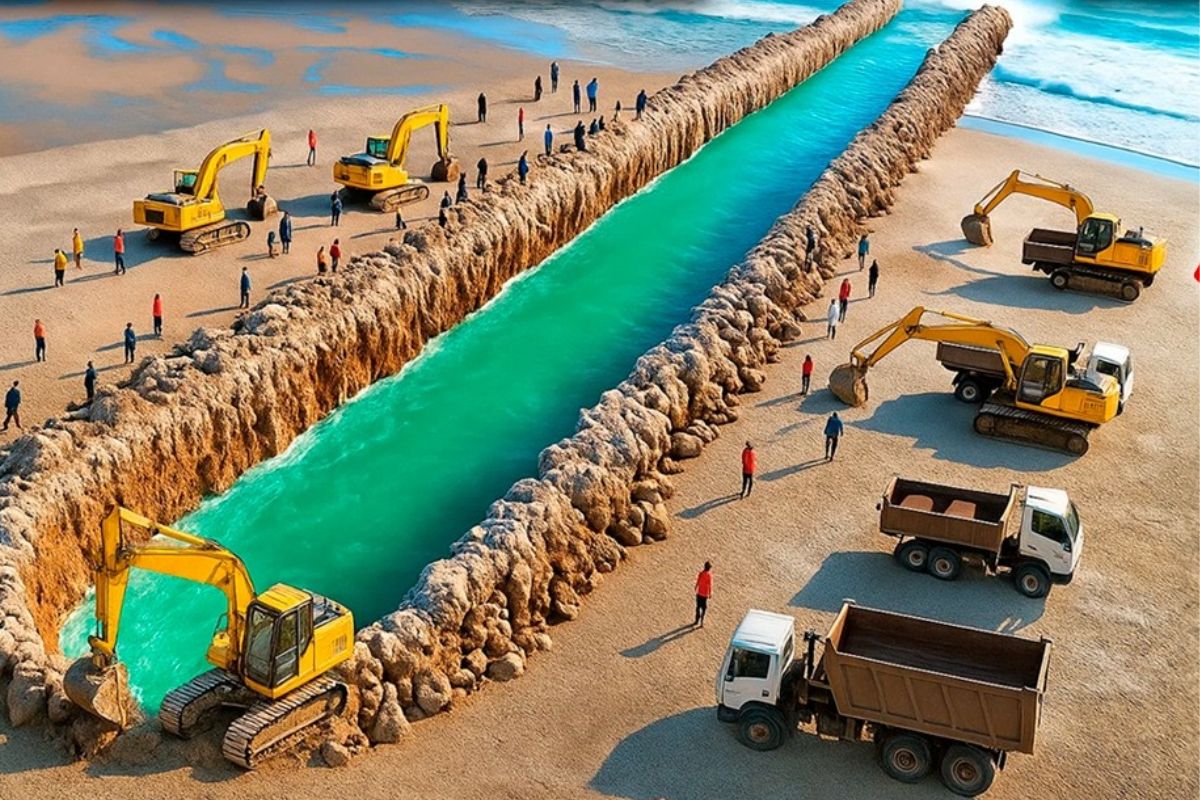
With Mass Desalination, Water Reuse, and Vertical Farms, One of the Driest Countries in the World Is Rewriting the Rules of Agriculture. Understand the Engineering Behind the Miracle.
If someone had said, 50 years ago, that Saudi Arabia would become an exporter of agricultural products, the idea would have been considered delusional. A country where the heat exceeds 50°C, rain is a rare event, and there are no permanent rivers seemed doomed to eternally depend on food imports.
Today, the reality is different. The country not only produces for its consumption but also sells dates, dairy products, and other goods to the world. The transformation of one of the most inhospitable territories on the planet into an agricultural hub is one of the most impressive sagas of engineering and technology of our era. But how has agriculture in Saudi Arabia become possible? The answer lies in a series of bold and high-investment solutions.
Solution 1: The (Temporary) Era of Fossil Water
The first major turning point began in the 70s and 80s, literally underground. Geologists discovered that the desert’s underground held immense fossil water reservoirs – aquifers formed thousands of years ago when the region was wetter. The Saudi government initiated an aggressive program to drill wells and pump this water to the surface.
-
A “silent skill” is allowing Brazilians to earn up to R$ 22,000 per month without a degree and become indispensable for companies that rely on millions of data to survive.

-
Researchers at the Toyota Research Institute found that if a human uses robotic arms to flip a pancake 300 times in an afternoon, the robot learns to do it on its own the next morning, and this is currently the most promising method to solve the biggest bottleneck in modern robotics.

-
Goodbye iron: a common item in households is starting to lose space to technology that smooths clothes in minutes without an ironing board and with less energy consumption.

-
Antarctica reveals an unusual clue high in the Hudson Mountains, and what appeared to be just an isolated rock began to expose a secret hidden under the ice for ages.


The result was an unprecedented agricultural boom. The country became self-sufficient in wheat and a major producer of dairy products. The problem, however, was mathematical: this water was not renewable. By the end of the 2000s, with the aquifers rapidly depleting, it became clear that this solution had an expiration date. A new water source was needed.
Solution 2: Turning the Sea into Fresh Water with Desalination
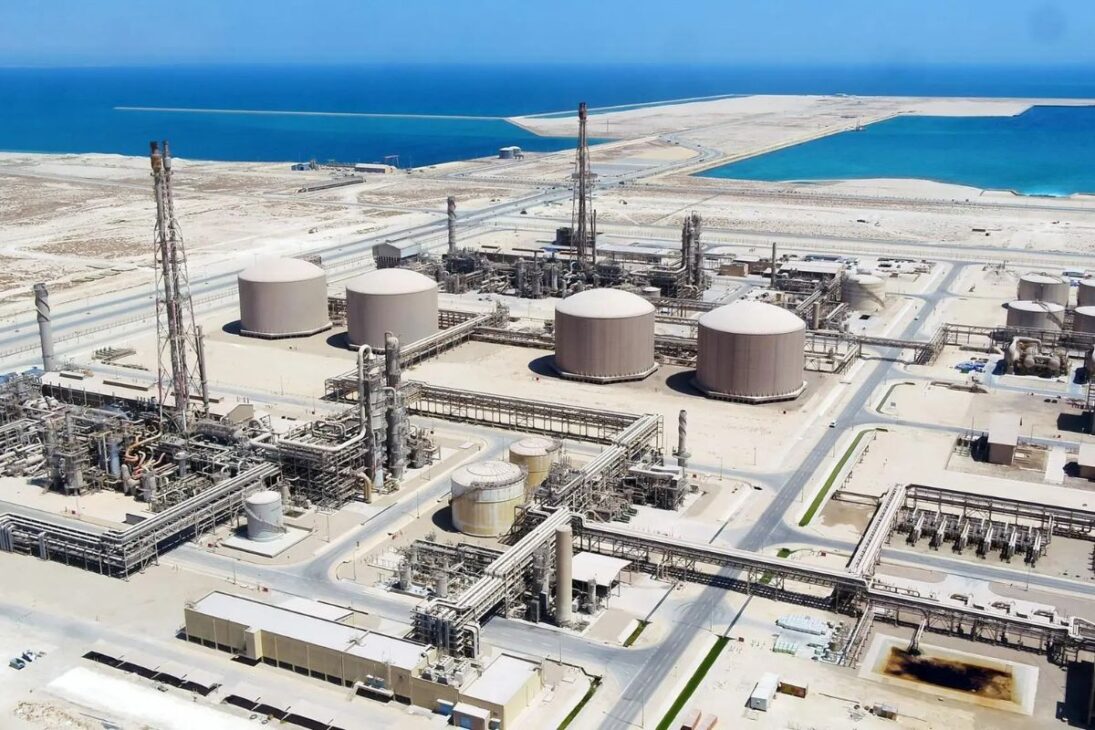
With two vast coastlines on the Red Sea and the Persian Gulf, Saudi Arabia turned its eyes to the ocean. The country invested billions to become the world leader in desalination technology. Today, more than 40 plants operate in the country.
The largest, Ras Al-Khair, is a technological monster that produces over 1 million cubic meters of potable water per day. The most modern process used is reverse osmosis, where seawater is forced under high pressure through membranes that act as superfine filters, separating the salt. And to reduce the carbon footprint of a process that consumes a lot of energy, the country invests in plants like Al-Khafji, one of the largest in the world to operate entirely with solar energy.
Solution 3: The Engineering of the Drop of Water – Reuse and Precision
Even with seawater, waste is not an option. The country developed one of the most advanced wastewater recycling systems in the world. Nearly 150 treatment plants recycle over 5 million cubic meters of sewage per day, transforming it into high-quality water for irrigating non-food crops and forage.
In the fields, efficiency is at its maximum. If you look at Saudi Arabia using satellite images, you’ll see thousands of perfect green circles in the midst of the sand. Each circle is a farm irrigated by center pivot, a mechanical arm that rotates and distributes water and nutrients with surgical precision directly to the plants’ roots, minimizing loss due to evaporation.
Solution 4: The Futuristic Revolution of Soil-less Agriculture

The most impressive of the solutions may be hydroponics in climate-controlled greenhouses. Inside these bubbles of technology, the desert stays outside.
- Soil-less Cultivation: The roots of plants (such as lettuce, tomatoes, strawberries) are suspended in channels, receiving a liquid nutrient solution, with exact control of each nutrient.
- Water Savings: The system reduces water consumption by up to 90% compared to traditional agriculture.
- Controlled Environment: Temperature, humidity, and CO2 are computer-controlled, protecting the plants from pests and extreme weather. The result is faster, higher-quality harvests year-round.
By combining desalination to obtain water, reuse to multiply it, precision irrigation to optimize it, and hydroponics to maximize its conservation, Saudi Arabia has created an agricultural ecosystem that seemed impossible. The journey, which began with the exploration of a finite resource, evolved into a showcase of technology and sustainability, showing that with planning and engineering, it is possible to find solutions to the most extreme challenges.
What do you think of this agricultural revolution? Do you believe that this model of intensive technology can be adapted to solve drought problems in other parts of the world, such as in Northeast Brazil?







Seja o primeiro a reagir!