





 Portuguese
  English
  Spanish
  4 min of reading
  3 comments


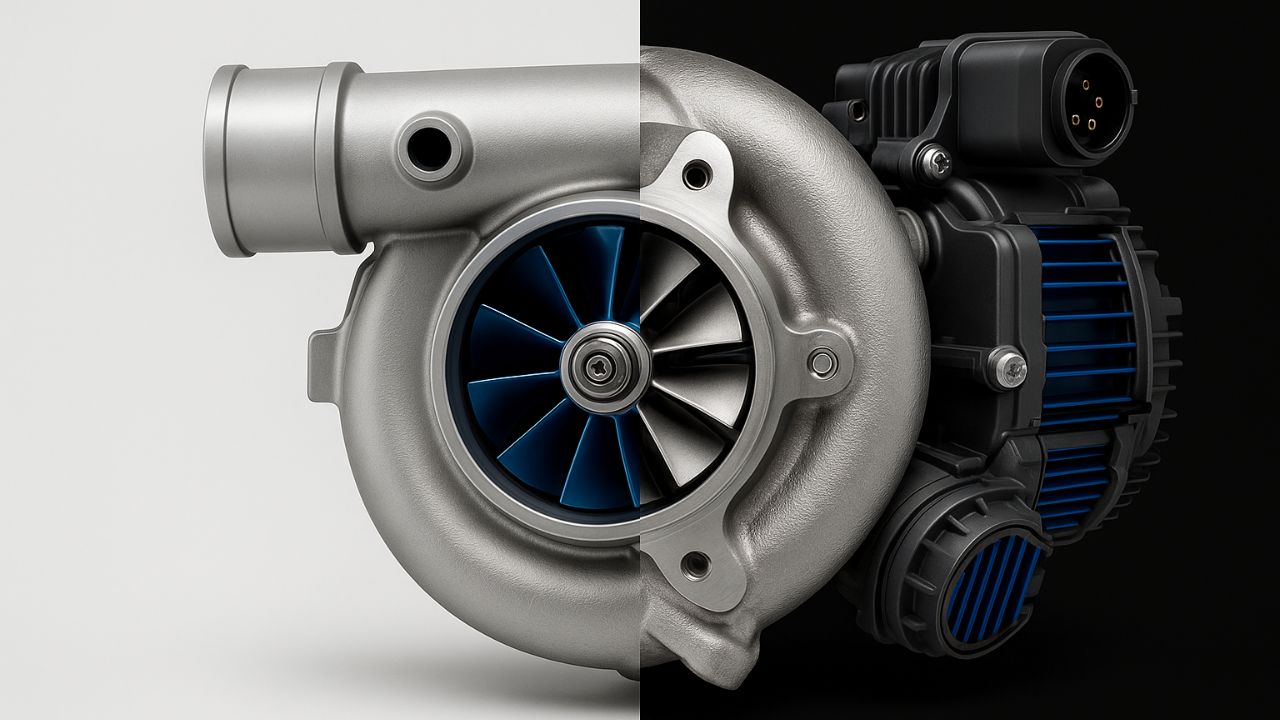


Understand How the New E-Turbo Technology Promises to Eliminate Turbo Lag, Increase Power and Efficiency, and What Its Impact on the National Automotive Market Is.
The automotive industry constantly seeks more powerful and efficient engines. In this scenario, a new technological battle is unfolding for engine power in Brazil: the electric turbo against the conventional turbo. While traditional technology, powered by exhaust gases, has consolidated downsizing, its electric evolution promises instant response and efficiency gains. This rivalry redefines the future of performance and sustainability in vehicles running in the country.
The Conventional Turbo: Known Engine Power, Known Limits
The conventional turbocharger is an established technology. It uses energy from exhaust gases to increase the amount of air entering the cylinders. Its operation is based on a turbine and a compressor connected by a shaft. Exhaust gases spin the turbine, which in turn drives the compressor. This compresses the air and sends it under pressure to the engine. With more air, it’s possible to burn more fuel, generating more engine power and torque.
Components such as the intercooler, which cools the compressed air to make it denser, and the wastegate valve, which controls maximum pressure, are crucial for its operation.
-
Jeep Avenger begins production in Brazil, debuting as the brand’s new entry-level SUV and inaugurating an unprecedented phase by becoming the first national Jeep manufactured outside of Goiana, as part of a R$ 3 billion plan.
-
Costing R$ 12,490, the new Shineray Urban Lite 150 “cheap one” arrives in Brazil with a CVT transmission, digital dashboard, and LED lights, making it more affordable than the Biz and targeting those who want to abandon the bus.
-
Ducati brings to Brazil the Superleggera V4 Centenario: 228 hp that become 247 with a track kit, carbon fiber and carbon-ceramic brakes, estimated price between R$ 1.5 and 2 million, deliveries only in 2027.
-
Used cars with electric steering for R$ 30,000: check out 5 practical and economical options for everyday use.


The significant advantage of this technology has been enabling downsizing. Smaller and lighter engines have been delivering the performance of larger engines, resulting in fuel economy and lower emissions. However, its main disadvantage is the notorious “turbo lag.” This refers to a delay in response at low RPMs when the gas flow is not yet strong enough to spin the turbine at the ideal speed.
The Revolution of the Electric Turbo (E-Turbo): Immediate Response and More Efficiency
The electric turbo, or e-turbo, emerges as an evolution to address the deficiencies of the conventional system. Its main feature is the use of a small electric motor integrated into the system. This motor accelerates the compressor at low RPMs, before the exhaust gases take over the work.
This electrical assistance ensures a much faster response from the engine. The result is the elimination or drastic reduction of “turbo lag,” delivering engine power immediately. To power this electric motor, vehicles with e-turbo generally need a more robust 48-volt electrical system.
The advantages are clear: instant throttle response, greater energy efficiency, and much more precise control of boost pressure. Some systems can even recover energy from exhaust gases. The challenges, however, include higher initial costs, the complexity of the electrical and control system, as well as durability and heat management issues of the electrical components.
What Changes in Practice and Engine Power?
The most noticeable difference for the driver lies in engine response. The e-turbo offers virtually instant acceleration. The conventional turbo, on the other hand, exhibits the well-known delay at low RPMs.
In terms of engine power and torque, both technologies increase performance. The e-turbo, however, allows for a more linear and consistent delivery of power across all RPM ranges. Maximum torque arrives faster and is maintained longer.
In terms of efficiency, the e-turbo also has the advantage. It optimizes combustion and, in some cases, recovers energy, which helps reduce fuel consumption and pollutant emissions. This technology allows the engine to operate in an ideal combustion condition (Lambda 1) for longer periods, which is essential to meet future and stricter environmental regulations.
The Future of Engines in Brazil: Impacts of the New Technology
The arrival of the e-turbo is already a reality for engines in Brazil, with models like the Mercedes-AMG C43 introducing the technology. The trend is that other manufacturers, especially in the premium segment, will follow suit in the coming years.
Naturally, innovation has a cost. The complexity of the e-turbo, with its electric motor and 48V system, raises production costs and the final price of the vehicle. Maintenance and repair costs may also be higher due to the new components.
However, Brazil has a unique and favorable scenario. The synergy of the e-turbo with ethanol is promising. The high octane of our biofuel can be better utilized with the precise pressure control of the e-turbo, generating more efficiency and power in engines in Brazil that are flex-fuel. Moreover, the technology integrates seamlessly with hybrid systems, which already possess the necessary 48V electrical architecture. Incentive programs like Rota 2030 also encourage the local development of these advanced technologies.
The Path of the E-Turbo in the National Market
The implementation of the e-turbo is not simple. Engineers face significant challenges, such as managing the heat generated by electrical components in the engine compartment. Ensuring the durability and reliability of an engine that can spin at 200,000 RPM in a harsh environment is another obstacle.
Despite the challenges, the opportunities are immense. Manufacturers that master this technology can take the lead in performance and efficiency. For Brazil, there is a chance to become a hub of innovation, developing solutions that combine the e-turbo with flex-fuel engines. This combination can generate technologies and vehicles with great export potential, reinforcing the country’s position in the global automotive industry. The battle for the efficiency of engines in Brazil is just beginning.








Matéria perfeita, muito bem escrita. Só um detalhe, eu acrescentaria antes das “200.000 rpm” a palavra componente ou turbo ao invés de “motor”. Por favor entenda como uma crítica construtiva. Obrigado!
Está rotação pertence ao turbo
Se referiu ao motor elétrico do “turbo elétrico” na matéria.
A colocação do autor está certa, pois ela está se referindo ao motor eletrico do turbo, que terá q girar 200mil rpm. Eu entendi dessa forma