





 Portuguese
  English
  Spanish
  5 min of reading
  0 comments


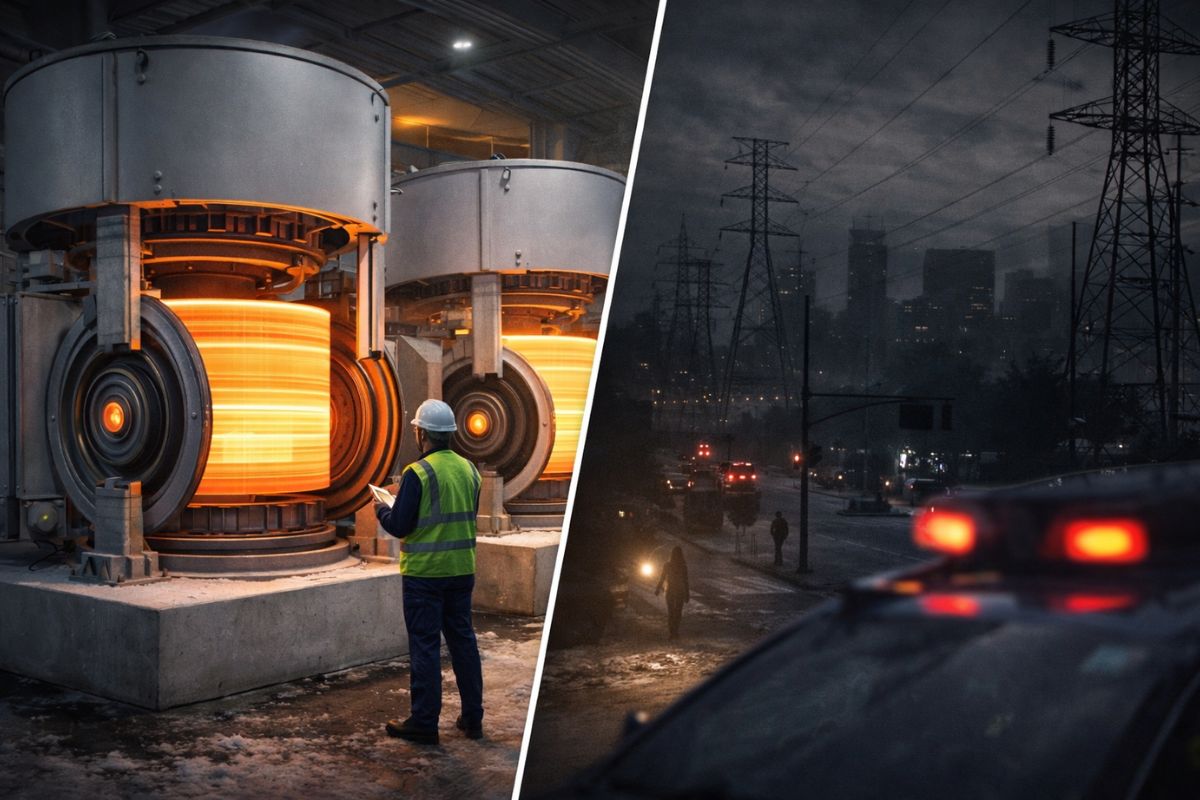
After The Blackout That Hit Spain And Portugal And Also Affected Areas Of France And Morocco, The Debate Grows On How Mechanical Battery With Flywheels, Synchronous Compensators, And Instantaneous Response Can Stabilize Frequency, Reduce Blackouts, And Gain Space In Renewable Grids During Peak Times And Failures
The discussion about mechanical battery has returned to the center of energy security after the blackout that hit Spain and Portugal on April 28, 2025. The incident exposed how an electric grid with a strong share of renewables can struggle when there is a lack of rotational inertia to absorb voltage and frequency fluctuations.
The central point is not to sell a miraculous solution, but to understand function and limit. Flywheels deliver very rapid response, help to hold stability in the most critical seconds, and can reduce the risk of new blackouts, but they do not replace alone other layers of protection and storage.
Why Inertia Became A Security Issue After Spain And Portugal
When the failure spread through Spain and Portugal, the effects went from domestic discomfort to an infrastructure crisis, with severe economic impact and reports of indirect deaths associated with the blackout.
-
Motorola launched the Signature with a gold seal from DxOMark, tying with the iPhone 17 Pro in camera performance, Snapdragon 8 Gen 5 that surpassed 3 million in benchmarks, and a zoom that impresses even at night.

-
Satellites reveal beneath the Sahara a giant river buried for thousands of kilometers: study shows that the largest hot desert on the planet was once traversed by a river system comparable to the largest on Earth.

-
Scientists have captured something never seen in space: newly born stars are creating gigantic rings of light a thousand times larger than the distance between the Earth and the Sun, and this changes everything we knew about stellar birth.

-
Geologists find traces of a continent that disappeared 155 million years ago after separating from Australia and reveal that it did not sink, but broke into fragments scattered across Southeast Asia.

Parts of France and Morocco were also affected, demonstrating how an interconnected electric grid amplifies the speed of problem propagation.
In this scenario, the technical issue gained political and operational weight.
Without sufficient inertia in the electric grid, sudden increases in demand or frequency variations can spiral out of control, especially in systems with a high presence of renewable sources and lower contributions from large conventional synchronous rotors.
How Mechanical Battery Works And Why It Reacts So Quickly
A mechanical battery, in this context, stores energy in rotation.
Instead of storing energy in chemical reactions, it uses a heavy flywheel that spins at high speed and then returns electricity via a generator, leveraging the accumulated rotational inertia.
This design explains the usefulness of flywheels for stabilization.
The material describes round-trip efficiency in the range of 90% to 95%, in addition to very rapid charging and discharging, with behavior comparable to that of supercapacitors.
To handle ultra-short-term fluctuations, this agility weighs more than long duration.
What The United Kingdom Did After 2019 And Why This Case Became A Reference
The United Kingdom faced similar blackouts in 2019 and responded with a grid stabilization program led by the national operator NESO, described as unprecedented.
One of the central examples is the Greener Grid Park in Liverpool, inaugurated in 2023 with participation from Statkraft.
The facility brings together two flywheels of 40 tons each, connected to synchronous compensators and supported by batteries for longer storage.
According to the data presented, this site provides about 1% of the inertia for the electric grid of England, Scotland, and Wales.
This figure is noteworthy because it shows real scale, not just a lab test.
The same material indicates that NESO already had 11 similar projects in operation in Great Britain since 2023, with plans for expansion.
This helps explain why the debate about mechanical battery has ceased to be merely a technological curiosity and has started to enter the reliability planning of electrical systems.
Where Else Are Flywheels Advancing And How Much Has This Expanded
The expansion is not only appearing in the discussion about Spain and Portugal.
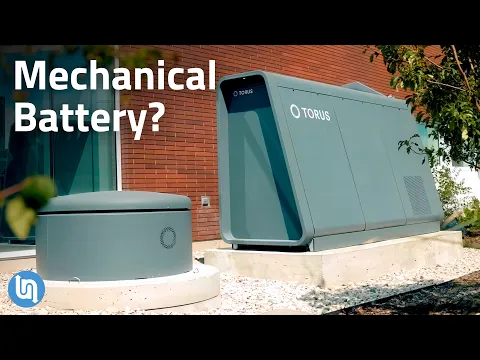
In Salt Lake City, Torus appears with contracts in commercial clients and an agreement with Rocky Mountain Power for 70 MW of systems combining FESS and batteries, in addition to opening a factory of 50,168 square meters and investing US$ 200 million to accelerate deployment.
Amber Kinetics, in partnership with Kawasaki Heavy Industries, combines FESS with technology for a virtual synchronous generator, the iVSG, to create an additional layer of stabilization.
The stated goal is to smooth voltage fluctuations and improve the integration of renewables, initially focusing on the Philippines and Japan.
Here, the logic is clear, software and physical rotation work together.
At the Port of Rotterdam, QuinteQ tested container systems to service cranes in partnership with Rhenus Logistics.
The material cites a supply of about 400 kW and a reduction of up to 65% in the peak demand of this equipment.
This use is different from blackout protection, but reinforces the same idea, flywheels are useful to dampen peaks and valleys in a congested electrical grid.
Limits, Costs, And Risks That Prevent Treating Mechanical Battery As A Total Solution
There is a reason why mechanical battery is not presented as a definitive solution. Flywheels lose energy over time due to residual friction, even with advanced solutions, and the material cites losses of 5% to 20% per hour.
This reduces competitiveness for long-term storage and explains the frequent association with chemical batteries.
Initial costs also weigh in. Durable materials, magnetic bearings, vacuum chambers, containment engineering, and safe installation increase the investment.
As they are very heavy masses spinning at high speed, the design needs to address mechanical risk rigorously, including containment structures and careful positioning.
Despite this, the defense argument for the system remains strong.
Long lifespan, relatively low maintenance, and instantaneous response make mechanical battery attractive for specific stabilization functions, especially in grids with more renewables and more unpredictable demand.
What Changes For The Next Blackouts And Where This Technology Can Really Make A Difference

The most important lesson from the debate is not that flywheels solve everything.
The lesson is that blackouts in modern electric grids can arise in seconds and spread quickly, while recovery takes hours. During this interval, economic damage and indirect effects accumulate.
Therefore, the combination of layers tends to gain strength, flywheels for immediate response, batteries for support, control software to coordinate frequency, and grid planning to reduce vulnerabilities.
After Spain and Portugal, this arrangement stopped seeming like excessive caution and began to sound like risk management.
The debate about blackouts, electric grids, and renewables became more tangible after Spain and Portugal because it showed a physical problem, not just a political one.
When there is a lack of inertia at the wrong moment, the bill comes due for hospitals, transport, commerce, and families.
In your opinion, if you were to prioritize investment to avoid new blackouts, would you allocate more resources to mechanical battery with flywheels for immediate response or to traditional batteries for longer duration, and why?








Seja o primeiro a reagir!