





 Portuguese
  English
  Spanish
  4 min of reading
  1 comment




Discount Attracts Business Owners, But Experts Warn of Risks of Seizure, 15% Tax on Sale, and Higher Financing Interest Rates
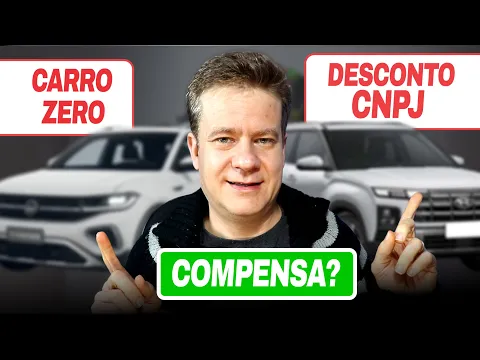
What seems like an immediate advantage can be costly in the long run. According to accountant Odair Bergamo, the “discount of up to 30%” offered to those who decide to buy a car under a CNPJ can turn into a headache with seizure for debts, high taxes at the time of sale, and interest rates above the market in financing.
Buying a vehicle at company name is common among MEIs and small business owners attracted by tax savings such as ICMS and IPI.
The problem, warns Bergamo, is that the car becomes the property of the CNPJ and can therefore be seized in the case of tax or labor debts.
-
OMODA & JAECOO grows in Europe in 2026 with an integrated strategy of sales, innovation, local production, and technological advancement in the United Kingdom, Italy, and Spain.

-
OMODA & JAECOO expands after-sales service in Brazil with competitive maintenance, a 7-year warranty, and high availability of parts for technological SUVs.

-
OMODA & JAECOO appoints Alessandra Souza as executive marketing director in Brazil and accelerates brand expansion with a focus on innovation, networking, and hybrid portfolio.

-
Jaecoo 7 with super hybrid SHS system exceeds 1,200 km of combined range with a 1.5 turbo engine, high-density battery, and intelligent energy management.


Furthermore, the initial benefit can be nullified when considering the delivery time, the taxation on capital gains, and the more expensive financing conditions.
Why Is There a Discount for CNPJ?
The price reduction occurs because the sale is billed directly from the factory, with reduced taxes.
In fact, it is possible to find advertisements for up to 30% discount for companies.
But this benefit has important counterpoints: the vehicle is registered under the CNPJ, not the CPF, and is subject to exposure to legal and financial risks of the legal entity.
Another point is that the delivery time is usually longer, potentially taking a month or more, especially for those who live far from the manufacturers.
For those who need the car immediately, this factor can make the advantage unviable.
Risk of Seizure and Challenges from the Tax Authority
According to Odair Bergamo, a car purchased under the CNPJ can be seized to pay off business debts.
It only takes a tax or labor action for the asset to enter the list of seizable goods, as provided by the Civil Procedure Code.
For MEIs with revenue of up to R$ 81 thousand per year, buying a R$ 150 thousand car can raise suspicions from the Federal Revenue regarding the origin of the funds.
The recommendation is to maintain organized accounting and proof of cash flow to avoid attracting the attention of the tax authorities. Otherwise, the promise of savings may turn into tax liabilities.
Sale Requires Invoice and Can Generate 15% Tax

One of the most critical points is resale. Under the Simples Nacional rule, the company must issue a sales invoice for the car, without which the buyer cannot transfer it at DETRAN.
The Federal Revenue applies 15% taxation on the capital gains calculated after the vehicle’s accounting depreciation.
In the example given by Bergamo, selling a car for R$ 80 thousand could generate R$ 12 thousand in tax, nullifying the discount obtained at purchase.
For those considering transferring the asset to the CPF of a partner or family members, the accountant warns: this practice could be seen as tax fraud, subject to penalties.
Financing Under CNPJ Has Higher Interest Rates
Another little-publicized factor is that financing rates are generally higher for legal entities.
While individuals can secure zero-rate promotions, the average cited for CNPJ stands at 1.99% per month, which significantly increases the cost of installments.
In simulations presented by Bergamo, even with a price discount, the final cost of the car under CNPJ was R$ 2.3 thousand more expensive than the purchase made as an individual.
This shows that the initial benefit can easily be nullified by interest rates over the financing period.
Is It Worth Buying a Car Under CNPJ?
The answer depends on the company’s profile and situation. For large companies with robust accounting that use vehicles as a work tool, the purchase can be advantageous.
For MEIs and small businesses, the risks outweigh the gains: seizure in case of debts, heavy taxation on resale, and high interest in credit can make the operation disadvantageous.
Odair Bergamo emphasizes that it is essential to do the complete calculations and not be swayed merely by shelf discounts.
And what about you, do you think buying a car under CNPJ really benefits the small entrepreneur or is it a trap disguised as an advantage? Leave your opinion in the comments—we want to hear from those living this reality.









Esse país é uma vergonha! Esses **** instalados no poder querem tirar o sangue do povo que trabalha e sustenta essa nação. O brasileiro não tem nenhuma facilidade ou vantagem que valha a pena. É incrível como Estado se propõe a tributar e extorquir do empresário ou trabalhador sem o mínimo de pudor. Mas a culpa é do povo brasileiro, que é muito passivo e aceita tudo calado. Tem de se lascar mesmo. Ponto para os sanguessugas no poder!