





 Portuguese
  English
  Spanish
  4 min of reading
  0 comments



Chinese Dealership Crisis Leads to Unprecedented Vehicle Accumulation, Store Closures, and Growing Concerns Among Resellers and Manufacturers Pressured by an Intense Price War and Oversupply in the Automotive Sector.
The Chinese automotive sector faces an alarming scenario, marked by the accumulation of vehicles at dealerships, abrupt store closures, and urgent appeals from resellers for changes in the business model.
An intense price war, which has intensified in recent years, has led to a rampant supply of electric cars in the country, causing serious impacts throughout the automotive chain.
The phenomenon has turned various dealerships into actual vehicle depots, while pressure for sales targets pushes retailers to the brink of financial collapse.
-
With an investment of R$ 612 million, a capacity to process 1.2 million liters of milk per day, Piracanjuba inaugurates a mega cheese factory that increases national production, reduces dependence on imports, and repositions Brazil on the global dairy map.

-
Brazilian city gains industrial hub for 85 companies that is equivalent to 55 football fields.

-
Peugeot and Citroën factory in Argentina cuts production by half and opens a layoff program for more than 2,000 employees after Brazil drastically reduced purchases of Argentine vehicles.

-
A Brazilian city gains a factory worth R$ 300 million with the capacity to process 200 thousand tons of wheat per year, a mill of 660 tons/day, silos for 42 thousand tons, and an industrial area of 276 thousand m².


Price War in China and Oversupply
The competition for increasingly larger shares of the Chinese electric vehicle market has led automakers to rapidly expand their production lines.
The result has been an oversupply of automobiles, particularly electric models, which crowd dealership lots.
Faced with the impossibility of absorbing all this supply, many stores have started operating as true warehouses.
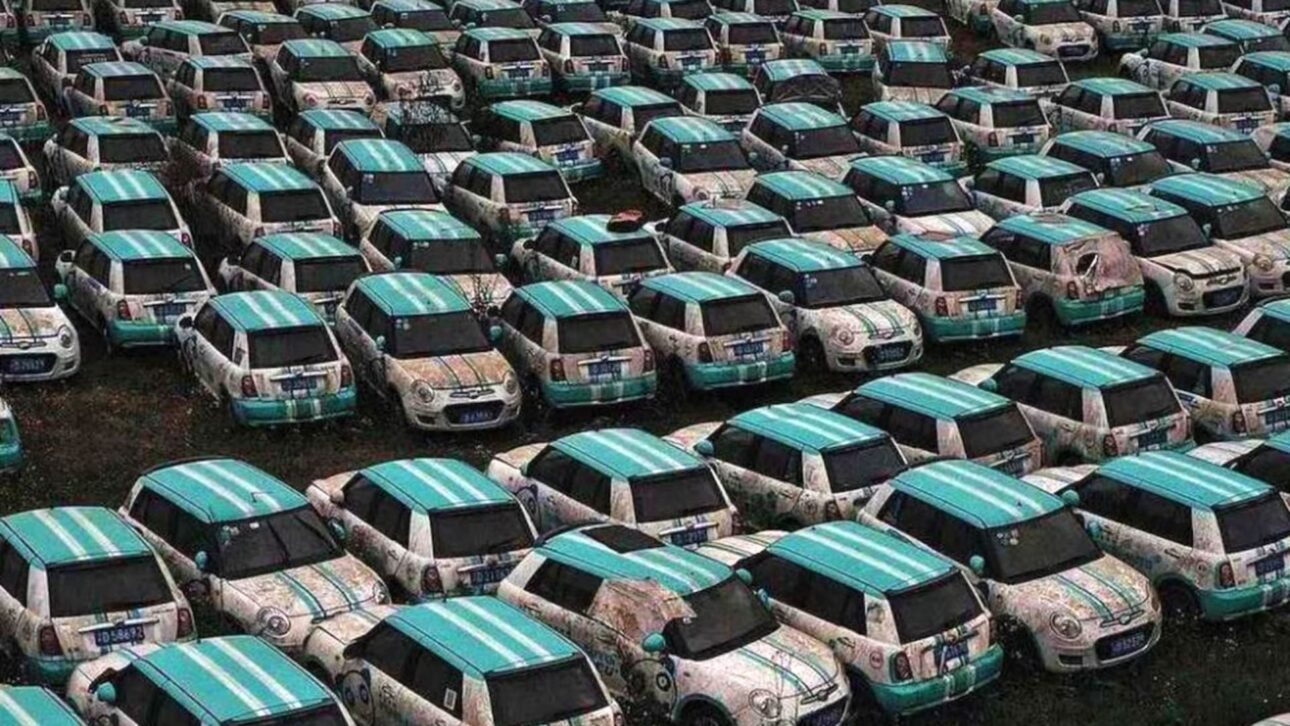
The phenomenon is exacerbated by practices such as the so-called “self-registration”, where dealerships and automakers register vehicles as sold only to meet end-of-quarter or year-end targets, even though these cars have not been acquired by end consumers.
Consequently, these models end up feeding the inventory of used cars at so-called “0 km” dealerships, without finding sufficient demand in the market.
Store Closures and Financial Impact
Reports from July 2025 indicate that, in the Shandong province alone, at least 20 BYD stores—one of the largest electric vehicle manufacturers in China—have been closed or are practically deserted.
The situation is spreading to other regions, demonstrating the scale of the imbalance faced by different brands and resellers.
According to information released by local media, the oversupply of stored cars is pressuring the cash flow of stores, harming the liquidity of companies, and drastically reducing business profitability, leading to layoffs and store closures.
Pressure on Dealerships and Consequences for the Sector
The consequences of the price war in China affect both large automotive groups and small independent dealerships.
Many companies in the sector report difficulties in supporting the volume of vehicles transferred by automakers, who continue to prioritize mass production, even in the face of weakening demand.
According to the China Automobile Dealers Association, the business environment has become even more severe in 2025.
The organization emphasizes that manufacturers need to reassess their annual production and sales targets, adjusting them to market reality and avoiding the indiscriminate transfer of inventories to sales points.
The sector’s alert also includes criticism of the practice of forcing dealerships to maintain large inventories, a situation that jeopardizes the financial sustainability of stores and limits their negotiating capacity.
According to representatives of the category, it is unacceptable to require resellers to maintain high inventories or close their doors under the pretext of restructuring distribution channels.
Pressure from manufacturers, with demands for performance beyond the real absorption capacity of the market, contributes to the instability scenario.
Entities’ Alert and Risks of Price Wars
Official entities, such as the Chinese Automobile Manufacturers Association and the Ministry of Industry and Information Technology, have also voiced their concerns on the topic, warning about the risks of so-called “disorderly price wars.”
In public statements, the institutions emphasize that the intensification of competition has led to a reduction in profit margins across the Chinese automotive sector, signaling that the pursuit of market share, without the proper balance between supply and demand, can cause long-lasting and harmful effects for all links in the chain.
Sustainability and Challenges of the Electric Vehicle Market
Besides the immediate impact of store closures and increased car inventories, the current situation raises concerns about the sustainability of the rapid growth of the electric vehicle market in the country.
The sales volume, although still significant, already shows signs of slowing down in some regions.
For automotive industry experts, the imbalance caused by oversupply could harm brand image and discourage new investments.


Global Impact and Need for Adjustments
The context of the price war among automakers is not limited to domestic competition.
The Chinese market, recognized as the largest in the world for electric vehicles, also faces export pressures and seeks to expand its international presence, further exacerbating the need to rethink production and marketing strategies.
The difficulty in clearing domestic inventory may have global impacts, affecting trade partners and price dynamics in other markets, such as Europe and Latin America.
Future of Dealerships and Strategy Adaptation
The transformation of dealerships into actual “graveyards of cars” highlights the urgency of revising target and incentive policies, which until now have driven rapid sector expansion.
Dealership representatives emphasize the need for greater dialogue between manufacturers and resellers to align supply with the real demand of Chinese consumers.
The goal is to prevent practices such as “self-registration” and the massive shipment of vehicles to stores from continuing to distort results and cause disruptions in the automotive chain.
The future of the sector will increasingly depend on adopting more balanced management models that can align production, sales, and consumer interests.
For experts, adjusting these practices may define the pace of recovery for the Chinese automotive market in the coming years.








Seja o primeiro a reagir!