





 English
  Francês
  Alemão
  Italiano
  Japonês
  Norueguês
  Portuguese
  Spanish
 4 min of reading
  0 comments


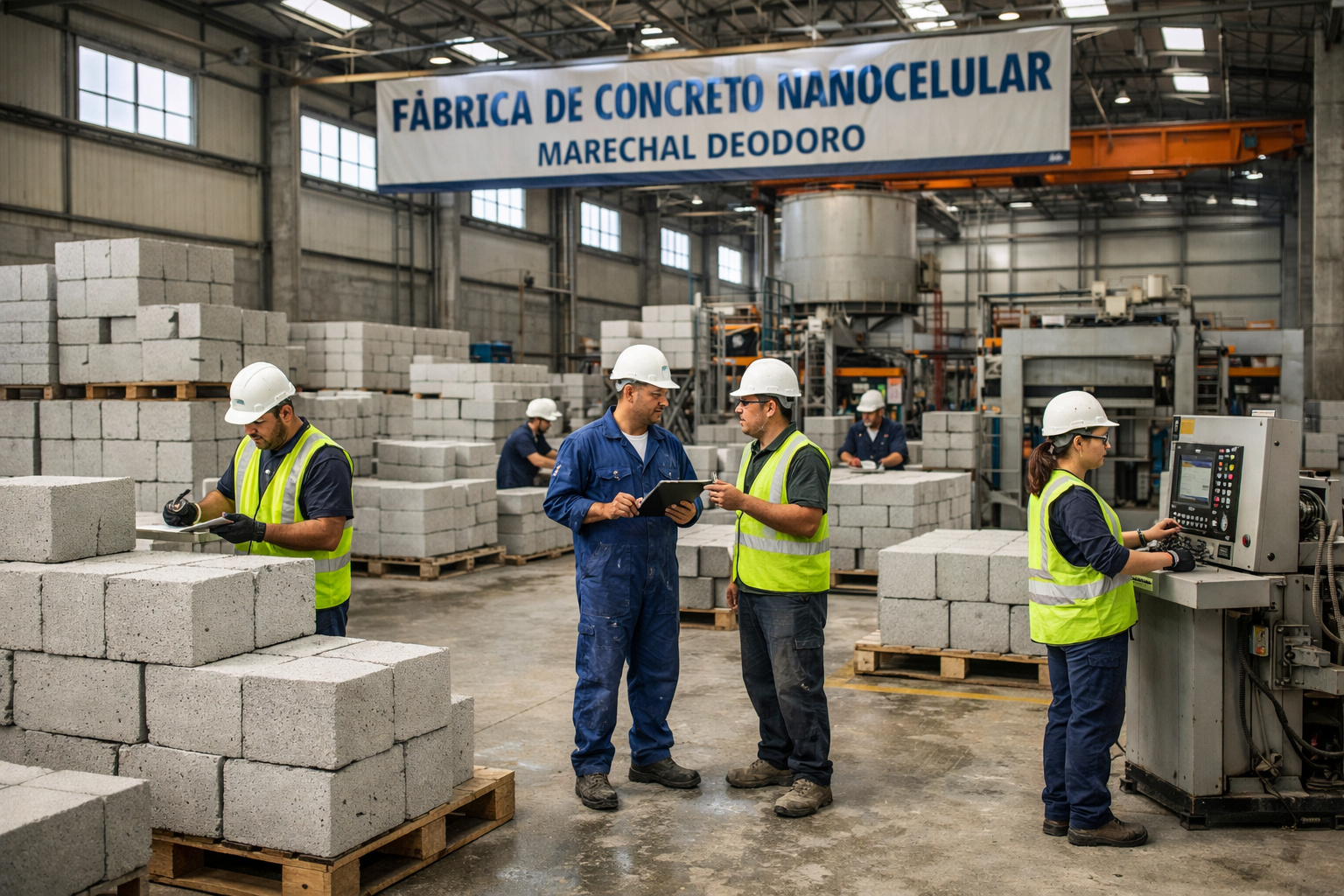
Technology Developed in Marechal Deodoro Reduces Construction Time by Up to 40% and Saves 3,794 Tons of CO₂
A company from Alagoas has been gaining space on the international stage by investing in materials engineering and the industrialization of civil construction. Based in Marechal Deodoro, Isobloco has developed a construction system based on nanocellular concrete. Now, in addition to growing in Brazil, the company is advancing into the European market through strategic connections in Germany.
The information was released by “Movimento Econômico,” which detailed the company’s selection for the Partnering in Business with Germany program. This initiative belongs to the Federal Ministry of Economics and Energy of Germany and aims to connect small and medium-sized enterprises with German industrial partners.
Founded in 2018 by mechanical engineer Henrique Ramos, Isobloco was born with a clear purpose: to industrialize civil construction. Since then, the company has combined research in materials engineering with modular processes. In this way, it replaces conventional methods marked by waste, rework, and unpredictability.
-
‘Interlocking brick’ made of earth arrives in the construction industry with cost reductions of up to 40% on the project.
-
Espírito Santo will receive the largest engineering project in its history with the duplication of BR 262, which will have 50 viaducts, 28 bridges, and 2-kilometer tunnels cutting through the most challenging mountainous region of the entire state.

-
A project of nearly 9 million reais already has the first kilometer paved in Santa Catarina and promises to completely transform the access between Jaraguá do Sul and Rio dos Cedros in an area where tourism is growing at a rapid pace.

-
A couple builds a system to bring water from the spring to their land, climbs a hill with materials on their backs, and creates a simple, cheap, and sustainable solution to ensure their own water supply.

How Nanocellular Concrete Reduces Costs, Waste, and Emissions

The system uses lightweight nanocellular concrete and prefabricated components. Therefore, it reduces the consumption of inputs and accelerates the execution of projects. In addition, it enhances quality control and reduces failures in the construction process.
At the same time, the technology significantly cuts the use of cement. Since cement accounts for a large part of carbon emissions in civil construction, this reduction has a direct environmental impact. Consequently, the projects have a lower carbon footprint.
In the last 12 months, Isobloco has sold about 25,000 square meters in construction solutions. According to the company’s sustainability report, this production has allowed for savings of approximately 3,794 tons of CO₂ equivalent over the life cycle of the buildings.
Moreover, the thermal-acoustic performance of the system provided accumulated savings of 184,000 kWh in energy consumption. As a result, buildings require less artificial climate control.
In waste management, the industrialized model generates volume up to 15 times lower than conventional construction. Even more importantly, the company fully reuses productive leftovers.
Another piece of data reinforces the environmental commitment: Isobloco acquired 15,000 liters of recycled vegetable oil for manufacturing use. This way, it avoided the potential contamination of up to 375 million liters of water. This strategy integrates the concept of circular economy applied in the operation.
“Our system reduces construction completion time by up to 40% compared to traditional methods. As a result, we have already surpassed R$ 10 million in annual revenue,” said CEO Henrique Ramos.
International Expansion and Strategic Recognition


Currently, the company serves schools, hospitals, urgent care units, and daycare centers across several states. In Pernambuco, it partnered with Plataforma Engenharia. The company will use Isobloco’s products in 36 daycare centers.
In addition to national growth, the company aligned its system with Resolution CGIEE No. 4/2025. The regulation establishes mandatory minimum energy efficiency indices. The schedule begins in 2027 for public buildings and subsequently in 2030 for private ones. In case of non-compliance, Law No. 9.933/1999 provides for penalties.
According to Henrique Ramos, nanocellular concrete already incorporates energy performance from the project’s conception. Therefore, it facilitates compliance with regulatory requirements.
Recently, Isobloco was selected for the Partnering in Business with Germany program. Thus, it entered a strategic agenda for technological cooperation and access to the European market.
The expectation now involves forming long-term industrial partnerships. Additionally, the company seeks technology transfer and new international contracts.
In 2024, the company won third place at the Green and Digital Startup Awards, organized by the Brazil-Germany Chamber of Commerce and Industry (AHK), in the Circular Economy category. At the same time, it participated in the Exporta Mais Brasil program, from ApexBrasil.
The company also integrated initiatives with Habitat for Humanity and Impact Hub UK, focused on sustainable housing solutions.
In January, Caixa Econômica Federal selected Isobloco for the TEIA program for Startups. Thus, the company will expand the development of construction solutions that combine engineering, sustainability, and economic viability.
Therefore, by combining technological innovation, proven emissions reduction, productive efficiency, and strategic international insertion, Isobloco consolidates Alagoas as an emerging hub for materials engineering in Brazil.
Do you believe that the industrialization of civil construction can transform Brazil into a global reference in sustainable technology?







-

-

4 pessoas reagiram a isso.