





 Portuguese
  English
  Spanish
  4 min of reading
  0 comments


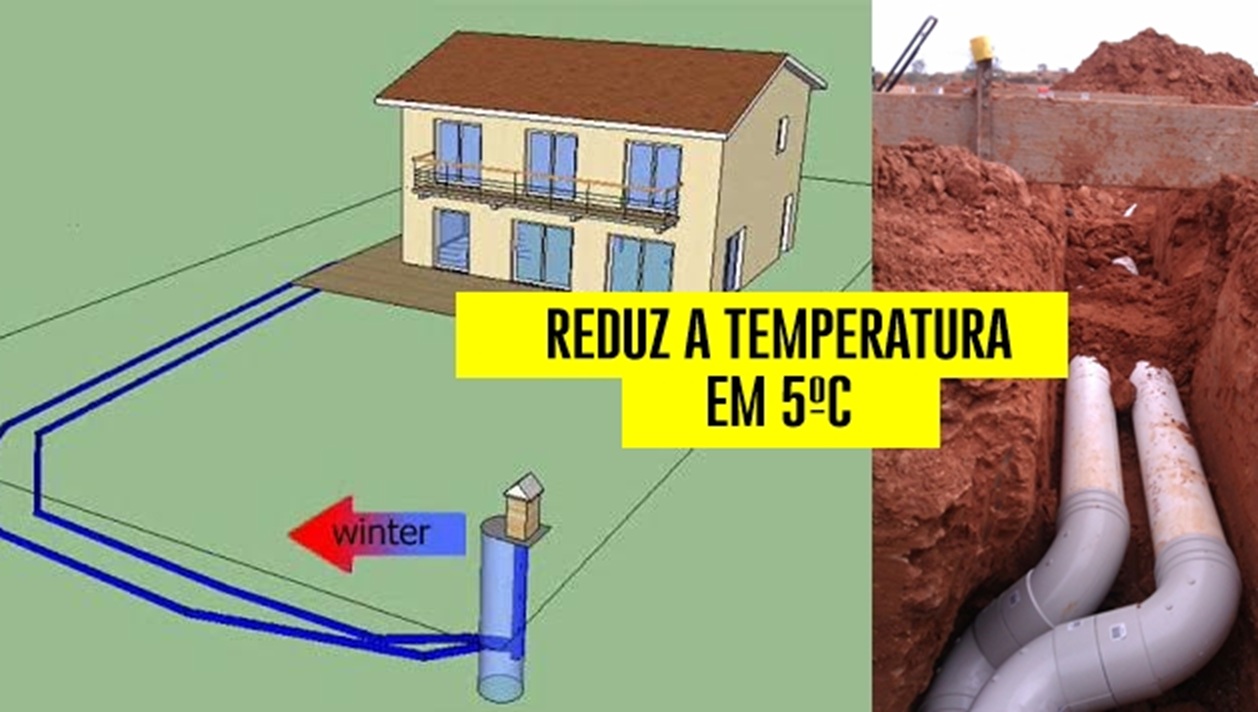
With Cheap Materials And An Ancient Technique, It Is Possible To Reduce The Temperature Of Your House Sustainably And Economically. Discover This Amazing Secret For Hot Days.
The ground and air heat exchangers, also known as “Earth Tubes“, which many refer to as an ancient air conditioner, are a passive technology for heating and cooling that uses the relatively constant temperature of the ground to efficiently and sustainably climatize environments.
This solution has been gaining more attention in Brazil due to the growing demand for sustainable practices and the need to reduce energy consumption in buildings.
In this article, we explore the history of the technology, how it works, its benefits and challenges, as well as studies conducted in Brazil that highlight its potential.
-
Motorola launched the Signature with a gold seal from DxOMark, tying with the iPhone 17 Pro in camera performance, Snapdragon 8 Gen 5 that surpassed 3 million in benchmarks, and a zoom that impresses even at night.

-
Satellites reveal beneath the Sahara a giant river buried for thousands of kilometers: study shows that the largest hot desert on the planet was once traversed by a river system comparable to the largest on Earth.

-
Scientists have captured something never seen in space: newly born stars are creating gigantic rings of light a thousand times larger than the distance between the Earth and the Sun, and this changes everything we knew about stellar birth.

-
Geologists find traces of a continent that disappeared 155 million years ago after separating from Australia and reveal that it did not sink, but broke into fragments scattered across Southeast Asia.

History Of Ground-Air Heat Exchangers
According to the Energy Efficiency Laboratory in Buildings (LABEEE) at the Federal University of Santa Catarina, the use of the ground as a thermal regulator is not a recent idea.
Ancient civilizations, such as the Persians, used underground tunnels to cool buildings during scorching summers.
In Europe, during the Middle Ages, underground ventilation systems were created to control the temperature of wine cellars.
With technological advancements, the concept evolved into more sophisticated thermal exchange systems between air and ground, being widely adopted in countries with extreme climates, such as Germany, France, and the United States.
In Brazil, the implementation of these systems is more recent, but it is gaining prominence as architects and engineers seek solutions that combine thermal comfort and energy efficiency.

Studies conducted by universities and research institutions reveal the potential for application in various regions of the country.
The need for more sustainable construction drives this technology as a viable alternative for commercial and residential buildings.
How Ground-Air Heat Exchangers Work
The operating principle of ground-air heat exchangers is based on utilizing the ground’s temperature, which remains relatively constant throughout the year, around 20°C to 25°C in Brazil, depending on depth and geographical region.
The system consists of tubes buried at a depth between 1.5 and 3 meters, where the thermal variation of the environment is significantly reduced.
The outside air is conducted through these tubes, exchanging heat with the ground. In summer, the warm air is cooled before entering the building; in winter, the cold air is heated.
This process results in a reduced need for conventional air conditioning systems, generating energy savings and promoting a more comfortable indoor environment.

Main Components Of The System
Piping: It can be made from materials such as PVC, concrete, or metal, depending on the desired durability and cost.
Air Intake: Generally positioned in elevated locations to avoid contamination by dust and moisture.
Air Outlet: Distributed throughout the internal environments of the building.
Drainage System: Essential to prevent moisture accumulation and to mitigate mold and bacteria.
Fans: Assist in air circulation if there is insufficient natural ventilation.
Air Filters: Can be added to ensure better indoor air quality by removing unwanted particles.


Studies And Applicability In Brazil
The application of ground-air heat exchangers in Brazil has been the subject of research in various regions of the country. Studies conducted by the Federal University of Santa Catarina (UFSC) have shown that the technique can be particularly effective in regions with a wide thermal amplitude, such as Brasília and Porto Alegre.
A study conducted in the city of Alexânia, Goiás, measured the soil temperature at different depths (0.5 m, 1.0 m, 1.5 m, 2.0 m, and 2.5 m).
The results indicated that the ideal depth for installing the tubes would be between 1.5 m and 2.0 m, where the temperature remains more stable throughout the year.
Another study conducted in Florianópolis evaluated the performance of an experimental system installed in a residence.
The results showed that the system was capable of reducing the indoor temperature by up to 5ºC during summer months, providing greater thermal comfort without the need for air conditioning.
Additionally, researchers have evaluated the impact of ground-air heat exchangers on the energy efficiency of commercial buildings, demonstrating that the technology can significantly reduce cooling costs in medium and large buildings.
Challenges And Considerations To Reduce Temperature In Brazil
Despite the advantages, the implementation of ground-air heat exchangers in Brazil faces challenges, such as:
Hot And Humid Climate: In regions such as the Northeast, high humidity can limit the system’s effectiveness, requiring complementary dehumidification solutions.
Initial Cost: The installation of underground tubes may have a high initial cost, despite long-term savings.
Maintenance: Preventing mold and bacteria in the tubes requires periodic maintenance to ensure air quality.
Lack Of Technical Knowledge: Many construction professionals are still unaware of the best practices for the proper installation and maintenance of these systems.
Advantages And Benefits Of Natural Air Conditioning That Reduces Temperature
Even with challenges, the benefits of ground-air heat exchangers are significant:
- Sustainability: Reduction of energy consumption and carbon emissions.
- Thermal Comfort: Improvement in air quality and internal temperature.
- Low Maintenance: When properly designed, the systems require little intervention.
- Financial Savings: Reduction in operational costs related to the use of conventional air conditioning systems.
- Energy Resilience: Greater independence from non-renewable energy sources.
Ground-air heat exchangers represent an effective and sustainable solution for thermal control in buildings in Brazil.
Although the technology is still relatively underexplored in the country, its potential for application is promising, especially in regions with dry climates and significant thermal variation.
With more in-depth studies, investments in awareness, and government support, these systems can become a viable and widely used alternative in sustainable constructions in Brazil.








-

-

-

-

-

43 pessoas reagiram a isso.