





 Portuguese
  English
  Spanish
  3 min of reading
  0 comments


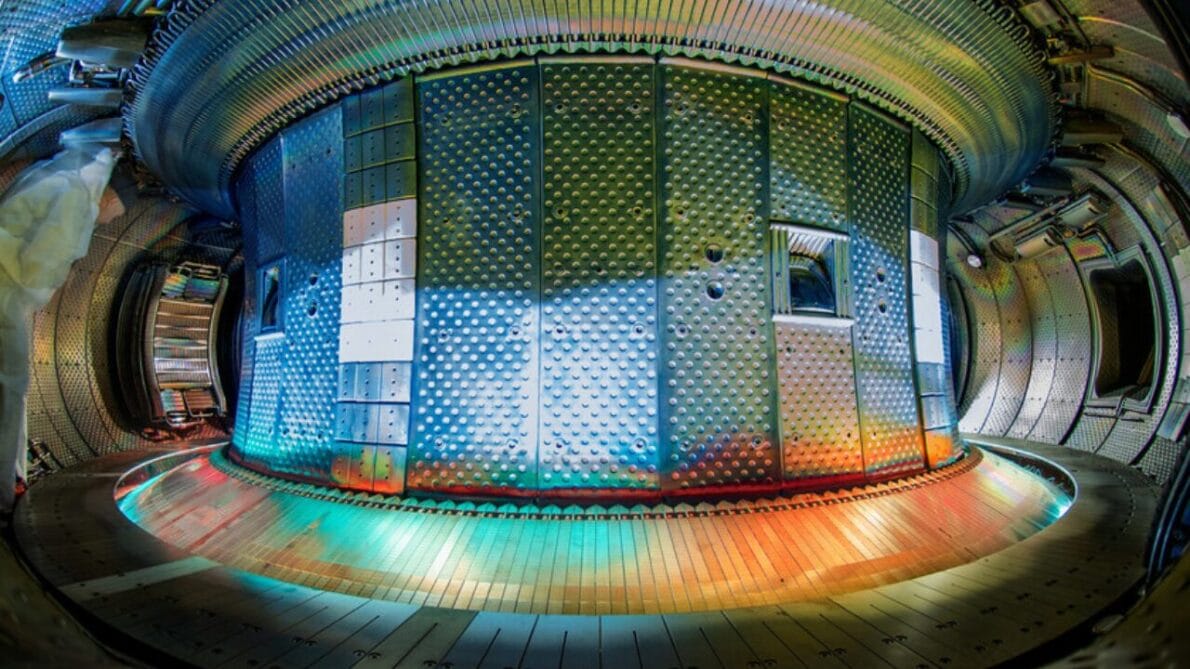
Discover The Records And Advances In Nuclear Energy With The ITER And WEST. Learn How These Experiments Are Shaping The Future Of Nuclear Fusion And Revolutionizing Science
When fully assembled and the first tests with plasma begin, the ITER (International Thermonuclear Experimental Reactor) will be the largest and most advanced experimental nuclear energy reactor on Earth. It is being constructed in Cadarache, a small locality in southern France, by an international consortium led by Europe, which also includes, among other countries, the USA, Russia, China, India, and South Korea.
This extremely complex machine has attracted all attention for more than a decade, but it is by no means the only experimental fusion reactor worth watching. In fact, a few kilometers from the site where the ITER is being built, there is another experimental fusion reactor called WEST (‘W’ Environment in Steady-state Tokamak). This machine is the true star of this article. An interesting fact: the ‘W’ in its name comes from the symbol used to identify one of the chemical elements used in its construction, tungsten.
The Milestone Of WEST Opens The Way For The ITER
The role of the WEST fusion reactor within the international nuclear fusion program is essentially the same as that of the JET (Joint European Torus) reactor, housed in Oxford (England), or the JT-60SA from Naka (Japan): to test and validate some of the technologies that will be used in the ITER. In short, these smaller experimental reactors aim to pave the way for the ITER, which will be a much larger, more complex, and ambitious machine.
-
Fukushima Marks A Turning Point In Japan’s Energy Policy: After The Disaster, The Country Shut Down Its 54 Nuclear Reactors And, 15 Years Later, Only A Small Portion Have Returned To Operation
-
How Japan Overcame The Nuclear Bomb And Now Houses Millions In Hiroshima, While Ukraine Lost Chernobyl?

-
Bill Gates Receives Historic Approval to Build Giant 345 MW Nuclear Plant in the U.S. and Promises to Generate Up to 500 MW of Energy with Innovative Technology

-
India Opens Nuclear Energy to Private Capital to Accelerate Projects and Attract Billions, While Brazil Remains Stalled at Angra 3 and Discusses Who Will Foot the Bill for Completion

WEST is housed in a research complex belonging to the French Institute for Atomic Energy (known as CEA by its French name), although during the experiment we are going to explore, it was operated by American scientists from the Plasma Physics Laboratory at Princeton University in New Jersey (USA). What these researchers achieved using this French tokamak is indeed a record: they maintained plasma at a temperature of 50 million degrees Celsius for no less than six minutes and four seconds.

It may seem like a short time, but it is not. It is indeed significant. In fact, as we anticipated in the title of this article, it is a record in the field of fusion energy. This is due to the fact that, for now, it is not easy at all to stabilize the plasma and minimize energy losses that prevent sustaining the fusion reaction over time. In nuclear fusion experimental reactors, scientists confine charged hydrogen nuclei using a magnetic field.
What happens is that, no matter how powerful this field is, it always has a limit of intensity, and the particles, when produced, acquire very varied energies. Some have a lot of energy, while others, however, acquire little energy. Reactor engineers are able to contain the average energy, but those particles that exceed this energy value have the capacity to escape the magnetic field. The problem is that if too many particles escape, a lot of energy is lost, and the fusion reaction cannot be sustained over time.
Fortunately, this challenge can be solved by modulating the magnetic fields and increasing the size of the plasma. This is why each experimental reactor is larger than the previous one. Another very important data derived from this experiment consists of the fact that, to initiate the reaction, the technicians injected 1.15 gigajoules of energy into the tokamak, and it delivered 15% more as a result of the fusion of hydrogen nuclei. The start of plasma tests at the ITER is getting closer every day, and this result excites us to rub our hands together. If all goes well, this promising reactor will break one record after another.
Image | CEA
More Information | Le Monde






Seja o primeiro a reagir!