





 Portuguese
  English
  Spanish
  4 min of reading
  5 comments


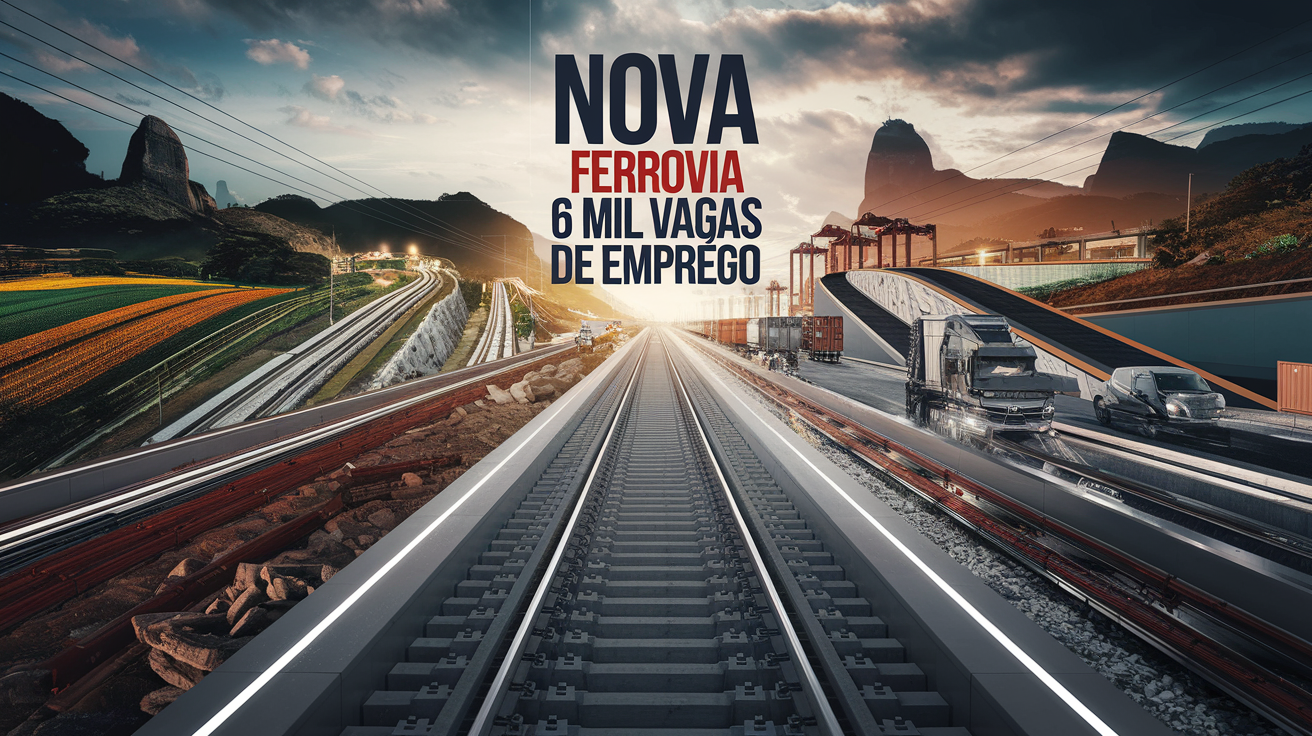


A Railway That Will Revolutionize Brazil! The Central-East Corridor Will Connect Regions, Create Thousands of Jobs, and Move 28 Million Tons of Cargo Per Year. Discover How This Mega-Structure Will Change the Future of Brazilian Transportation!
Can you imagine an infrastructure project capable of connecting strategic regions of Brazil, generating thousands of jobs, and still revolutionizing national logistics?
Well, that’s exactly what is about to happen in a Brazilian state, with the construction of a colossal railway that promises to significantly impact the country.
The numbers are impressive, and the economic impact is huge, but the details of this ambitious project go far beyond.
-
A new Brazilian shopping center worth R$ 400 million will be built in an area equivalent to more than 4 football fields, featuring 90 stores, 5 cinemas, a supermarket, a college, and parking for 1,700 cars, potentially generating 3,000 jobs.

-
Larger than entire cities in Brazil: BYD is building a 4.6 km² complex in Bahia with a capacity for 600,000 vehicles per year, but the discovery of 163 workers in conditions analogous to slavery has shaken the entire project.

-
With an investment of R$ 612 million, a capacity to process 1.2 million liters of milk per day, Piracanjuba inaugurates a mega cheese factory that increases national production, reduces dependence on imports, and repositions Brazil on the global dairy map.

-
Brazilian city gains industrial hub for 85 companies that is equivalent to 55 football fields.


As presented in a public hearing held at the Anchieta Palace in Espírito Santo, the Central-East Corridor is one of the most ambitious projects underway in Brazil.
With construction scheduled to start in 2026, the plan is to create a railway network of 2,160 kilometers, connecting northern Espírito Santo to the Midwest region.
The project, led by the Petrocity group, will not only facilitate cargo transport but also generate about 6,000 direct jobs during construction, with peaks that could reach 20,000 vacancies in certain phases.
The Dimension of the Project
The Central-East Corridor includes four sections of railway already authorized by the federal government, with two of these routes receiving a Declaration of Public Utility (DUP), allowing for the necessary expropriations for its implementation.
According to Petrocity, the planned lines are:
- EF 456/030: Connects São Mateus (ES) to Ipatinga (MG) – 431.3 km.
- EF 030: Links Barra de São Francisco (ES) to Brasília (DF) – 1,188 km.
- EF A20: Railway between Corumbá de Goiás and Anápolis (GO) – 67.9 km.
- EF 355: Railway from Brasília (DF) to Mara Rosa (GO) – 452 km.
The railways will play a crucial role in integrating productive regions, connecting logistics centers and ports, such as Petrocity’s future port in Urussuquara, São Mateus (ES).
The total investment is R$ 28 billion, of which R$ 23.5 billion will be allocated to railway works and the remainder to the port.
Job Creation and Economic Impact
According to José Roberto Barbosa da Silva, president of the Petrocity group, the construction of the railways will require the hiring of about 6,000 workers directly, in addition to another 2,000 indirectly.
During the peak of construction, job vacancies can reach 20,000, distributed among the four railway sections.
In operation, scheduled to begin in 2031, the project would employ 1,787 professionals directly, including roles such as train drivers, maintenance technicians, and operators in control centers.
The expectation is that the railway will move 28 million tons of cargo in the first year of operation.
State-of-the-Art Infrastructure and Sustainability
In addition to the tracks, the project includes the implementation of 11 dry ports along the railway, with two located in Espírito Santo: one in São Mateus and another in Barra de São Francisco.
These terminals will allow for the transshipment of goods and facilitate the transport of agromineral products.
The dry ports will act as logistics hubs, enabling not only the shipment of cargo to the Urussuquara port but also the transportation between regions served by the railway.
This is expected to improve internal logistics in Brazil, providing an efficient alternative to existing bottlenecks in road transport.
Challenges and Political Support
During the public hearing, Governor Renato Casagrande emphasized that the project is essential for integrating Espírito Santo with other regions of the country.
“Everything that depends on the government will be done to make this initiative viable,” he stated. Meanwhile, Vice Governor Ricardo Ferraço described the railway as strategic not only for the state but for all of Brazil, highlighting its contribution to solving the national logistics bottleneck.
However, Senator Zequinha Marinho pointed out a hurdle: the delay in environmental authorizations, conducted by the Brazilian Institute of the Environment (Ibama).
According to him, there are currently 108 requests for authorization for railways in the country, but only 45 have been approved.
A Vision for the Future
The construction of the railways also aims to integrate the national railway network. This means that the new lines will not operate in isolation, but will connect with existing railways, allowing for more efficient cargo transport.
The expectation is to create a link between the Midwest and the ports of Espírito Santo, consolidating the state as a logistics hub.
With completion expected in 2031, both the railway and the port should operate together, providing an integrated solution for the transport of goods.
This is especially relevant for agribusiness and mining, sectors that rely on efficient infrastructure to maintain competitiveness.
The Financing Issue
To make the project viable, Petrocity has signed memoranda of understanding with two investment funds and is seeking tax incentives that could reduce the total cost by up to R$ 8 billion.
The search for financial partners reflects the complexity and magnitude of the initiative, which also faces the challenge of ensuring returns for investors.
Question to the Reader
With so many challenges and promises, do you believe the Central-East Corridor will fulfill its role in transforming cargo transport in Brazil and generating jobs? Or could bureaucratic hurdles delay this dream? Share your opinion!





É concorrente da FIOL, que já está em construção e conecta o portdo de Ilhéus (BA) com Figueirópolis em Goiás? Se pretendem a mesma coisa só variando na latitude, creio que não tem futuro
No final o governo federal é buquê banca esse projeto,porque a matéria não fala no governo federal?
O PRINCIPAL MEIO DE TRANSPORTE DE UM PAÍS É HIDROVIAS, (ESTRADA PRONTA) O SEGUNDO FERROVIA; DE PREFERÊNCIA SEGUINDO ÀS ÁGUAS, O TERCEIRO RODOVIA COM: CALÇADAS, CICLOVIAS, PISTAS PARA CAVALGADAS, TÚNEIS PARA PASSAGEM DE ANIMAIS, OS TÚNEIS SERVIRÃO TAMBÉM PARA PEDESTRES E CAVALEIROS, O PRINCIPAL MEIO DE DESENVOLVIMENTO DE UM PAÍS É: EDUCAÇÃO (APRENDE EM CASA) CONHECIMENTO NAS ESCOLAS, SABEDORIA COM O DONO DA SABEDORIA !!!! NOSSO BOM DEUS (CRIADOR) ECLESIASTES capitulo 12 verciculo 13 amém 🙌🙌🙌🙌🙌🙌🙌