





 Português
  Inglês
  Espanhol
  4 min de leitura
  0 comentários



Ox Horn Campus of Huawei Blends European Architecture with Cutting-Edge Technology in a Mega Space for 20,000 Employees, China Surprises.
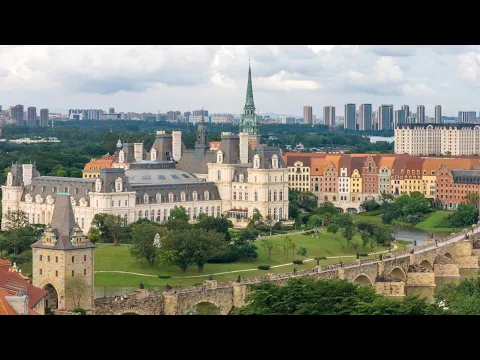
China has always been masterful at surprising the world, but what Huawei has done in Guangdong has taken this to a new level. Imagine a place where you can walk through Paris, pass by Oxford, and even take a peek at Granada, all without leaving the same space. Seems crazy, right? But it’s real. Huawei’s Ox Horn Campus is a true “mini Europe,” covering an impressive 120 hectares and housing 20,000 employees. But don’t worry, this is not an amusement park; it’s a mega-office complex that combines European charm with Chinese efficiency.
Huawei and Its European City in China
If you think Huawei is just another tech company, you need to know about the Ox Horn Campus. Opened in 2019, this complex is almost a city, with 12 neighborhoods, each inspired by a European city or region. The idea? To create a work environment that not only impresses but also provides quality of life and a touch of European culture for its employees.

The campus cost 40 billion yuan, about 5.1 billion euros. That’s right, Huawei spared no expense in making this project grandiose, comparable even to Apple’s famous “spaceship” in Cupertino. And if you’re wondering how employees get around this gigantic place, the answer is simple: electric trains. Three lines (A, B, and C) run through the campus, ensuring that everyone can move easily between the neighborhoods.
-
A megaproject worth R$ 89 billion is advancing in Iraq and promises to change the game in global trade by creating a new corridor between Asia and Europe, reducing traditional routes and repositioning the country as a logistics powerhouse.

-
Goodbye bedside table: floating shelves become a trend in 2026 by freeing up space in the bedroom, improving circulation, bringing visual lightness, and integrating technology without taking up floor space.

-
Israel, Greece, and Cyprus signed an agreement in 2020 to transport gas from the Mediterranean to Europe via a 1,872 km pipeline, but Turkey claimed sovereignty over part of the maritime route, and the project never materialized.

-
Israel, Greece, and Cyprus signed an agreement in 2020 to transport gas from the Mediterranean to Europe via a 1,872 km pipeline, but Turkey claimed sovereignty over part of the maritime route, and the project never materialized.


Thematic Neighborhoods: A Slice of Europe in China
Shall we take a tour of the campus? Each of the 12 neighborhoods is based on a city or region in Europe. Paris, for instance, not only has administrative buildings in classic French style but also a replica of the Cité Internationale Universitaire. In Oxford, besides the typical English buildings, you will find a version of Big Ben. And if you are a fan of German architecture, the Heidelberg neighborhood will charm you with its replica of the famous castle.
But it’s not just buildings that make up Huawei’s campus. They also heavily invested in green areas, planting various European species and creating an environment that truly feels imported from the Old Continent. For employees who prefer a more active lifestyle, there is a bike-sharing system that facilitates movement between neighborhoods.
A City to Work, Live, and Get Inspired
In addition to all the impressive architecture, Huawei made it a point to think of every detail to ensure that its employees have a unique work experience. In the neighborhood inspired by Granada, for example, most of the restaurants offer cuisine from different parts of the world, a clear strategy to attract international talent. If you’ve been to Granada, you’ll easily recognize some corners of Albaicín and even a life-size replica of the Palacio de Carlos V from the Alhambra.
And the campus goes even further: you can find gyms, recreation areas, cafeterias, and coffee shops spread throughout all the neighborhoods. Not to mention that Huawei did not overlook the care of local wildlife, bringing in some animals to populate the green areas of the campus.
China and Its Obsession with Western Replicas
China has a curious history of replicating Western cities and monuments. Thames Town, a copy of an English town, and Tianducheng, a mini Paris with its own Eiffel Tower, are just a few examples. But the Ox Horn Campus of Huawei elevates this trend to a whole new level by integrating these references into a center of technological innovation.
On the other hand, this passion for replicas may be coming to an end. President Xi Jinping, who has a critical view of this type of architecture, has promoted laws that limit “strange architecture” inspired by the West. This means that projects like the Ox Horn Campus may become rarer, but they remain impressive landmarks in the Chinese landscape.
The Future of Architecture in China

With these new regulations, the question remains: will China continue to draw inspiration from Western cities? What we know is that Huawei’s campus has already become one of the largest and most impressive technological centers in the world, combining tradition, innovation, and a touch of Western extravagance. And even if other replicas do not appear as frequently in the future, the legacy left by the Ox Horn Campus will continue to impress and inspire all who visit.
In the end, China managed to create a unique European experience without leaving Guangdong, once again showing that when it comes to innovation and grandeur, they are always ready to surprise.









Seja o primeiro a reagir!