





 Portuguese
  English
  Spanish
  4 min of reading
  3 comments


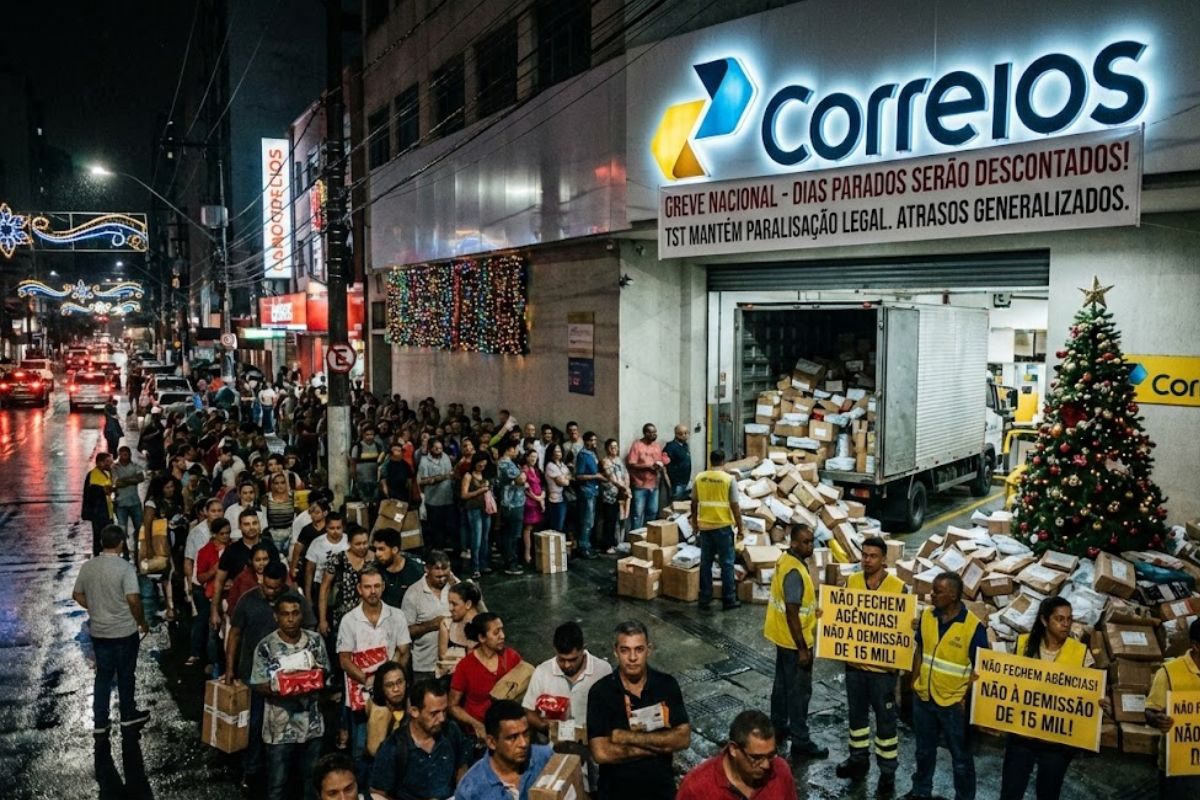


In a Ruling This Tuesday, 30, the TST Maintained the Postal Workers’ Strike as Legal, Authorized the Deduction of Days Not Worked, and Required 80 Percent of the Staff While Delays in Deliveries, Billion-Dollar Debts, Closure of a Thousand Agencies, and Dismissal of Fifteen Thousand Employees Expose the Crisis Throughout the Country.
The Postal Service reached the peak of its crisis this Tuesday, 30, when the Superior Labor Court decided that the strike of employees is not abusive, but authorized the state-owned company to deduct the days not worked, following a negotiation round that ended without an agreement last Friday between the company and labor federations.
Following this deadlock, the president of the TST had already reiterated, on Thursday, a previous decision that requires the maintenance of at least 80 percent of the staff per agency, under the threat of a daily fine of R$ 100 thousand against the entities representing the employees, while the directors of the Postal Service presented, this Monday, a restructuring plan anchored in a loan of R$ 12 billion.
TST Decision: Legal Strike, But with Salary Cuts
In the ruling this Tuesday, 30, the judges of the TST defined two central points: the Postal Service’s strike is not abusive, meaning it was considered legitimate within the rules of labor legislation, but the days not worked may be deducted from the salaries of employees who participated in the strike.
-
A new Brazilian shopping center worth R$ 400 million will be built in an area equivalent to more than 4 football fields, featuring 90 stores, 5 cinemas, a supermarket, a college, and parking for 1,700 cars, potentially generating 3,000 jobs.

-
Larger than entire cities in Brazil: BYD is building a 4.6 km² complex in Bahia with a capacity for 600,000 vehicles per year, but the discovery of 163 workers in conditions analogous to slavery has shaken the entire project.

-
With an investment of R$ 612 million, a capacity to process 1.2 million liters of milk per day, Piracanjuba inaugurates a mega cheese factory that increases national production, reduces dependence on imports, and repositions Brazil on the global dairy map.

-
Brazilian city gains industrial hub for 85 companies that is equivalent to 55 football fields.


This decision maintains the pressure from workers on the company by recognizing the legality of the movement, but at the same time, reserves the right for the Postal Service’s management to apply salary cuts, which is likely to increase tension in the forthcoming rounds of negotiation.
The labor federations, in turn, continue to seek salary adjustments and better working conditions amidst the ongoing strike.
Requirement for 80% of the Staff and Threat of Daily Fines
Even before the collegiate ruling, the president of the TST had reinforced, on Thursday, a previous order requiring the presence of at least 80 percent of the staff in each agency of the Postal Service during the strike.
Non-compliance with this order results in a daily fine of R$ 100 thousand against the federations representing the category.
In practice, this directive aims to balance the right to strike with the need to maintain a minimum level of service, especially during a sensitive period such as the end of the year.
The challenge is to keep the service running without completely undermining the strike’s leverage.
Delayed Deliveries on the Eve of Christmas
The strike in strategic locations such as Rio de Janeiro, São Paulo, and Belo Horizonte has exacerbated delivery delays just before Christmas, when the volume of packages increases significantly across the country.
According to the state-owned company itself, the on-time delivery rate had already been declining throughout the year, pressured by debts with suppliers, which hindered investments in operations and logistics.
With the strike, the situation worsened: there was a rush for services from private carriers, while many consumers were left without essential packages or year-end gifts.
This scenario reinforces the perception that the crisis of the Postal Service is not limited to the labor conflict, but directly affects the services provided to the population and commerce during one of the most critical periods of the calendar.
Financial Crisis, Debt, and a R$ 12 Billion Loan
The operational situation is worsened by the financial crisis faced by the Postal Service. To attempt to reorganize its finances, the board of the state-owned company secured a R$ 12 billion loan, opening up space for a restructuring plan to be presented this Monday.
This plan appears as a response to the context of indebtedness and loss of efficiency, but also deepens concerns about the company’s future and the impact on thousands of workers amid the strike that pressures collective bargaining.
The combination of high indebtedness and pressure for cost-cutting is currently the cornerstone of the state-owned company’s strategy.
Closure of a Thousand Agencies and Dismissal of Up to 15 Thousand Employees
The restructuring plan presented by the Postal Service plans for the closure of a thousand unprofitable agencies, equivalent to about 20 percent of the company’s total units.
In addition, there is a voluntary dismissal plan on the table that may affect up to 15 thousand employees.
In practice, this projects a smaller, leaner company focused on points considered profitable, jeopardizing service in areas where postal service is often the only state presence.
For the workers, the combination of strike, potential salary deductions, and the possibility of layoffs creates a strong sense of uncertainty about their professional future.
While the management seeks to convince the market and the government that the restructuring is necessary to recover financial health, unions warn of the risk of loss of service quality and deterioration of working conditions amid a strike that has already shown a direct impact on the daily lives of millions of Brazilians.
And you, do you think that the Postal Service strike is the only way to pressure for change or is it going beyond limits for those who depend on deliveries in their daily lives?










Vendam logo essa bomba chamada de Correios e demitam todos.
Uma vergonha e falta de respeito com nós que pagamos pelas despesas não recebi ainda minha encomenda que está no centro de distribuição de São Paulo, já paguei todas as taxas ,existe sim outros meios para eles,nós não deveríamos ser prejudicado por isso.
Uma pouca vergonha, este problema é dos correios com a presidência, deixei de entregar presentes estou aguardando eles que repassem para às transportadores ,não temos nada à ver com isso afinal de contas pagamos o que pediram pelo valor de sedex etc.zE ninguém faz nada