





 English
  Francês
  Alemão
  Italiano
  Japonês
  Norueguês
  Portuguese
  Spanish
  5 min of reading
  0 comments


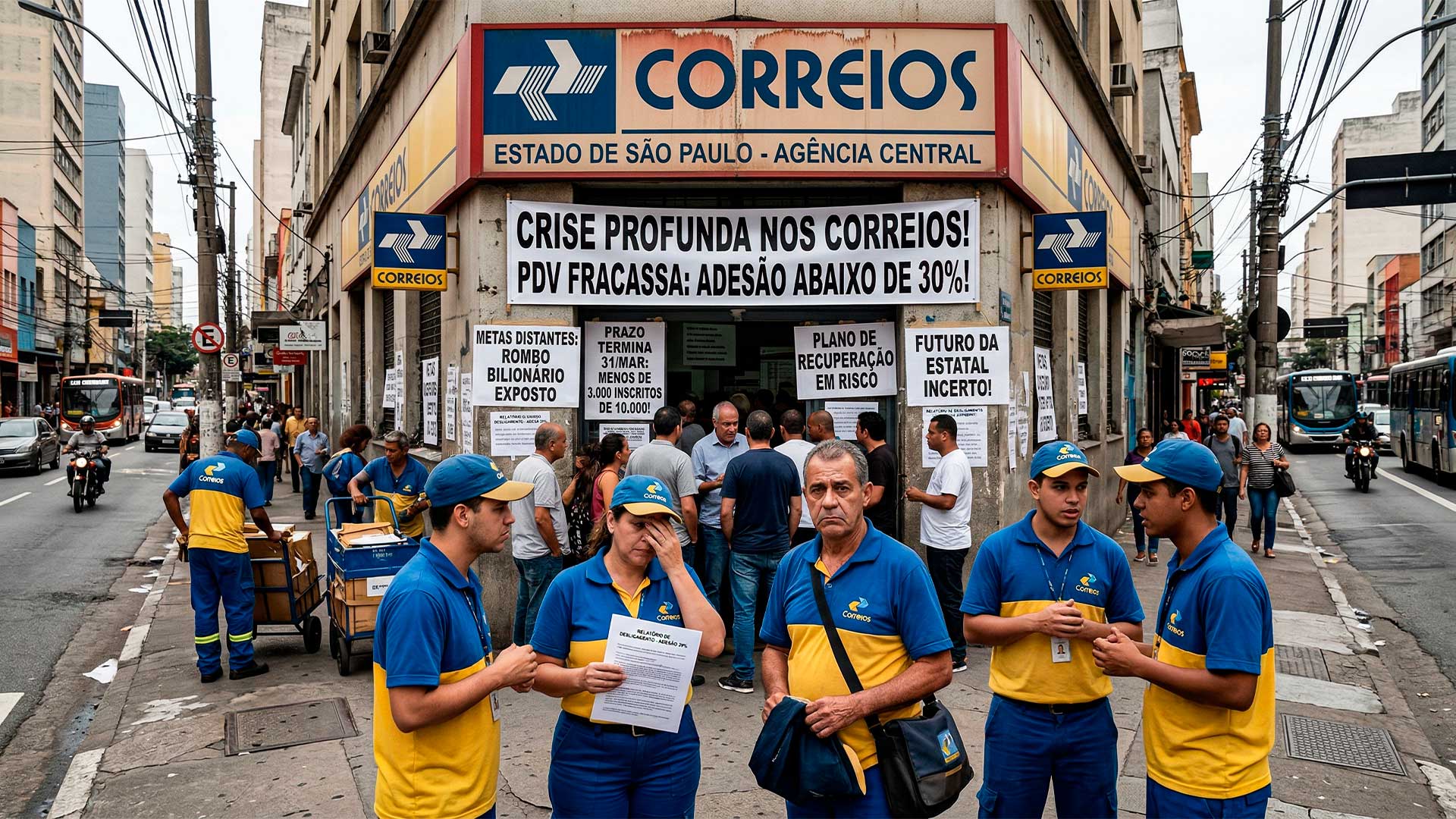
With a deadline until March 31 and an ambitious layoff target in 2026, the program advances slowly, exposing the difficulty of cutting costs quickly and increasing pressure on a recovery plan surrounded by increasingly worrying numbers
The Postal Service has entered the final stretch of its Voluntary Dismissal Program with a difficult problem to hide. Participation remains below 30% of the target expected for 2026, according to a report published by VEJA, which points to fewer than 3,000 sign-ups against the expectation of 10,000 layoffs still this year. The same report states that the deadline ends on March 31, 2026 and that, internally, the trend is not to extend it.
This data is relevant because the VDP is not an isolated measure. It was relaunched by the Postal Service at the end of January as one of the main fronts of the state-owned company’s financial restructuring plan, with sign-ups open until March 31 and layoffs expected by the end of May, according to the company’s official statement. In institutional discourse, the measure aims to reduce expenses and help rebalance the company’s financial health.
In practice, however, the slow progress of the program raises doubts about the company’s ability to convert the promise of savings into concrete results. The low participation has been attributed by VEJA, among other factors, to the compensation ceiling of 600,000 reais, which may have reduced the appeal of the plan for some employees. When a VDP is born as a central piece of restructuring and fails to gain traction near the final deadline, the signal to the market and the government itself is one of fragility.
-
Expansion of Federal Institutes: 38 new campuses and R$ 200 million for public education; see the cities included.

-
Lula’s government changes rule in important benefit and thousands of Brazilians will no longer receive it; see what has changed.

-
New Gripen fighter makes Argentines surrender to Brazil, and the heavy reaction exposes envy, frustration, and shock at Brazil’s technological leap.

-
This discovered deposit near the Andes could change the future of Argentina, attract billions, and even shake up the global metals market.


This new chapter in the crisis of the Postal Service gains weight because it emerges amid a financial deterioration that has been accelerating. The state-owned company projects a loss of 9.1 billion reais in 2026, following estimated losses of 5.8 billion reais in 2025, according to estimates from the board released by the press in February. At the same time, the company itself reported in December that it carries a structural deficit exceeding 4 billion reais per year and a negative net worth of 10.4 billion reais.
The VDP has become a real test to see if the restructuring of the Postal Service gets off the ground
The restructuring plan presented by the Postal Service foresees a combination of cuts, asset sales, operational reorganization, and new sources of revenue. In an official statement from December, the state-owned company reported that the reopening of the VDP in 2026 would have potential participation of up to 15,000 employees between 2026 and 2027, with estimated annual savings of 2.1 billion reais when the impact is fully reflected.
Additionally, the Postal Service also announced sale of properties with a potential of 1.5 billion reais, reduction of up to 1,000 deficit service points, and review of expenses such as health plans, within an agenda aimed at reducing spending and recovering liquidity. On another front, the company raised 12 billion reais at the end of 2025 to strengthen its cash flow and support the first phase of the plan.
The problem is that much of this engineering depends on rapid execution and sufficient employee participation in the VDP. Without this, what was presented as structural relief tends to become merely temporary breathing space. The growing reading behind the scenes is simple: the loan buys time but does not alone resolve a cost structure that remains heavy.
The crisis of the Postal Service did not start now, but the partial failure of the VDP aggravates the sense of stalemate
According to Agência Brasil, the management of the Postal Service attributes part of the crisis to the transformation of the postal market, with the digitalization of communications reducing traditional letter revenue and with tougher competition in e-commerce. This diagnosis helps explain why the state-owned company talks about remodeling the business, modernizing logistics, and diversifying revenues.
At the same time, the expense structure limits the speed of reaction. Reports published at the end of 2025 based on the presentation of the restructuring plan indicated that about 90% of the Postal Service’s expenses are fixed and that the payroll accounts for 62% of this total, a percentage that rises even more when labor claims are included. In a company with this structure, any attempt at adjustment inevitably goes through the employee count.
That is precisely why weak participation in the VDP carries more weight than just the simple number of sign-ups. It suggests that the state-owned company may have underestimated internal resistance to the program or overestimated the attractiveness of the proposal. It also shows that cutting costs in a public company with national reach and universalization commitments is much more complex than announcing targets at a press conference.
The company itself maintains that universalization has a high cost and remains an unnegotiable strategic and social commitment. In November 2025, the Postal Service stated that executing the plan could reduce the deficit in 2026 and bring the state-owned company back to profitability in 2027. However, with the VDP stalling precisely at the phase where it should show strength, this promise is now viewed with more caution.
What is at stake now is more than a layoff program
In the coming days, last-minute participation may still boost the VDP numbers, as some sectors of management hope. Even so, the current scenario already indicates that the state-owned company will hardly be able to celebrate the program as an unequivocal success, especially since the difference between the reported number of sign-ups and the projected target for 2026 is still significant.
If the anticipated savings do not materialize at the expected pace, the restructuring plan loses one of its most visible bases. This increases pressure on other measures, such as asset monetization, closure of deficit units, review of benefits, and pursuit of new revenues. In other words, the partial failure of the VDP does not alone undermine the Postal Service’s plan, but it can make its execution slower, more expensive, and politically more exhausting.
The case also reignites an old discussion about the future of the Postal Service. For some, the company needs time and investment to adapt to a radically different market. For others, recent numbers show that the state-owned company has already entered a phase where emergency measures are no longer sufficient to reverse the crisis.
If the VDP closes far from the target, the question will no longer be just how much the Postal Service can save. The question becomes another, how much time can the company still gain without facing deeper changes. And this is the kind of debate that tends to divide opinions, within the state-owned company, in the government, and among Brazilians who depend on the service.
With information from Veja.
Does the crisis of the Postal Service still have a solution, or has the VDP already shown that the plan started smaller than the problem? Leave your comment and say whether the state-owned company needs more time to reorganize or if it is already time for a much tougher change.









Seja o primeiro a reagir!