





 Portuguese
  English
  Spanish
  4 min of reading
  0 comments


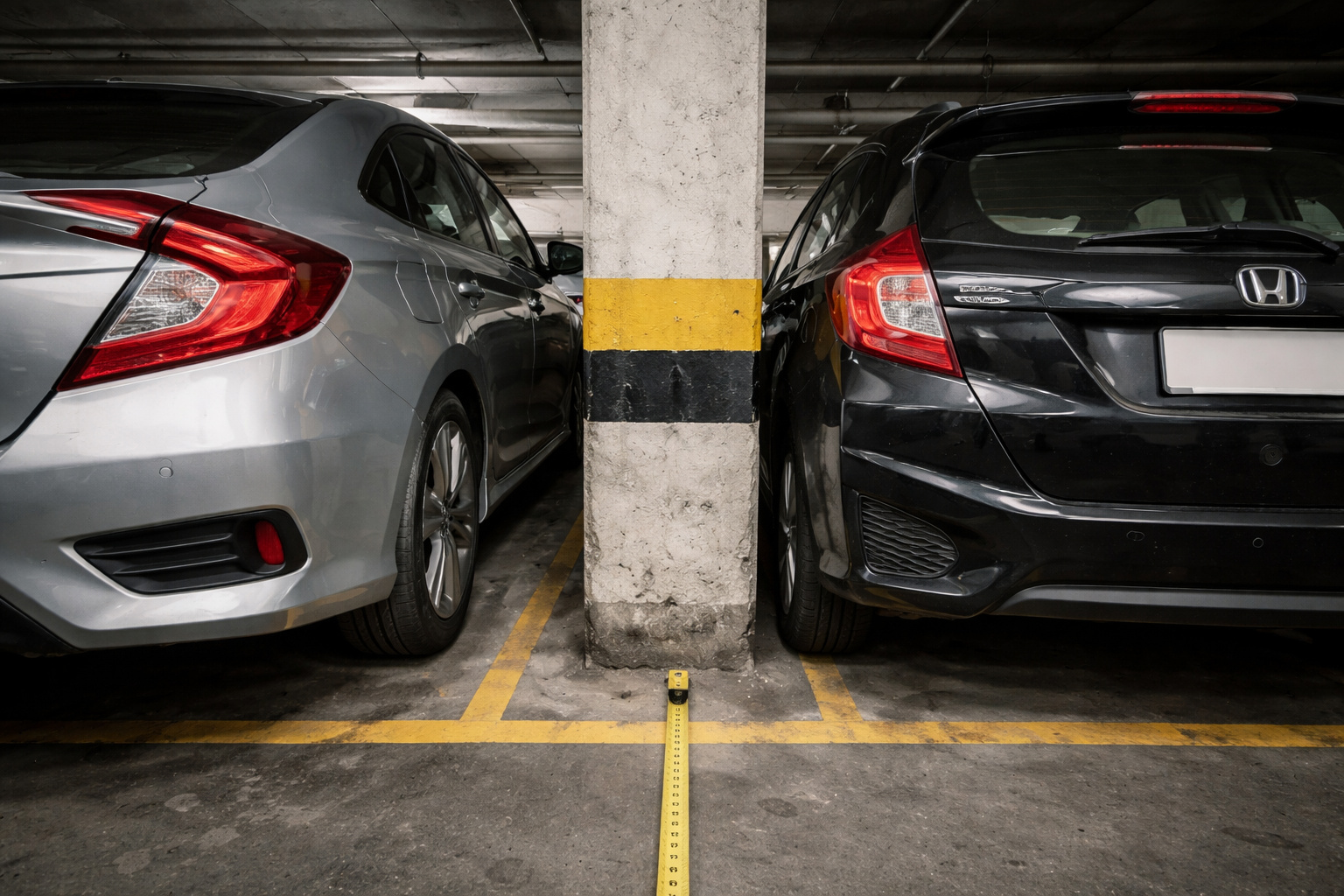
Irregularity in Parking Space Dimensions Led the Court of Justice of Mato Grosso to Uphold the Conviction and Mandate Compensation for Moral and Material Damages to the Buyer
A court decision involving a condominium in Cuiabá attracted attention after the Court of Justice of Mato Grosso upheld the conviction of two construction companies responsible for delivering parking spaces with dimensions lower than permitted by municipal legislation.
The buyer of the property sued after discovering that the parking spaces did not meet the minimum standard required by local law, compromising the appropriate use of the garage.
According to the case reviewed by the TJMT, the parking spaces had a width smaller than that required by municipal regulations, a fact later confirmed by technical expertise conducted during the proceedings.
As a result, the court understood that there was a failure in the delivery of the property and recognized that the situation caused direct harm to the consumer.
Irregularity in Parking Space Dimensions
The municipal legislation establishes that parking spaces in condominiums must have a minimum width of 2.50 meters.
However, in the property acquired by the consumer in Cuiabá, the two delivered spaces were smaller than the prescribed standard.
As pointed out in the expert report produced during the legal process, the spaces measured only 2.28 meters and 2.30 meters in width.
This seemingly small difference ended up causing concrete difficulties in the daily use of the owner’s parking spaces.
Thus, the technical expertise confirmed that the spaces were outside the standards required by applicable urban regulations.
Garage Structure Complicated Maneuvering
In addition to the reduced dimensions, the technical analysis identified another structural problem that aggravated the situation.
In one of the spaces, a support column occupied almost half of the total length of the area.
Consequently, the presence of this obstacle further compromised parking maneuvers.
Thus, even when the vehicle physically fit in the space, the practical use of the area became difficult.
The court considered that this condition significantly reduced the functionality of the garage delivered with the property.
-
The noise law will no longer be in effect at 10 PM starting in June with a new rule valid during the 2026 World Cup.

-
The Chamber opens a debate on driver’s licenses at 16 years old as part of a reform that includes around 270 proposals to change the Brazilian Traffic Code and may redesign rules for licensing, enforcement, and circulation in the country.

-
The new Civil Code could revolutionize marriages in Brazil with “express divorce” and changes that could exclude spouses from inheritance.

-
Banco do Brasil sues famous influencer for million-dollar debt and intensifies debate on delinquency, risks of seizure, and direct impact on Gkay’s credibility.

Arguments Presented by the Construction Companies
During the proceedings, the construction companies argued that the Civil Code allows a tolerance margin of up to 5% on property area and dimension measurements.
Furthermore, the defense pointed out that the owner was using the garage to park vehicles such as Honda Civic and Honda Fit.
According to the companies, the Honda Civic is approximately 1.80 meters wide, depending on the model generation.
The Honda Fit has a width of around 1.70 meters.
Thus, from the perspective of the construction companies, it would be possible to use the parking spaces, even with the smaller measurements.
Court Applies the Consumer Defense Code
Despite the arguments presented, the reporting judge, Desembargadora Marilsen Andrade Addario, rejected the companies’ thesis.
According to the magistrate, the relationship between the buyer and the construction company must be analyzed in light of the Consumer Defense Code.
Thus, the court understood that the possibility of parking the vehicle, even with difficulty, does not eliminate the defect existing in the product.
The ruling emphasizes that the consumer has the right to fully enjoy the acquired asset, respecting the applicable technical and urban regulations.
Thus, the existence of the parking space does not mean it is suitable for the required standard.
Depreciation of the Property and Compensation Recognized
Upon analyzing the set of evidence, the Court of Justice of Mato Grosso concluded that the inadequacy of the parking spaces causes direct depreciation of the property.
For this reason, the court recognized the existence of material damage to the buyer of the apartment.
The amount of financial compensation will be defined later during the sentence liquidation phase.
Additionally, the court ordered the payment of compensation for moral damages in the amount of R$ 10,000.
According to the decision, the amount was considered proportional to the troubles faced by the resident.
Practical Impacts on the Owner
During the legal proceedings, it was demonstrated that the owner had to change vehicles to be able to use the garage of the condominium.
This factor was considered by the court as a relevant element to characterize the damage suffered.
The decision also highlighted that the limitation of space directly interferes with the normal use of the acquired property.
Thus, even if the problem is restricted to the garage, the impact reaches the value and functionality of the apartment as a whole.
Final Decision of the Court of Justice of Mato Grosso
Based on these elements, the Court of Justice of Mato Grosso upheld the conviction of the construction companies responsible for the development.
The appeal presented by the companies was rejected by the state court.
Moreover, the attorney’s fees were increased to 15% of the total amount of the conviction.
The decision reinforces the understanding that properties must be delivered in accordance with the applicable technical and urban standards.
To what extent can small structural differences in a development affect the value and functionality of a property over time?










Seja o primeiro a reagir!