





 Portuguese
  English
  Spanish
  5 min of reading
  0 comments


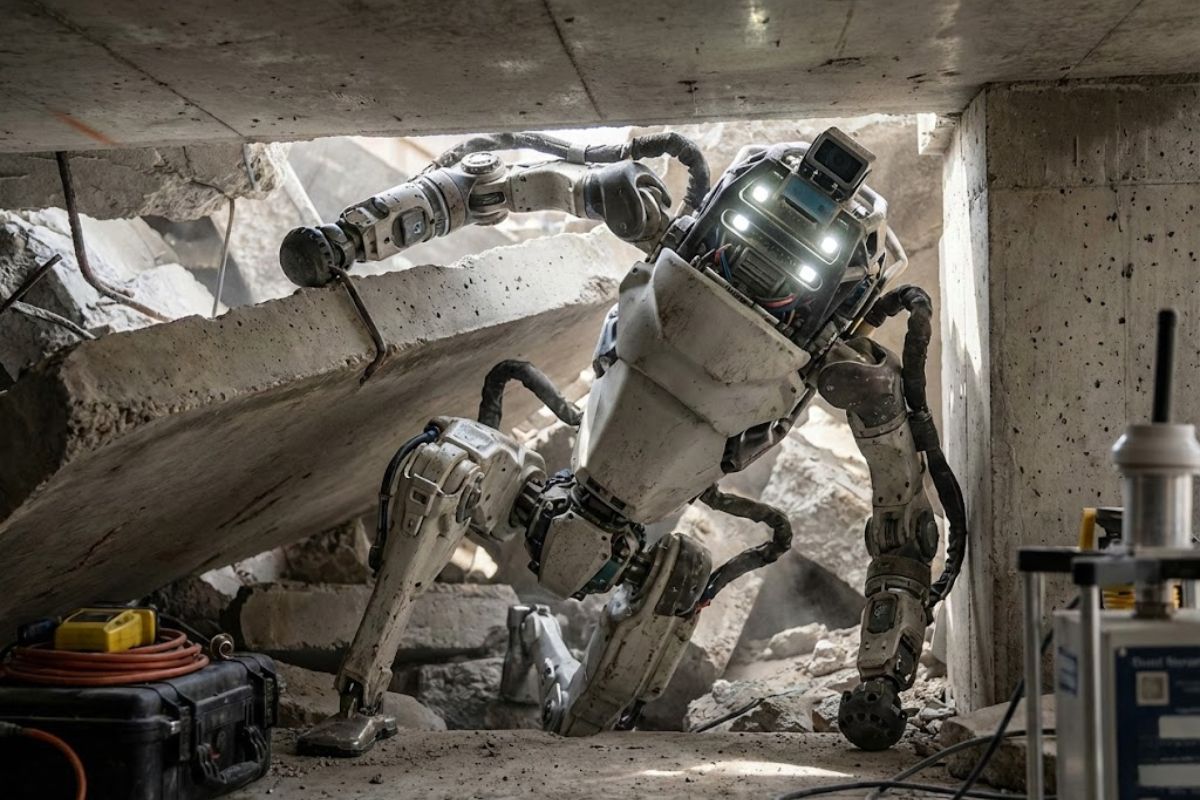
Presented at CES 2026, the Atlas robot from Boston Dynamics swaps hydraulics for 100% electric architecture, combining autonomy with teleoperation and targeting rescue operations in collapsed areas, where 360° mobility, 50 kg lifting force, 2.3 m reach, and environmental resistance reduce human exposure to risk in critical scenarios.
The robot Atlas 2026 places robotics at a new turning point: leaving controlled environments and entering unstable areas with debris, low visibility, and the risk of secondary collapse. The central proposition is simple yet tough: to preserve the lives of victims without sacrificing the lives of rescuers.
By combining a structure of 1.88 m, 90 kg, and 56 degrees of freedom, the platform is designed to execute movements that a human body cannot replicate under extreme pressure. More than just attracting attention with its humanoid shape, the Atlas is designed to answer a practical emergency question: who goes in first when no one can enter safely?
The Technical Leap That Separates the Atlas 2026 from Previous Versions

The most profound change is in the architecture: the Atlas has abandoned the hydraulic system and transitioned to a 100% electric setup, a decision that alters maintenance, fine control, and operational stability. Instead of being just an incremental upgrade, the 2026 design repositions the machine for critical tasks in the field, with mechanical predictability and greater precision of movement.
-
Motorola launched the Signature with a gold seal from DxOMark, tying with the iPhone 17 Pro in camera performance, Snapdragon 8 Gen 5 that surpassed 3 million in benchmarks, and a zoom that impresses even at night.

-
Satellites reveal beneath the Sahara a giant river buried for thousands of kilometers: study shows that the largest hot desert on the planet was once traversed by a river system comparable to the largest on Earth.

-
Scientists have captured something never seen in space: newly born stars are creating gigantic rings of light a thousand times larger than the distance between the Earth and the Sun, and this changes everything we knew about stellar birth.

-
Geologists find traces of a continent that disappeared 155 million years ago after separating from Australia and reveal that it did not sink, but broke into fragments scattered across Southeast Asia.
With 56 degrees of freedom, many capable of 360° rotation, the robot can adjust its torso, arms, and neck to reach difficult spots without having to move large debris blocks.
This range is not an aesthetic detail; it is a survival feature, as it reduces the need for abrupt maneuvers in already compromised structures and minimizes the risk of additional collapse during searches.
How Rescue Operations Change When the Risk is Removed from the Rescuer
The Atlas operates in three layers of command: autonomous mode, teleoperation, and tablet control. In rescue situations, this combination allows for switching between automatic execution of repetitive tasks and direct human intervention when the scene necessitates fine judgment.
In practice, the operator maintains strategic decision-making while the robot assumes physical exposure.
With motion capture gear or virtual reality, a professional can “wear” the robot in real-time and reproduce movements with high fidelity without entering the focus of biological, thermal, or structural danger.
This design addresses the “where” and “why” of use: locations of collapse, fires, and contamination, where every minute counts, and every human step can lead to a new accident.
Specifications That Transform Mobility into Real Salvage Capability
In objective numbers, the Atlas can already work with a load of 50 kg, a reach of 2.3 m, and operation in temperatures from −20 °C to 40 °C. It also withstands water and industrial washing, something essential for scenarios with toxic dust, chemical sludge, or contaminating waste.
The environmental robustness prevents the equipment from being taken out of operation precisely when it is most needed.
Another decisive point is operational autonomy: double batteries replaceable by the robot itself, with up to 4 continuous hours without direct human intervention.
The human-scale hands, equipped with tactile sensors in the fingers and palms, enhance the ability to manipulate existing tools in the teams.
And with the Orbit platform, learning can be shared among units: when one Atlas learns a task, the entire fleet accelerates its performance curve.
Atlas and Optimus: Technical Comparison Without Bias
The comparison with Optimus from Tesla has gained traction because both projects target real uses but start from different priorities.
The Atlas emphasizes strength, range, and operational resilience; the Optimus, based on estimated data presented, appears to have a greater focus on fine dexterity and potential for broad industrial scaling. It’s not “which is better,” but rather “better for which mission”.
In disaster response scenarios, the numbers favor the Atlas in the current proposal: more degrees of freedom, higher load capacity, and explicit environmental resistance. However, in the cost and mass adoption debate, the outcome tends to depend on production, software, and integration with business routines. The correct technique is market complementarity, not automatic substitution between platforms.
Objective comparison (initial phase):

- Atlas (Boston Dynamics): 56 degrees of freedom, 50 kg load, 4h autonomy with replaceable battery, focusing on 360° mobility and water resistance, starting price above US$ 100,000.
- Optimus (Tesla): around 40 degrees of freedom (estimated), around 20 kg load (estimated), undisclosed autonomy, focusing on fine tactile sensitivity, estimated range of US$ 80,000 to US$ 120,000.
From Factory to Disaster: At What Stage Is This Application Really At


The declared strategy by Hyundai, the parent company of Boston Dynamics, envisions production of 30,000 units per year by 2028.
The immediate use focuses on the automotive industry, where repetitive processes and structured environments facilitate standardization, training, and operational return. This shows that the path to large-scale rescue first passes through industrial maturation.
At the same time, the architecture already comes with a vocation for civil defense and extreme scenarios. The announced integration with models from the Gemini Robotics Foundation of Google DeepMind points to increased decision-making autonomy in unprecedented environments.
The technical objective is to allow the robot to enter a collapsed building, map routes, maintain communication, and assist in the removal of victims with less improvisation in the field.
What Changes for Human Work When the Machine Enters the Risk Zone
The main change is not to eliminate people, but to reallocate skills. Rescuers, engineers, and operators move to act with more tactical supervision, scenario reading, and priority decision-making, while the robot performs the physically riskier part. The human value rises at the decision-making level, rather than disappearing from the operation.
Still, there are concrete challenges: specialized training, command protocols, interoperability with emergency teams, and clear criteria for switching between autonomy and manual control.
Without this arrangement, technology becomes a demonstration; with it, it becomes a public safety tool. The critical point is operational governance: who authorizes, who supervises, and to what extent can the machine decide on its own.
The Atlas 2026 leaves an objective message for applied robotics: the relevant advance is not just in moving 56 joints or lifting 50 kg, but in making viable an emergency response where the human body cannot be the first line of exposure. When the robot enters first, the rescuer gains time, information, and a margin for life.
Considering your context, which scenario in your city would benefit the most from a rescue robot: collapse, industrial fire, or flooding with contamination? And to what extent do you consider acceptable the machine’s autonomy before demanding total human control over each movement?








-

-

-

5 pessoas reagiram a isso.