





 Portuguese
  English
  Spanish
  3 min of reading
  0 comments


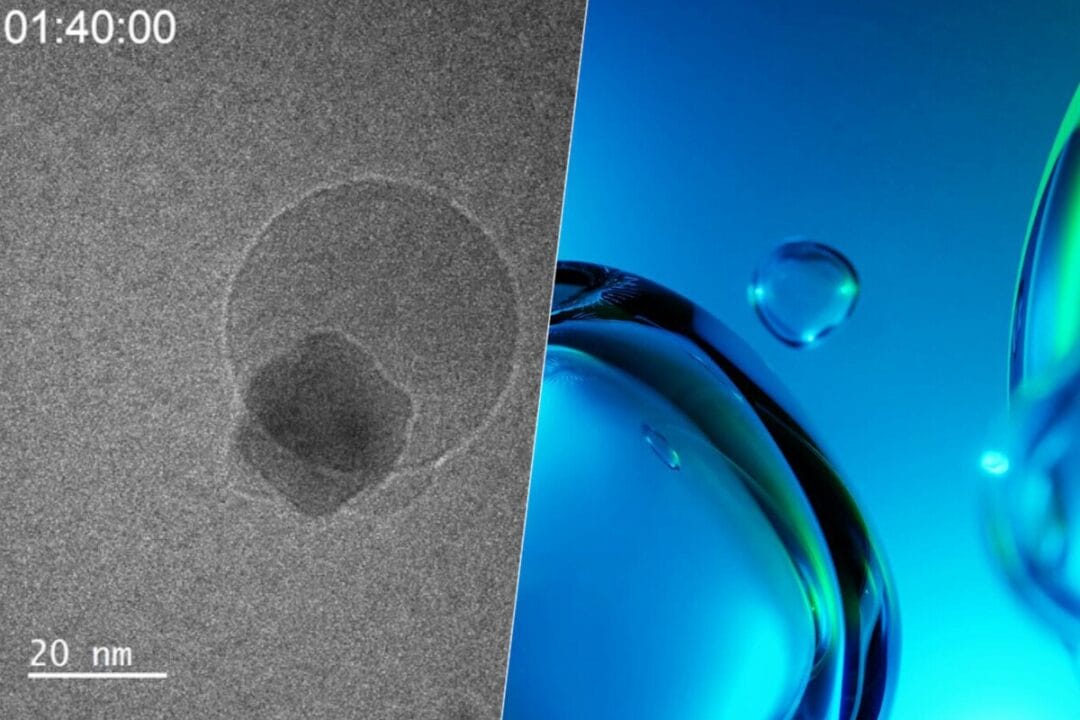
Scientists Register for the First Time, in Real Time, the Formation of Water Molecules from Atoms, Revealing Unprecedented Details of a Chemical Reaction Fundamental to Life
A group of researchers from Northwestern University achieved an unprecedented feat: observing, in real time, the formation of water molecules from the union of oxygen atoms and hydrogen. The registration was made with a resolution of 0.102 nanometers, marking an important advance in scientific research on the chemical process of creating H2O.
Experiment with High Precision
The goal of the experiment was to understand the role of palladium as a catalyst in the reaction that generates water molecules. The challenge was significant: combining direct observation of the reaction with detailed analysis at the atomic scale. This combination had never been successfully performed until now.
To achieve the result, the scientists developed an ultra-thin crystalline membrane. This structure housed the gases in a series of hexagonal nanoreactors, resembling a honeycomb.
-
Motorola launched the Signature with a gold seal from DxOMark, tying with the iPhone 17 Pro in camera performance, Snapdragon 8 Gen 5 that surpassed 3 million in benchmarks, and a zoom that impresses even at night.

-
Satellites reveal beneath the Sahara a giant river buried for thousands of kilometers: study shows that the largest hot desert on the planet was once traversed by a river system comparable to the largest on Earth.

-
Scientists have captured something never seen in space: newly born stars are creating gigantic rings of light a thousand times larger than the distance between the Earth and the Sun, and this changes everything we knew about stellar birth.

-
Geologists find traces of a continent that disappeared 155 million years ago after separating from Australia and reveal that it did not sink, but broke into fragments scattered across Southeast Asia.

It was this membrane that allowed the use of a high-vacuum transmission electron microscope, a device capable of capturing images with extremely high resolution.
Recording the Reaction in Action
During the observation, the researchers noticed hydrogen atoms entering the palladium. According to the group, this caused an expansion in the square structure of the material’s lattice. Subsequently, to their surprise, they were able to see the formation of tiny bubbles on the surface of the palladium.
These bubbles are possibly the smallest ever seen. To confirm that it was indeed water, the team used a technique called electron energy loss spectroscopy. This method identifies the energy released by the electrons during the reaction. With it, they were able to confirm that the bubbles contained water.
Create Water from Scratch: Advancement Over Previous Studies
The resolution achieved, at 0.102 nanometers, represents a significant advancement compared to previous studies, which had managed to observe similar reactions with a precision of 0.236 nanometers. This leap allowed an unprecedented visualization of the formation of the water molecule.
The data and methods of the study were published in two scientific articles. The details about the instruments and techniques used were published in the journal Science Advances. The specific observations of water formation were disclosed in the publication PNAS.
Possible Uses in the Future
Although the experiment has an academic focus, the research raises expectations in various areas. The possibility of “manufacturing” water could bring solutions for arid places, drought regions, or even space missions. In these situations, generating water locally can represent a huge benefit.
Currently, missions like those of the International Space Station already have water recycling systems. However, transporting water to more distant places, such as the Moon or Mars, represents a very high cost. Creating water directly on site could be an alternative in the future.
Last Step Observed
The study shows that the dream of creating water from scratch is no longer just a theoretical concept. The direct observation of molecule formation, even at a nanoscopic and controlled scale, is a remarkable step.
According to the researchers, the real-time visualization of this chemical reaction offers new paths for science and potential applications in the real world.
With information from Xataka.







-

Uma pessoa reagiu a isso.