





 Portuguese
  English
  Spanish
  4 min of reading
  0 comments


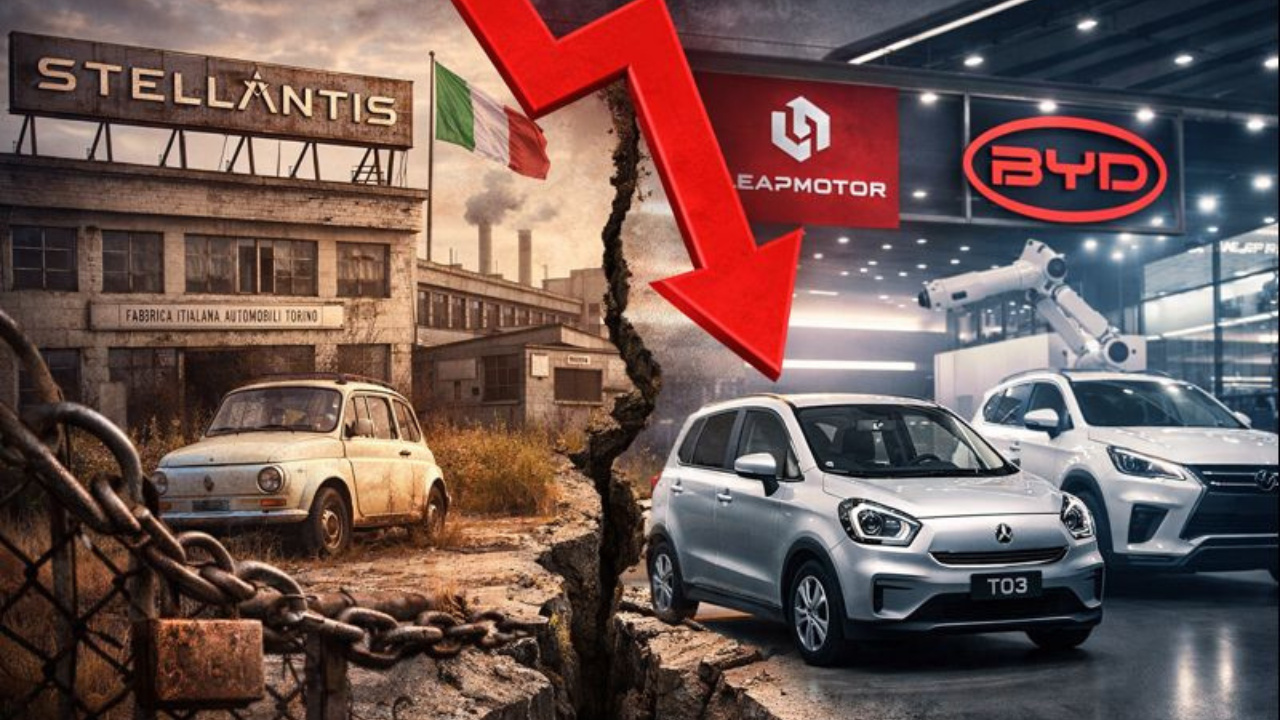
The Italian Automotive Production Falls to Its Lowest Level Since the 1950s as the Factory Faces Industrial Crisis and Chinese Advancement.
The Stellantis faces in 2025 an unprecedented industrial crisis that has pushed the Italian automotive production down to levels similar to those of the 1950s.
The 20% drop in vehicle manufacturing occurred throughout the year, affecting all of the group’s plants in the country and reigniting the debate over deindustrialization, jobs, and productive sovereignty in Italy.
The decline directly impacts historic factories of the group, involves strategic decisions made in recent years, and intensifies in light of the increasing Chinese competition in the European market.
-
Historic bankruptcy of Centauro shocks the market, and the century-old company puts more than 500,000 products, machines, and complete infrastructure up for online auction.

-
New shoe factory in Ceará is expected to create 400 jobs and strengthen the local economy.
-
No one imagined it, but a mixture of sawdust with a mineral that fights fires surprises scientists with a result that changes the course of fire-resistant construction.

-
From empty land to a high-end house, wooden construction uses a lightweight system, metal structure for the foundation, ventilated ceramic cladding, and special windows to create an efficient and comfortable living space throughout the year.

The scenario worries unions, government, and regional authorities, especially since the automotive industry has always been one of the pillars of the Italian economy.
Numbers Reveal the Size of the Industrial Crisis
Data from the FIM-CISL union show that Stellantis produced 379,706 vehicles in Italy in 2025, including 213,706 passenger cars.
For comparison, in 1955 — the peak of the former Fiat — 230,988 cars were produced, a number higher than the current performance of passenger models.
Until September, the situation was even more critical. Automobile production had accumulated a drop of 36%, and only a point recovery in the last quarter prevented a deeper collapse.
Still, the consolidated result reinforces the diagnosis of a structural industrial crisis.
Mirafiori Reacts, but Retreat Dominates Italian Automotive Production
The Mirafiori factory in Turin was the only partial exception within the Italian operation.
The unit managed to increase its production in the final months of the year with the start of manufacturing the Fiat 500 Hybrid, a model seen as an attempt to reverse the loss of competitiveness.
This change generated a 17% increase in local production, but the relief was isolated.
The 100% electric version of the Fiat 500, launched earlier, did not win over the European public, leading Stellantis to reposition its industrial strategy.
Melfi and Cassino Symbolize the Advancement of Deindustrialization
While Mirafiori was breathing, other factories deepened their decline.
In Melfi, production plummeted nearly 50% compared to the previous year, becoming one of the most emblematic cases of the ongoing deindustrialization.
The Cassino plant remained completely shut down for 105 days in 2025, raising alarms about its future.
The FIM-CISL union states that the lack of immediate strategic decisions could irreversibly compromise Stellantis’ industrial presence in these regions.
Chinese Competition Pressures Traditional Fiat Models
In addition to the internal retreat, Chinese competition has become a decisive factor in the crisis.
The Fiat Pandina, produced in Melfi, started to compete directly with the Chinese compact Leapmotor T03, which enters the European market with aggressive pricing.
Another pressure element is the arrival of a new Panda, larger and more expensive, which could cannibalize the current model.
At the same time, the offensive from Chinese brands likeBYD accelerates the loss of market share for traditional automakers on the continent.
Change of Command and Investment Promises
The new CEO of Stellantis, Antonio Filosa, took command in June and began to engage directly with the government in Rome.
The executive promised to maintain commitments to Italy, even with the group’s increasing focus on investments in the United States.
According to Filosa, in 2025, Stellantis made more than R$ 44 billion in orders with Italian suppliers and invested around R$ 12 billion in local factories.
Still, the numbers did not convince the government of Prime MinisterGiorgia Meloni, who demands more concrete actions.
Global Strategy Increases Criticism and Political Tension
Stellantis brings together 14 brands, including Fiat, Peugeot, and Opel, but a significant part of production has been transferred to lower-cost countries, like Morocco.
The strategy adopted during the tenure of former CEO Carlos Tavares fed discontent among workers and authorities while also opening space for the entry of Chinese vehicles into the group’s European portfolio.
Italian Automotive Production Under Structural Risk
At its recent peak, Italy produced more than 750,000 vehicles per year. In earlier periods, this number surpassed 1 million units annually.
Today, production has been practically halved, consolidating fears of a structural loss of the industrial base.
Under increasing pressure, Stellantis is expected to present a new strategic plan in the first half of 2026.
The challenge will be to contain the industrial crisis, curb deindustrialization, and redefine the role of Italian automotive production in an increasingly Chinese-dominated market.









Seja o primeiro a reagir!