





 Portuguese
  English
  Spanish
  3 min of reading
  0 comments


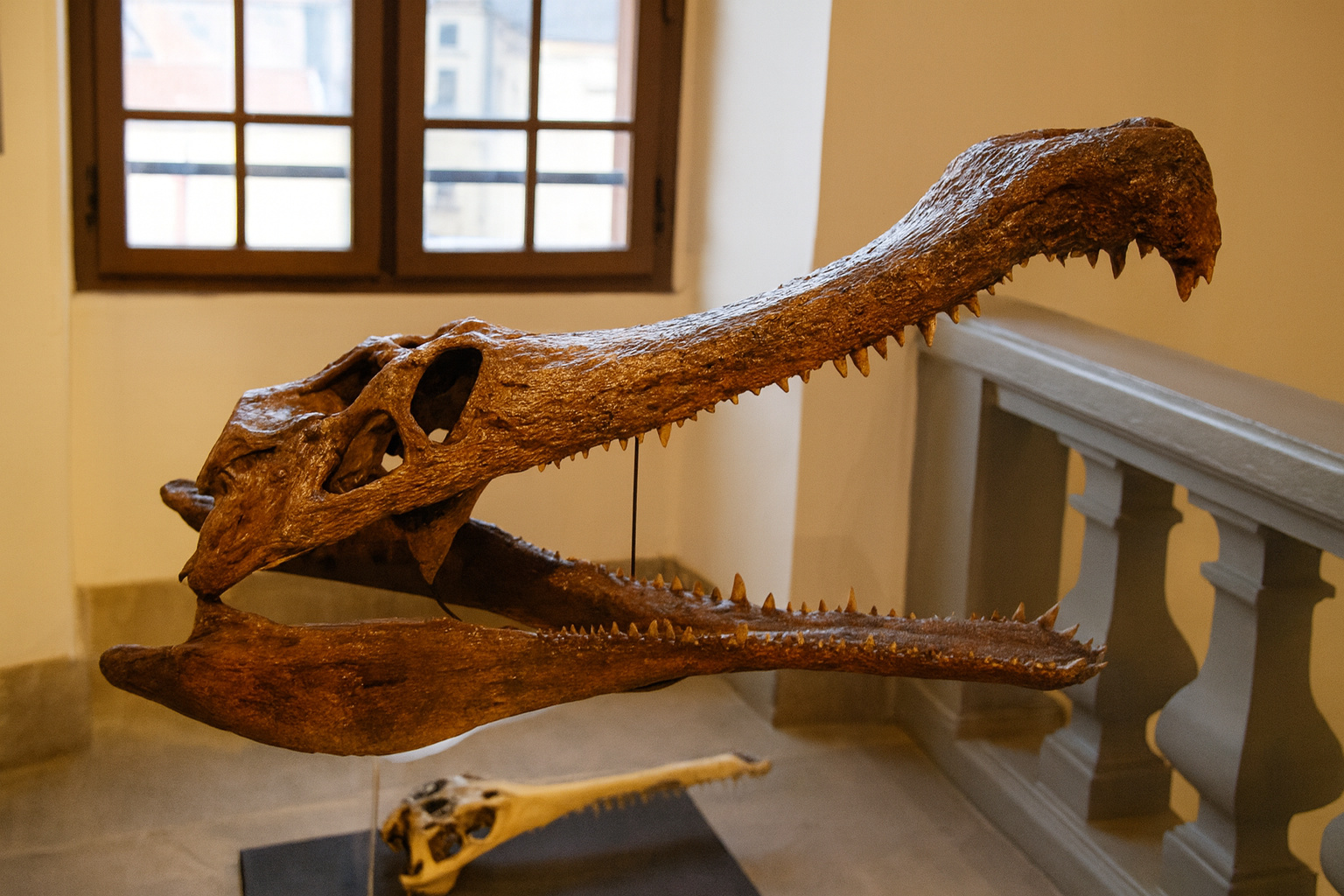
Researchers Identified One of the Oldest Marine Crocodiles Ever Found, Revealing Details About the Evolution of Reptiles
A new species of marine crocodile has been identified in Egypt, with an age of approximately 80 million years, according to researchers from Mansoura University. Furthermore, the animal inhabited the region that today corresponds to the New Valley Governorate, marking a milestone in African paleontology.
The discovery of the fossils was published in the international journal The Zoological Journal of the Linnean Society. Thus, the study reinforces Egypt’s role as a cradle of important evolutionary records and expands knowledge about ancient reptiles.
Name and Meaning
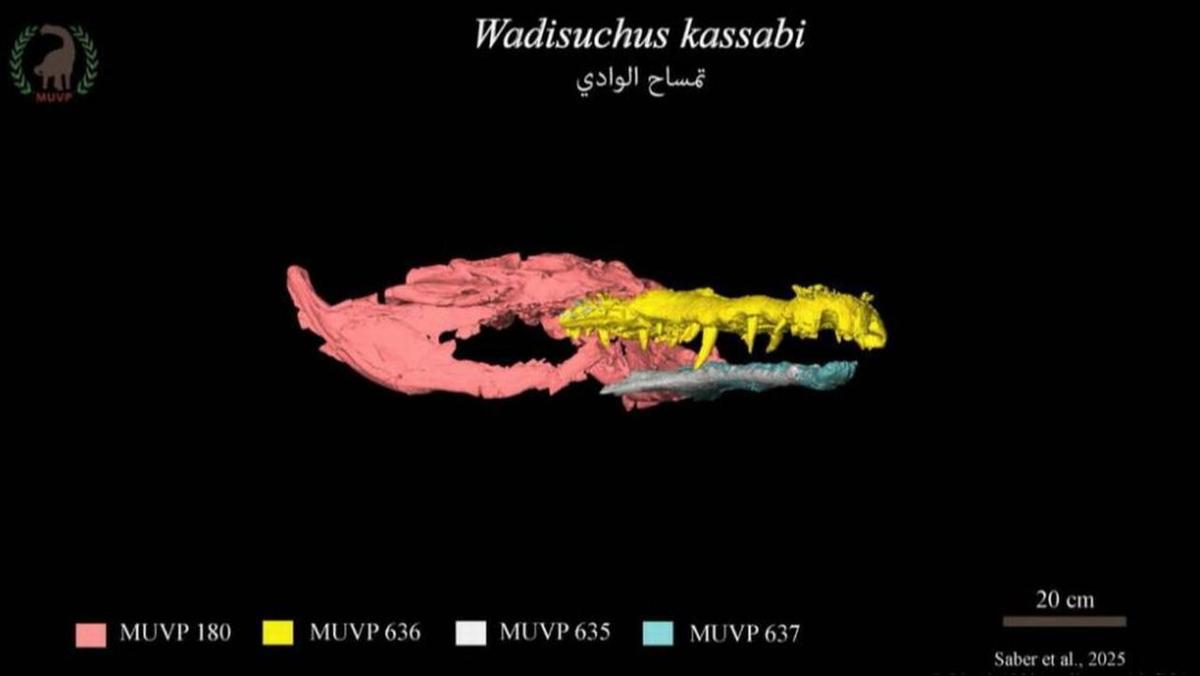
The species was named Wadisuchus kassabi, considered one of the oldest members of the Dyrosauridae family. Additionally, this group of marine crocodiles managed to survive the extinction of dinosaurs, remaining adapted to the coastal environment.
The term “Wadi” refers to the archaeological site in the New Valley, while “Sox” derives from the Egyptian god Sobek, a symbol of strength and fertility. “Kassabi” honors the geologist Ahmed Kassab, a pioneer of paleontology in Egypt. Thus, the name unites scientific tradition and Egyptian culture, strengthening the scientific identity of the country.
Habitat, Adaptation, and Morphology
Unlike modern crocodiles, the ancestral species lived in shallow coastal seas and hunted efficiently. Furthermore, the animal was perfectly adapted to the marine environment.
With a long snout and sharp teeth, it was a skilled predator that survived after the disappearance of the dinosaurs. Its length varied between 3.5 and 4 meters, and the nostrils positioned above the snout allowed it to breathe easily at the surface.
Additionally, it had four front teeth instead of five, and a deep cavity in the jaws, which distinguished it from other species in the same family.
-
A “silent skill” is allowing Brazilians to earn up to R$ 22,000 per month without a degree and become indispensable for companies that rely on millions of data to survive.

-
Researchers at the Toyota Research Institute found that if a human uses robotic arms to flip a pancake 300 times in an afternoon, the robot learns to do it on its own the next morning, and this is currently the most promising method to solve the biggest bottleneck in modern robotics.

-
Goodbye iron: a common item in households is starting to lose space to technology that smooths clothes in minutes without an ironing board and with less energy consumption.

-
Antarctica reveals an unusual clue high in the Hudson Mountains, and what appeared to be just an isolated rock began to expose a secret hidden under the ice for ages.

Collection, Samples, and Methods
The fossil remains were found in the oases of Kharga and Baris, including parts of skulls and snouts from individuals of different ages. Additionally, the research team used 3D computed tomography to study the fossils in detail.
This technique revealed unprecedented anatomical details, allowing for a better understanding of the internal structure of these marine creatures. Thus, the technological advancement provided accurate information about skull shape, dental arrangement, and the respiratory system.
As a result, the study significantly expanded knowledge about the Dyrosauridae lineage and its adaptation to marine environments.
Evolutionary Importance and Role of Africa
The discoveries brought new insights into the adaptations of marine reptiles after major extinction events. Additionally, they revealed an important link in the evolution of crocodiles.
The study indicates that the diversification of this family began in Africa earlier than previously thought. Thus, the Egyptian Western Desert played a crucial role in the origin of the Dyrosauridae.
According to Bilal Salem, a team member, the evolutionary analysis gives the discovery a global dimension. Therefore, the result reinforces the importance of the Egyptian geological heritage for world science.
Statements and Scientific Preservation
Professor Dr. Hesham Sallam, founder of the Center for Vertebrate Paleontology at Mansoura University, stated that the Egyptian desert still holds secrets about the distant past. Furthermore, he emphasized that protecting these fossils is essential, as they represent part of Egypt’s scientific and cultural identity.
The research, therefore, contributes to the understanding of reptile evolution and reinforces the need to preserve the natural heritage of the country.







-

Uma pessoa reagiu a isso.