





 Português
  Inglês
  Espanhol
  4 min de leitura
  0 comentários


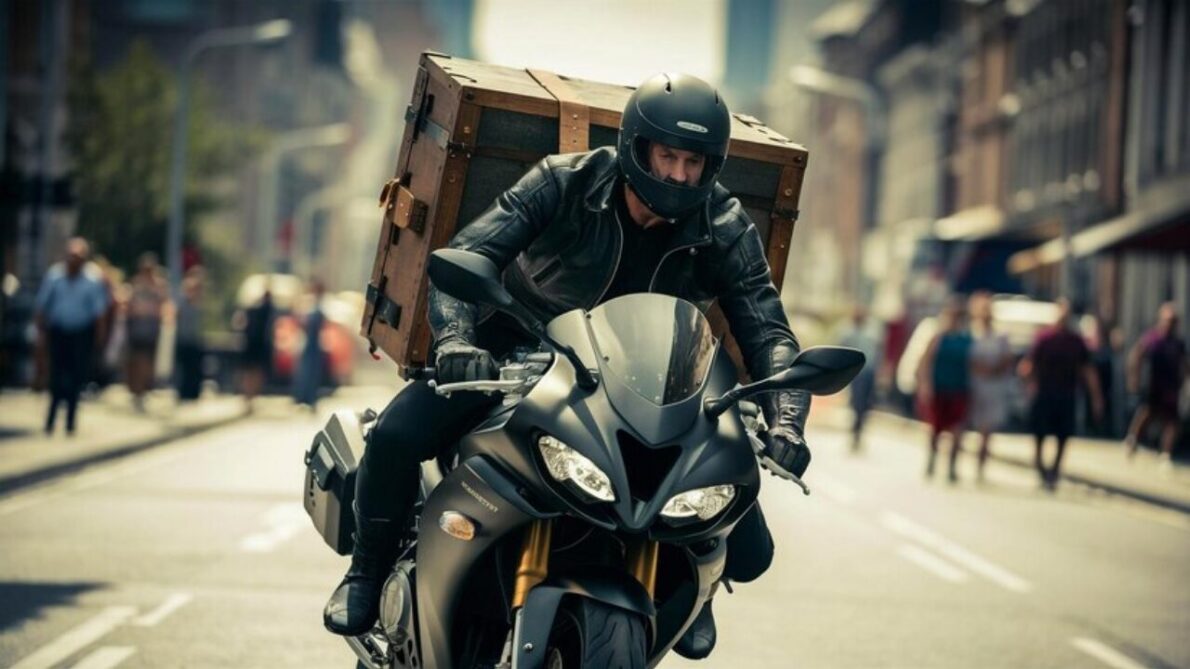
Regulation by Contran Defines Weight Limits and Dimensions for Cargo Transport on Motorcycles Aiming for Road Safety and Avoiding Possible Fines.
The transport of cargo on motorcycles is an increasingly common practice, driven by the growth of delivery services and motorcycle freight platforms. With the popularization of transportation and delivery apps, it is possible to hire these services quickly and conveniently, often via smartphone. However, the increase in demand has raised safety concerns, especially regarding the transport of cargo that exceeds the permitted limits for motorcycles. This article explores the regulations of the National Traffic Council (Contran) and highlights the importance of following these rules to avoid accidents and fines.
The Growth of Motorcycle Freight and Risks
In recent years, motorcycle freight services have expanded significantly in Brazil, mainly due to the increase in app-based rides.
With the ease of access to these services, many people have begun to use them to transport different types of cargo, often without paying attention to the established regulations.
-
OMODA & JAECOO grows in Europe in 2026 with an integrated strategy of sales, innovation, local production, and technological advancement in the United Kingdom, Italy, and Spain.

-
OMODA & JAECOO expands after-sales service in Brazil with competitive maintenance, a 7-year warranty, and high availability of parts for technological SUVs.

-
OMODA & JAECOO appoints Alessandra Souza as executive marketing director in Brazil and accelerates brand expansion with a focus on innovation, networking, and hybrid portfolio.

-
Jaecoo 7 with super hybrid SHS system exceeds 1,200 km of combined range with a 1.5 turbo engine, high-density battery, and intelligent energy management.


An example that gained traction on social media was the case of Antônio Pereira da Silva, known as “Antônio Cabeludo”, who transported a fully assembled four-door wardrobe on his motorcycle.
This type of situation, while impressive, poses a significant risk to both the motorcyclist and other road users.
The Legislation: What Does Contran Say?
The transport of cargo on motorcycles is regulated by the National Traffic Council (Contran), which has established specific guidelines to ensure safety on roads and streets.
Resolution No. 943, dated March 28, 2022, clearly defines the limits of dimensions and weight that must be respected when transporting cargo on motorcycles.
The cargo transported on motorcycles must be secured in appropriate compartments, such as trunks, racks, saddlebags, bags, or side boxes.
These securing devices can be permanent or removable, but must always ensure the safety of the cargo and the motorcyclist.
Furthermore, it is essential that the cargo does not compromise the visibility of the motorcycle’s rearview mirrors.
According to the Brazilian Traffic Code (CTB), riding a motorcycle with cargo above the permitted limit is classified as a serious infraction.
This violation can result in a fine of R$ 195.23, along with 5 points on the driver’s National Driver’s License (CNH). The motorcycle may also be seized.
Limits and Permissions for Cargo on Motorcycles
The legislation from Contran establishes precise limits for the dimensions of cargo transport devices on motorcycles.
For enclosed trunks, the maximum allowed dimensions are: a width of up to 60 cm, as long as it does not exceed the distance between the inner ends of the rearview mirrors.
The length must not exceed the rear end of the motorcycle; and a height of up to 70 cm from the central base of the trunk, measured from the motorcycle seat.
In the case of saddlebags, bags, or side boxes, the restrictions are: the width must not exceed the maximum dimensions of the motorcycle, measured from the end of the handlebars or brake levers to the clutch, as specified by the manufacturer.
The length must not exceed the rear end of the motorcycle; and the height must not be greater than the height of the motorcycle seat.
For open racks, the allowed dimensions are: a width of up to 60 cm, as long as it does not exceed the distance between the inner ends of the rearview mirrors.
The length must not exceed the rear end of the motorcycle; and the height of the cargo must not exceed 40 cm from the central base of the rack, measured from the motorcycle seat.
In addition to these restrictions, the transported cargo must never compromise the efficiency of the motorcycle’s rearview mirrors, which are essential for the safety of the motorcyclist.
Exceptions and Additional Rules for Cargo Transport
Although the rules are strict, there is an important exception for the transport of helmets on motorcycles.
According to Article 11 of Resolution No. 943, specially designed boxes for carrying helmets may extend beyond the rear end of the motorcycle by up to 15 cm.
This exception aims to ensure that helmets are transported safely and appropriately.
Another fundamental rule is the weight limit. While the legislation does not specify an exact weight value for cargo, it is mandatory for the motorcyclist to respect the maximum load limit indicated by the motorcycle manufacturer.
This limit includes not only the cargo itself but also the weight of the rider, fuel, lubricating oil, and other items that may affect the motorcycle’s performance.
Compliance with these rules is the responsibility of local traffic authorities, who must monitor the conditions of cargo transport on motorcycles.
Motorcyclists who violate the established limits may receive fines and even have their vehicle seized, depending on the severity of the infraction.
Enforcement is essential to ensure safety on the roads and prevent accidents that may be caused by the inadequate transport of cargo.
In addition to legal penalties, non-compliance with the rules can put the lives of the motorcyclist and others on the road at risk.
The transport of cargo on motorcycles is a common and necessary activity in many contexts, but it is crucial to be conducted according to the rules established by Contran, so that you do not receive a fine.
Respecting the limits of dimensions and weight, as well as using appropriate securing devices, are fundamental measures to ensure the safety of everyone on the road and avoid fines.










Seja o primeiro a reagir!