





 Portuguese
  English
  Spanish
  5 min of reading
  0 comments



Learn How to Build an Offshore Industry Resume, Focusing on Safety, Embarked Experience, and Differentiators Valued by Companies in the Maritime and Oil Sector.
The offshore industry, with its operations at sea, has played a crucial role in the global economy since the mid-20th century.
The exploration of oil and gas on offshore platforms has not only brought technological advances but also created a diverse range of job opportunities.
Thus, the need to create a specific resume tailored to this reality — the offshore industry resume — arose.
-
With Announcement for ROV Course in Partnership with Zen, Rio das Ostras Aims to Transform Technical Qualification into Real Jobs in the Competitive Offshore Market

-
Free Offshore Steward Course in São Gonçalo Emerges as a Strategic Opportunity for Those Seeking Qualified Work at Sea

-
Messer Gases Reopens Branch in Macaé to Serve Offshore Oil and Gas Market in Northern Fluminense with Supply of Oxygen, Argon, and CO₂
-
Offshore Profession Simplified: Comprehensive Guide Reveals How to Trade Common Routine for High Salaries and Long Breaks in Life Aboard in the Oil Sector

Understanding how to structure a resume geared towards this sector can be the first step for those looking to secure a position on oil platforms or specialized vessels.
In this article, we will discuss the historical context of the offshore industry, the main professional profiles sought, and, of course, how to create an effective resume for this very specific environment.
A Bit of History of the Offshore Industry
Oil exploration on land had already been occurring since the early 20th century.
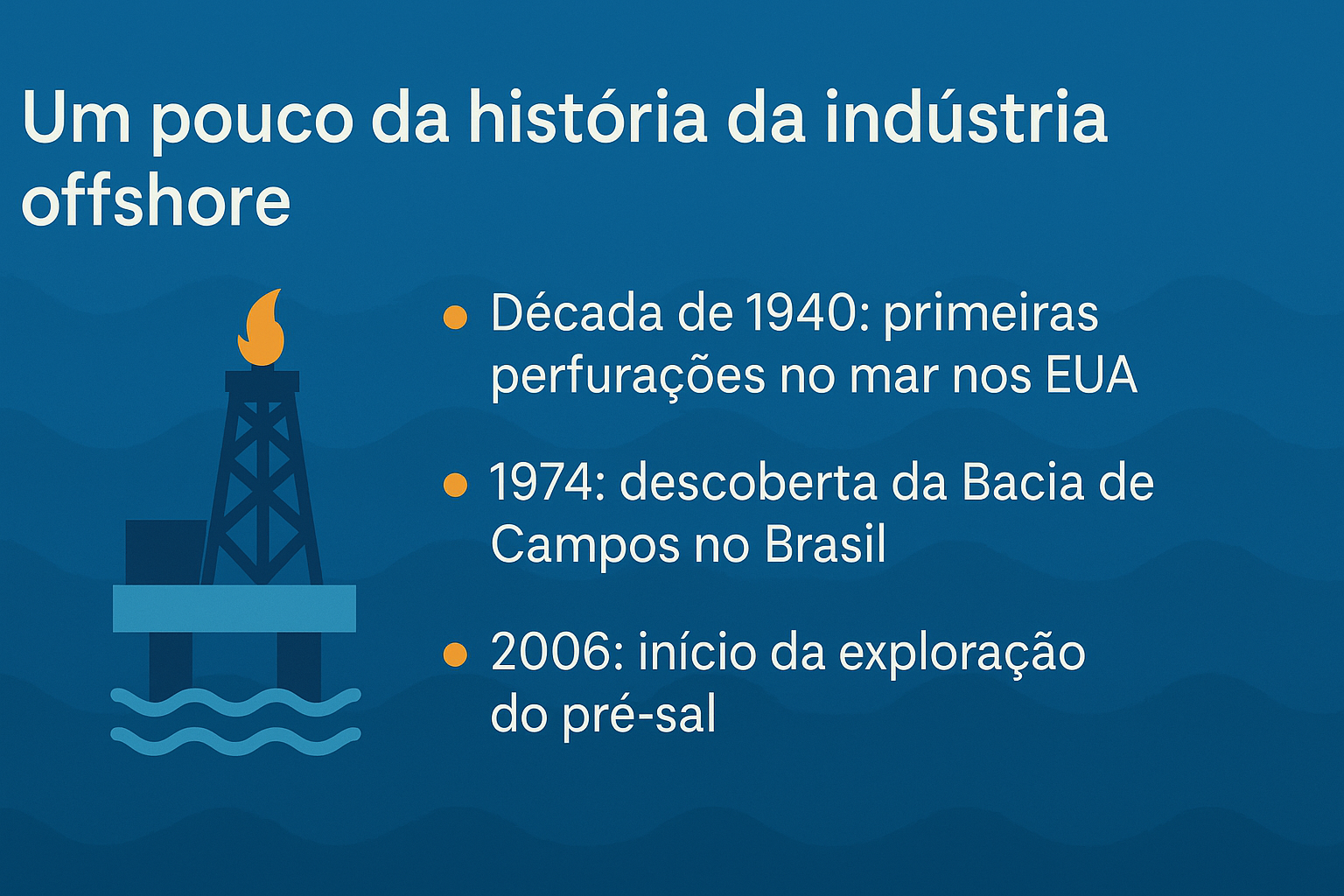
However, the growing global demand for fossil fuels led, in the 1940s, to the first drilling initiatives at sea, especially in the United States. This expansion marked the beginning of the modern offshore industry.
According to the National Agency of Petroleum, Natural Gas and Biofuels (ANP), offshore exploration in Brazil gained momentum especially from the 1970s, after the historic discovery of the Campos Basin in 1974.
This region became the epicenter of offshore oil production in the country and transformed Brazil into one of the world’s largest producers.
The Brazilian Institute of Oil and Gas (IBP) emphasizes that, with the discovery of the pre-salt in 2006, Brazil further consolidated its position in the global offshore market, opening new frontiers for oil extraction in deep and ultra-deep waters.
These discoveries required more advanced technologies and, consequently, increasingly qualified professionals to operate in challenging environments.
Additionally, countries such as Norway and the United Kingdom have also heavily invested in offshore technologies since the 1970s, contributing to the sector’s development.
The International Maritime Organization (IMO) highlights that the evolution of international safety and environmental standards has driven the formation of a professional profile adapted to the demands of this segment.
What is the Offshore Industry Resume?
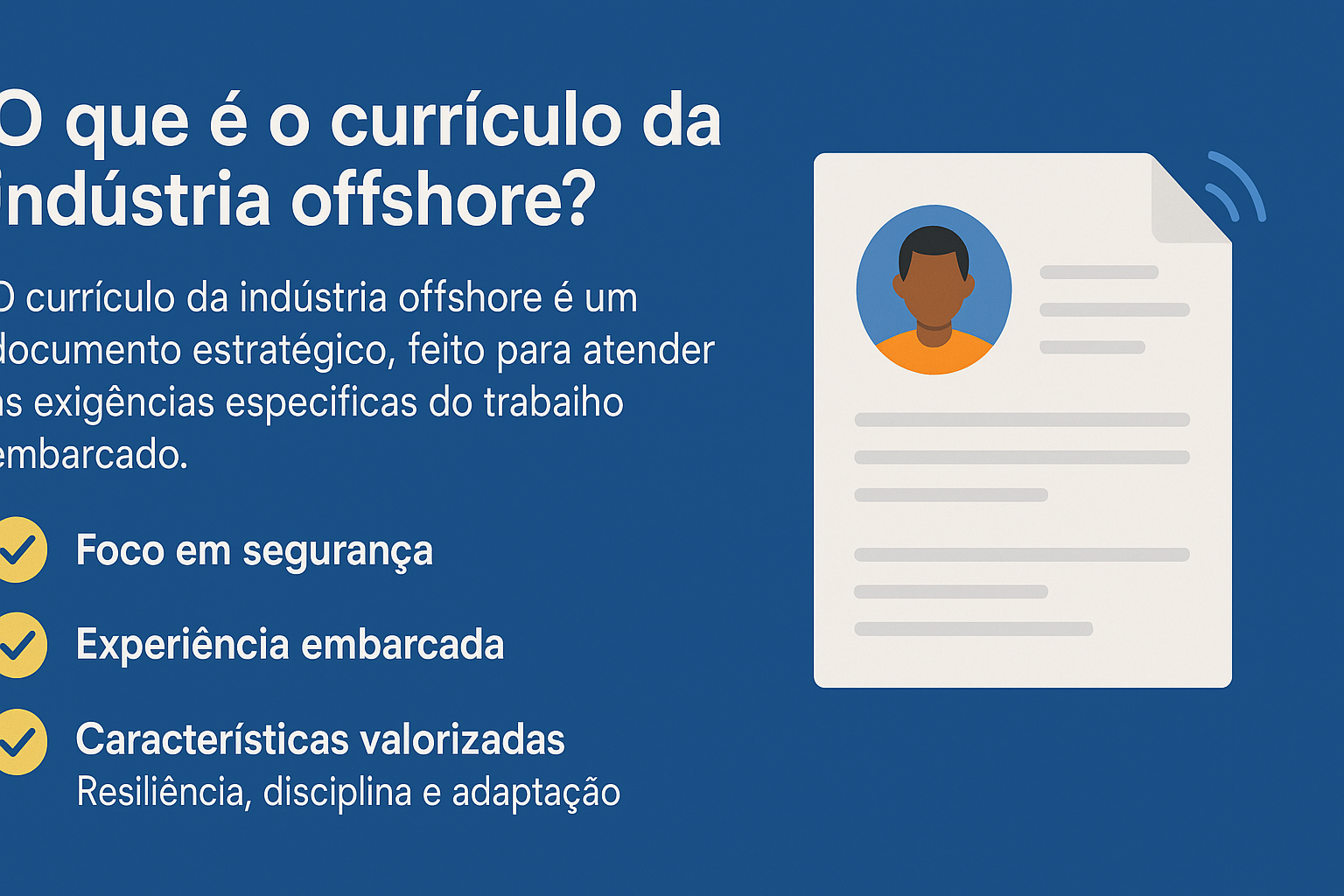
The offshore industry resume is a strategic document designed to meet the specific requirements of embarked work.
It should reflect not only the candidate’s technical experience but also valued behavioral characteristics, such as resilience, discipline, and adaptability to isolated and challenging environments.
Unlike conventional resumes, the offshore resume highlights specific training, such as the mandatory courses from the Brazilian Navy.
For example, the CBSP – Basic Offshore Safety Course is an essential requirement for those wishing to work on offshore platforms, according to official information from the Brazilian Navy website.
Additionally, the document should present experiences in industrial maintenance, welding, electrical work, mechanics, instrumentation, drilling, and maritime logistics, all conducted in an offshore environment.
Ongoing updates in mandatory training reinforce the commitment to safety, a requirement that has been increasing since the industry’s early regulations, as pointed out by the Ministry of Labor and Employment (MTE).
Therefore, mentioning the validity of courses and training on the resume is not just a formality, but a differentiator valued by companies.
Who are the Professionals Working in this Sector?
Offshore operations involve various roles. Petroleum engineers, crane operators, occupational safety technicians, seamen, offshore nurses, and industrial cooks are some of the main professional categories in the sector.
According to the International Maritime Organization (IMO), compliance with the ISM Code — International Safety Management Code — is essential to ensure safety in maritime operations, making knowledge and adherence to the regulations mandatory for any embarked worker.
Furthermore, proficiency in technical English is a fundamental requirement for offshore work, as operations often involve multinational teams and communication with vessels and bases in other countries.
Training programs and internships offered by large companies in the sector, such as Petrobras and Transpetro, according to data from the IBP, are important entry points for professionals wishing to enter the offshore industry.
It is also important to highlight that the offshore lifestyle requires psychological preparation to deal with isolation, distance from family, and the intense routine of long shifts. Therefore, the resume should demonstrate that the professional is equipped to face these conditions.
How to Create an Effective Resume for the Sector?
To start or progress in an offshore career, the resume should present three fundamental pillars: clarity, objectivity, and proof of qualifications.
First and foremost, the recruiter will check if the candidate possesses the mandatory courses to work onboard. Therefore, highlight this information clearly.
Start with a brief introduction, such as: “I seek an opportunity as an offshore maintenance technician, applying my skills with a focus on safety, productivity, and operational excellence.”
Next, list your professional experiences chronologically, including the company name, position, duration, and main activities. Whenever possible, demonstrate concrete results, such as completed projects or implemented improvements.
Include important training and certifications for the sector, such as:
- CBSP (Basic Offshore Safety Course)
- HUET (Helicopter Underwater Escape Training)
- NR-33 (Confined Spaces)
- NR-35 (Work at Height)
The Ministry of Labor and Employment (MTE) emphasizes that this training is essential to ensure the safety and health of offshore workers.
If you are proficient in English, indicate your level and where you studied, as this is a competitive advantage for multinational companies.
Additionally, state your availability for immediate embarkation and shift work. Tailoring your resume for each position, highlighting the most relevant experiences, demonstrates preparation and interest in the opportunity.
Offshore Resume and the Future of the Sector
Although the world is moving towards renewable energy, the oil and gas industry will continue to play an important role in the global energy matrix.
The International Energy Agency (IEA), in its 2023 report, states that offshore oil will remain a strategic source at least until 2040.
In this scenario, the offshore industry will evolve with the incorporation of robotics, automation, and artificial intelligence to increase safety and efficiency in operations.
Thus, the demand for highly qualified professionals is expected to grow, requiring resumes that demonstrate both technical knowledge and a forward-thinking perspective.
Furthermore, companies are increasingly prioritizing environmental issues and sustainability. Professionals with knowledge of environmental practices and occupational safety, combined with a conscious attitude, will have an advantage in the market.
Therefore, the offshore resume should highlight not only the candidate’s past but also their potential to keep up with changes and innovations in the energy sector.
Remember: a good resume can open the bridge between you and your next opportunity at sea.










-

Uma pessoa reagiu a isso.