





 Português
  Inglês
  Espanhol
  5 min de leitura
  0 comentários



Discover Everything About Infrastructure Courses, How They Work, Their Areas of Operation, and Why They Are Essential for the Development of Cities and Society.
When talking about infrastructure, people often immediately think of roads, bridges, water networks, or construction. However, the term goes much deeper than that.
In fact, infrastructure is directly linked to the entire foundation necessary for the functioning of a society, whether in the physical or digital world.
Indeed, infrastructure courses play a fundamental role in training professionals who ensure the quality, safety, and efficiency of these structures.
-
Employee Fired After Accumulating 114 Days of Medical Leave in One Year, Labor Court Upholds Company’s Decision

-
Employee Fired While Treating Depression Wins in Court and Vale Is Required to Rehire Him Following Decision Based on the CLT and INSS Benefits

-
Workers Should Be Aware! March 6 Will Be The Fifth Business Day Of March And The Final Deadline For Companies To Pay Salaries According To The CLT

-
2026 FGTS Anniversary Withdrawal Is Released According to Birth Month, Sets Amounts by Balance Range, Establishes Deadlines for March and April, and Changes Rules in Case of Dismissal


After all, the development of any society depends, among other things, on a well-planned and maintained infrastructure system.
A Bit of Infrastructure History
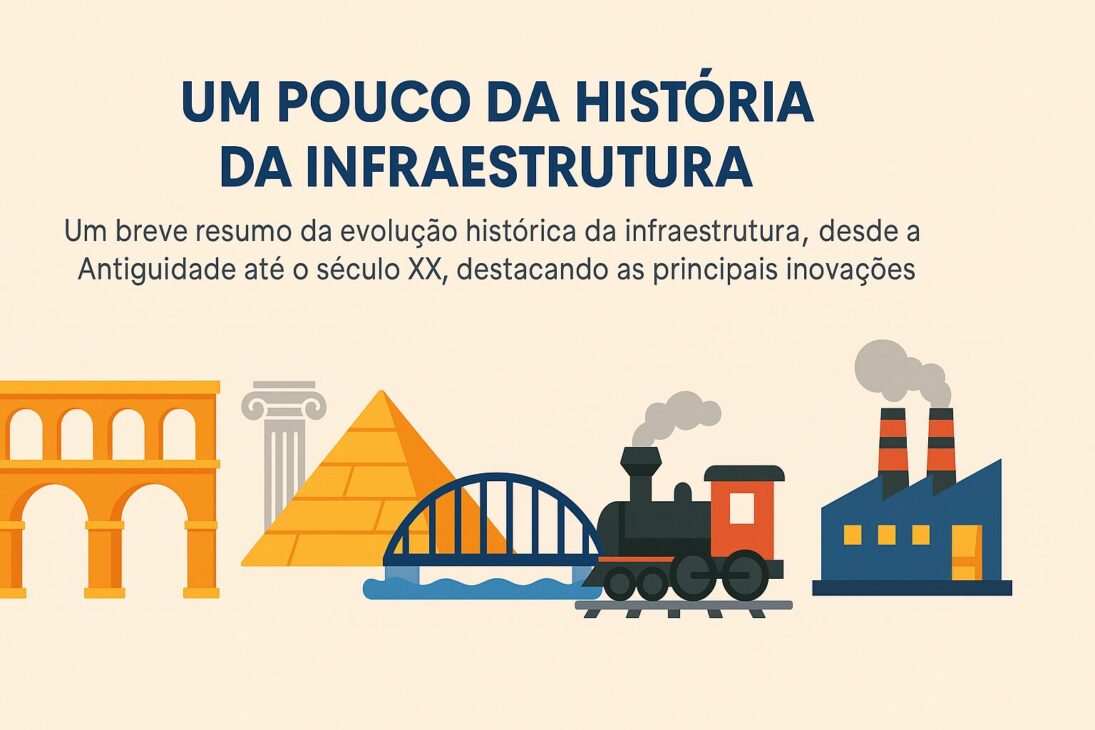
Historically, since ancient times, humans have been concerned with building environments that support community life.
In the oldest civilizations, such as those of Egypt, Greece, and Rome, there were already large engineering works that required technical knowledge, such as aqueducts, irrigation systems, roads, and even monumental constructions.
These earliest infrastructures were fundamental for the formation of societies, allowing for trade, cultural dissemination, and strengthening of economies.
Even without the technology we have today, these constructions required detailed planning, precise calculations, complex logistics, and collaborative work.
There, the first forms of what we now call infrastructure emerged.
According to the website of the Brazilian Institute of Geography and Statistics (IBGE):
The infrastructure of cities is one of the essential factors for the growth and development of a country, especially when observing the growing urbanization.
From the 19th century, with the Industrial Revolution, infrastructure gained new contours, with the construction of railways, industries, and energy networks.
In the 20th century, urbanization and technological advancement brought the need for new forms of infrastructure, which include everything from telecommunications networks to renewable energy plants.
Therefore, these challenges require well-prepared professionals, which is only possible with technical and specialized training provided by infrastructure courses.
The Importance of Technical and Specialized Training
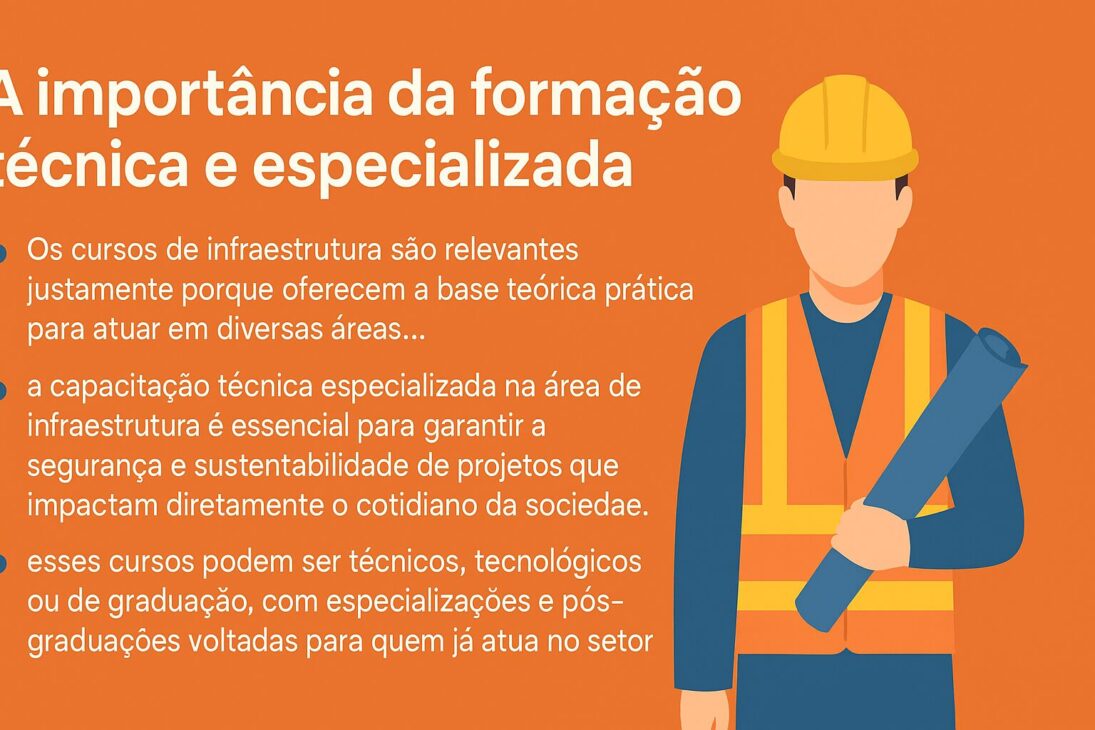
Infrastructure courses are relevant precisely because they offer the theoretical and practical foundation to operate in various areas.
From traditional civil construction to computer networks, covering energy, logistics, urban mobility, and environmental planning.
According to the Brazilian Association of Production Engineering (ABEPRO), specialized technical training in the infrastructure area is essential to ensure the safety and sustainability of projects that directly impact society’s daily life.
Indeed, these courses can be technical, technological, or undergraduate, with specializations and postgraduate courses aimed at those already working in the sector.
Due to the growing demand, educational institutions have noticed that infrastructure is a broad and constantly evolving field.
As a result, the courses have also evolved. Today, many of them already include subjects focused on sustainability, information technology, occupational safety, and project management.
After all, building a bridge, installing an internet network, or planning a power plant requires more than technical knowledge.
For this, it is necessary to understand the social, environmental, and economic impact of each work, as all infrastructure actions affect the daily lives of the population.
Moreover, with the advance of digital technology, a new branch within infrastructure has emerged: IT infrastructure.
Thus, infrastructure courses in this area focus on preparing professionals to set up, maintain, and optimize computer networks, servers, storage systems, and information security.
The role of this area has become essential, as connectivity is crucial for the functioning of businesses and for the development of local and global economies.
Career, Opportunities, and Job Market
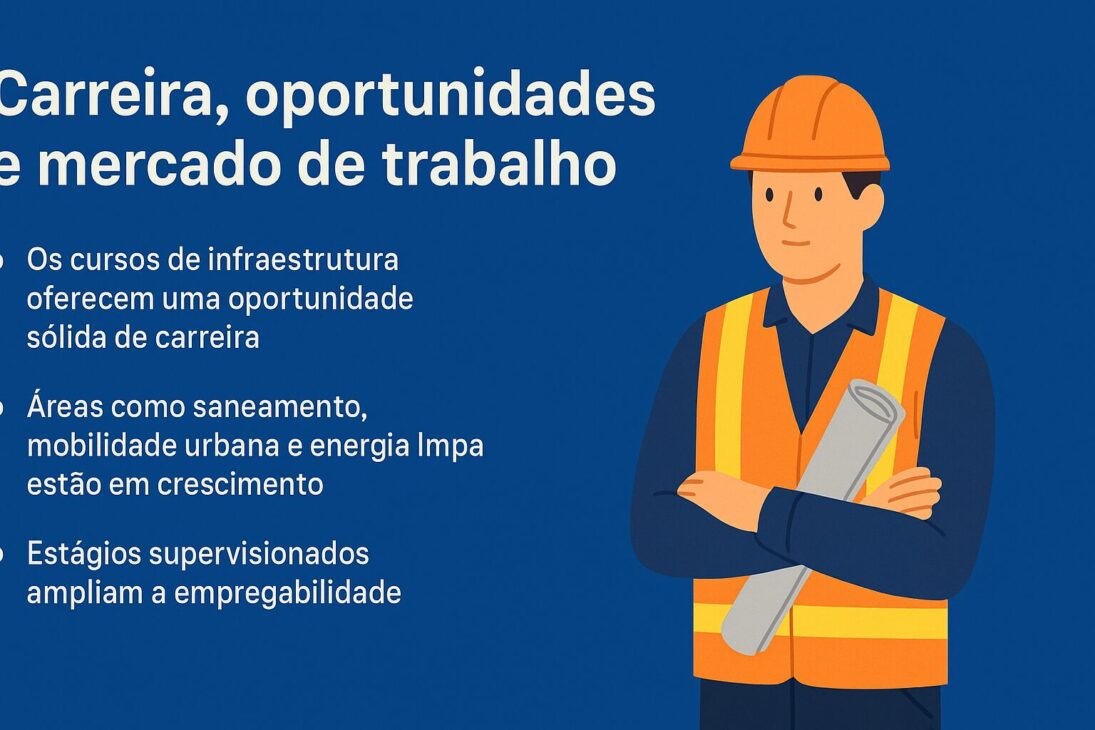
Infrastructure courses cater to both those starting in the field and those already in the market who wish to update themselves.
Indeed, these courses provide an excellent opportunity for those seeking a solid career, with good prospects and a direct impact on people’s lives.
After all, infrastructure is essential for the well-being and development of any society.
In 2023, according to the Ministry of Infrastructure of Brazil, the infrastructure sector remained one of the most strategic in the country, with increasing investments in basic sanitation, urban mobility, and clean energy.
These areas are generating a large number of opportunities for trained professionals.
These courses combine theory and practice, as in many cases, students have contact with laboratories, technical visits, and even supervised internships, which facilitates insertion into the job market.
Additionally, many universities and educational institutions form partnerships with large companies, offering students the chance to intern in large-scale infrastructure projects.
This, in turn, increases employability and improves the understanding of what is learned in the classroom.
Therefore, infrastructure courses are strategic for the development of a country, as the more qualified professionals, the greater the capacity to carry out safe, sustainable, and efficient works.
This directly impacts the quality of life of the population and the competitiveness of companies, as well as contributing to the economic growth in a balanced way.
In this sense, investing in technical education is essential to ensure a prosperous and well-structured future.
The Infrastructure of the Future
Even in times of crisis or instability, the infrastructure sector tends to maintain a constant demand for professionals.
This is due to the ongoing need for maintenance, expansion, and modernization of existing structures.
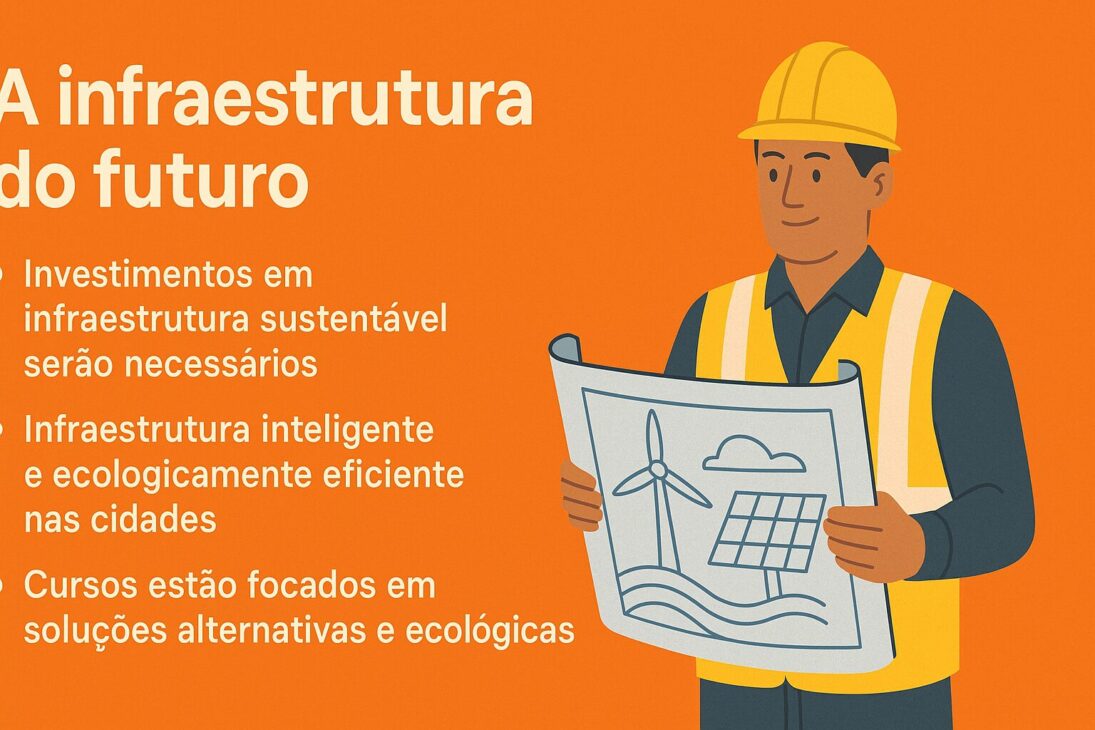
According to the United Nations (UN), by 2030, the world will need significant investments in sustainable infrastructure, including renewable energy, basic sanitation, and digital infrastructure.
This reflects the urgency to train professionals to deal with future challenges.
In this context, the growing concern for the environment has generated a strong movement for sustainable solutions, which requires new knowledge and adaptations on the part of professionals in the area.
Thus, the cities of the future will demand smart infrastructure that combines natural resources with technology to ensure sustainable development.
As a result, infrastructure courses are increasingly focused on ecological and efficient alternatives.
Infrastructure courses also offer various learning options, whether in in-person or distance learning, with variable durations.
The most important thing, however, is to choose a reputable educational institution that offers updated content and teachers with practical market experience.
With dedication and interest, it is possible to build a solid career and take advantage of many growth possibilities.
Moreover, professionals in the field can work in different segments throughout their careers, making this profession even more attractive and dynamic.
Therefore, the market is in constant evolution, and those who prepare now will be ready to seize the best opportunities.
Thus, if you are considering entering this field, know that you will be choosing a dynamic, necessary, and full of possibilities area.
Be it in civil works, IT networks, or energy, logistics, and transport systems, infrastructure is the foundation of everything that moves the world.
And infrastructure courses are the first step to being part of this transformation.










Seja o primeiro a reagir!