





 Português
  Inglês
  Espanhol
  4 min de leitura
  1 comentário





Six Paths in the INSS to Retire at 55 Years or Less: Teacher, Disability, Special by Risk, Points (86), 50% Pedágio and Amendment 103/2019
According to attorney Elizelton Reis Almeida, there are six routes provided by law that allow retirement at 55 years or even earlier. These rules are already in effect and can benefit teachers, people with disabilities, and workers exposed to risks, as well as those who meet the points, 50% pedágio, and acquired rights criteria.
In practice, the INSS applies different criteria defined by the Pension Reform (EC 103/2019) and previous legislation, allowing thousands of Brazilians to retire before the standard age.
Knowing each modality and presenting the correct documentation can reduce years of contribution and increase the value of the benefit.
-
Brazilian city gains industrial hub for 85 companies that is equivalent to 55 football fields.

-
Peugeot and Citroën factory in Argentina cuts production by half and opens a layoff program for more than 2,000 employees after Brazil drastically reduced purchases of Argentine vehicles.

-
A Brazilian city gains a factory worth R$ 300 million with the capacity to process 200 thousand tons of wheat per year, a mill of 660 tons/day, silos for 42 thousand tons, and an industrial area of 276 thousand m².

-
Havan will leave the shopping mall in Blumenau to inaugurate something that the chain has never done before: a megastore in half-timbered style in the Historic Center of the city, which is expected to be completed in May and change the landscape of local retail.


How Can a Teacher Retire at 55 Years?
Teachers in early childhood, elementary, and middle education have specific rules. Women can retire at 55 years with 25 years of contribution.
Men, on the other hand, need 30 years of teaching and also a minimum age of 55.
There is also the 100% pedágio, which requires contributing double the time that was left in November 2019 to meet the requirements.
This rule ensures that those who already had a significant part of their career completed before the reform can shorten the waiting time.
The teacher must present a minimum of 180 contributions.
How Does It Work for People with Disabilities?
The retirement for people with disabilities (PcD) has more advantageous conditions. For the time of contribution, there is no minimum age: men can retire with 33, 29, or 25 years (depending on the degree of slight, moderate, or severe disability). Women need 28, 24, or 20 years.
In terms of age, women with disabilities can retire at 55 years with 15 years of contribution. Men can do so at 60 years with the same time.
In these cases, the degree of disability must be proven by official inspection, including detailed medical reports.
Special Retirement by Risk
Those who worked exposed to harmful agents such as noise, chemicals, biological substances, or in dangerous activities may qualify for special retirement.
If the worker completed 25 years of special activity before November 2019, they can retire without a minimum age and with acquired rights.
After the reform, the rule now requires 86 points (sum of age and special time). Thus, it is possible to retire at 55 years by accumulating 31 years of special contributions, for example.
The essential document is the PPP (Profissional Profiling Report).
50% Pedágio Rule
Those who, on November 13, 2019, were up to 2 years away from completing the minimum contribution time (30 years for women and 35 for men) can benefit from the 50% pedágio. This means contributing the remaining time plus half.
An example: a woman who had 1 year left will contribute 1 year and 6 months and can retire at any age, even before 55.
The same applies to men, respecting the requirement of 35 total years.
Acquired Rights and Special Time Conversion
Those who had already met all the requirements before the Pension Reform in 2019 have acquired rights.
In these cases, retirement can be requested at any time, even at 55 years or less, as long as the conditions were already fulfilled.
Moreover, periods in special activity can be converted into common time, increasing the count.
This conversion hastens the fulfillment of transition rules, speeding up the possibility of retirement.
Is It Worth Seeking Early Retirement?
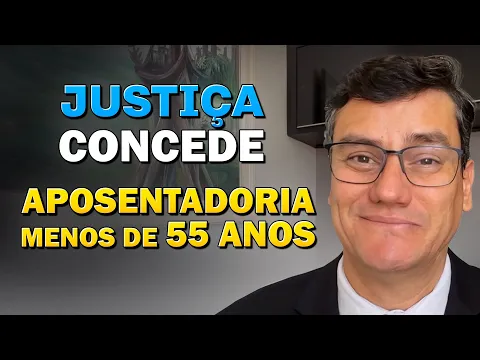

According to attorney Elizelton Reis Almeida, each case needs to be analyzed individually.
Simulations in the INSS, presenting documents such as PPP, work card, and contribution receipts are essential to prove the right.
Many people could already be retired at 55 years or less and do not know it.
Therefore, specialists recommend keeping old proofs, reviewing links in the CNIS, and, if necessary, filing a request for review. The lack of information can delay a right already guaranteed by law.
The welfare legislation offers six paths to retire at 55 years or earlier: teacher, person with disability, special retirement, points rule, 50% pedágio, and acquired rights.
Knowing the rules and presenting the right documents makes all the difference in the amount and time of the benefit.
Do you believe these rules really provide fair conditions for workers to retire at 55 years?
Do you already know someone who managed to retire before the traditional minimum age?
Share your opinion in the comments — we want to hear from those who experience this in practice.










Olá!
Tinha já conhecimento, entrei com o pedido em dezembro de 2024. Hoje responderam que foi negado.
Não passei por perícia.
Nem fui chamada.
Apresentei todos os documentos comprobatórios.
Displasia de quadril com protese. Tenho um encurtamento na coluna e muita dor , e todos os médicos concluíram que é um fator limitante, está no CID.
Como prosseguir ?