





 Portuguese
  English
  Spanish
  6 min of reading
  0 comments


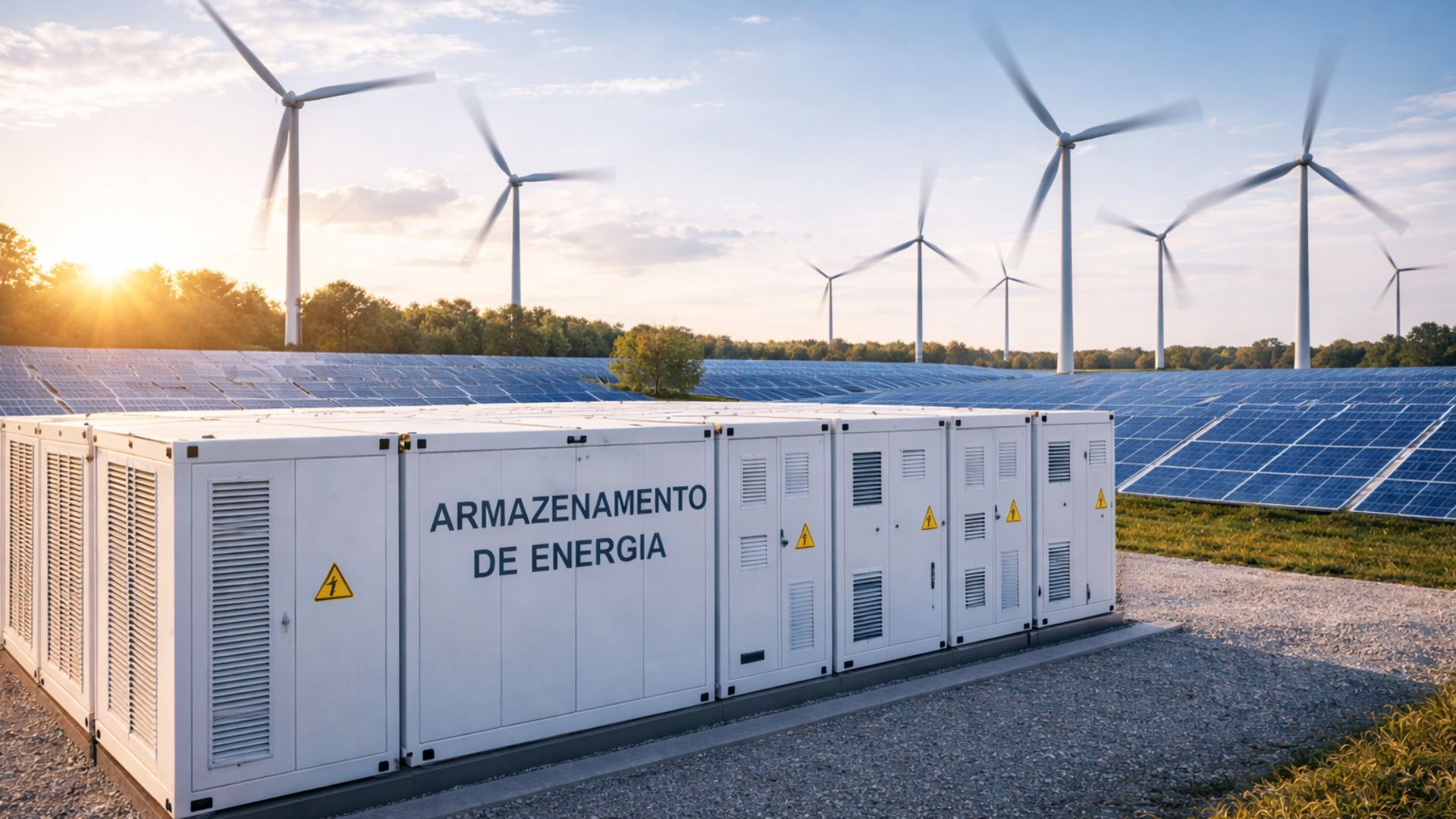
The Advancement of Batteries in Brazil Gains Momentum Amid Excess Renewable Energy and Repositions the Energy Transition as a Strategic Priority. Understand How Storage Technology Reduces Waste, Prevents Curtailment, and Attracts Billion-Dollar Investments
Brazil faces a challenge that, until a few years ago, seemed unlikely: dealing with excess renewable energy. According to an article published by Capital Reset this Monday (23), the rapid growth of solar and wind sources has driven Brazil’s energy transition, but it has also revealed structural limitations in the transmission network and supply management.
In 2024, wind and solar generation accounted for 24% of the country’s electricity, according to the Ministry of Mines and Energy. In 2019, this percentage was 9.9%. The leap shows the speed of renewable expansion but also exposes a new bottleneck: the electrical system was not prepared at the same pace to absorb this variable production.
From time to time, the National System Operator needs to request the temporary interruption of energy delivery by solar and wind generators. This procedure, known as curtailment, represents a direct waste of clean energy. On Father’s Day 2025, Brazil came close to a blackout due to excess energy, according to ONS itself.
-
The Brazilian state accelerates industrial competitiveness with a focus on the extraction of strategic minerals to boost the energy transition in Goiás.
-
A Canadian retiree creates a hydroelectric system on a real river, generating energy continuously throughout the day and demonstrating how the power of water can supply a house with stability even in a simple structure.

-
Petrobras reaffirms its commitment to the market and ensures that it will carry out the energy transition safely to maintain national sovereignty.

-
Researchers discover a possible hydrogen deposit of up to 46 million tons beneath an ancient coal basin, and the volume could exceed half of the entire global production.


Storage Technology Gains Prominence Amid Excess Renewable Energy
In this scenario, storage technology leaves the realm of promises and takes on a strategic position. Large-scale batteries emerge as a concrete solution to stabilize the grid, reduce losses, and strengthen the electricity market.
Storage technology operates as a balancing mechanism for the electrical system. When there is excess renewable energy at certain times, the batteries absorb this excess production. Later, when demand increases or generation decreases—especially at night for solar—this energy is reinjected into the grid.
This model allows for a reduction in forced generation cuts and increases the utility of the clean matrix. Instead of shutting down turbines or limiting solar production, the operator can direct electricity to temporary storage.
The problem of excess renewable energy is directly linked to the intermittency of the sources. Wind farms produce according to wind intensity, while solar plants depend on sunlight. A thermal plant, on the other hand, can be activated on demand. This structural difference requires flexible solutions.
Storage technology fits exactly into this critical point of the energy transition, offering rapid response capacity and more refined control of supply.

The Brazilian Energy Transition Advances But Requires Structural Modernization
The energy transition in Brazil is often cited as an international reference. The country has a predominantly renewable matrix, with a strong presence of hydro, wind, and solar power. However, the accelerated expansion of new sources has revealed the need for infrastructure upgrades.
Between 2019 and 2024, the share of wind and solar jumped from 9.9% to 24% of national electricity. This significant growth has brought environmental benefits and reduced dependence on fossil sources, but it has also strained the capacity to distribute the generated energy.
The electrical system needs to maintain a constant balance between supply and demand. When generation exceeds the transmission capacity or instantaneous consumption, there is a risk of instability. Curtailment then becomes a preventive measure.
The incorporation of storage technology represents a decisive step to consolidate the energy transition sustainably. It is not just about generating clean energy, but about ensuring its complete and efficient use.
Storage Technology: Battery Market Accelerates and Moves Billions
The effects of this movement are already visible in the market. According to estimates by the consultancy Clean Energy Latin America, the battery storage sector in Brazil generated R$ 2.2 billion in 2025. The previous year, the volume was R$ 700 million, demonstrating significant growth.
Currently, the installed capacity of storage systems in the country is 685 megawatt-hours, enough to supply 1.7 million Brazilian households. About 70% of this total has been implemented in isolated systems, aimed at factories, commercial installations, agribusiness, and remote communities.
Only in 2024, 269 megawatt-hours were added to the national system, among grid-connected projects and distributed systems. The growth was 29% compared to the previous year.
This data illustrates that storage technology already plays a significant role in Brazil’s energy transition. The movement is no longer experimental and is beginning to integrate corporate and governmental strategies.
Operational Flexibility Strengthens the Energy Transition
Experts point out that the main value of batteries lies in operational flexibility. The ability to control when energy will be injected into the grid creates an additional layer of security.
According to professionals in the legal and regulatory sector, batteries serve as a management tool. The operator can determine not to inject more energy when there is already sufficient supply, directing the excess to storage.
This flexibility is especially important in the light of excess renewable energy. During moments of high solar production in the middle of the day or intense winds during the night, storage technology prevents the system from becoming overloaded.
Additionally, storage contributes to smoothing abrupt variations, maintaining frequency and voltage within the required technical standards. The result is greater reliability and a lower risk of interruptions.

Instant Response and Reduction of Structural Costs
Another relevant technical differential is the almost immediate response capability of batteries. Unlike thermal power plants, which require activation time and have variable costs associated with fuel, storage systems can be activated quickly.
Markus Vlasits, president of the Brazilian Association of Energy Storage Solutions, highlights that power deficits typically last only two or three hours. In such cases, the battery acts surgically, without the need to keep a thermal plant running for eight or twelve hours.
A study by consultancy Aurora Energy Research, commissioned by the association, indicates that 1 gigawatt supplied by a battery system can cost up to R$ 4.6 billion less over 15 years than the same amount dispatched by gas-fired thermal plants.
This data reinforces that storage technology not only addresses the excess of renewable energy but also generates direct economic impact. The reduction of systemic costs is likely to benefit consumers and companies in the long run.
Federal Auction and New Phase of the Electricity Market for Storage Technology
With a federal auction planned to contract batteries, the topic gains strategic dimension. The initiative signals that the government recognizes the need to integrate storage into national energy policy.
Regulatory advancement will be crucial to consolidate this market. Defining clear rules on remuneration, asset classification, and dispatch criteria is essential to attract long-term investments.
The Brazilian energy transition thus enters a more sophisticated stage. The focus is no longer just on expanding renewable generation but also includes operational efficiency and network intelligence.
Storage technology emerges as a link between clean production and systemic stability. Without it, the risk of exacerbating the excess of renewable energy and new episodes of curtailment is likely to grow.
The New Balance Between Expansion and Energy Efficiency
Brazil has already demonstrated the ability to rapidly increase its share of renewable sources. The jump from 9.9% to 24% in wind and solar generation in just a few years proves this. The challenge now is to translate volume into efficiency.
Storage technology represents the most promising tool to achieve this balance. By absorbing excess renewable energy, reducing blackout risks, and lowering structural costs, batteries strengthen the electrical system.
More than a technical solution, storage redefines the logic of the energy transition itself. It allows the clean matrix to operate with greater predictability, stability, and competitiveness.
If the country can align regulation, investments, and innovation, it may transform an emerging problem into a strategic advantage. Intelligent energy management will be as important as its generation. In this new scenario, efficiency becomes the key word for Brazil’s energy development.








-

Uma pessoa reagiu a isso.