





 Português
  Inglês
  Espanhol
  4 min de leitura
  1 comentário


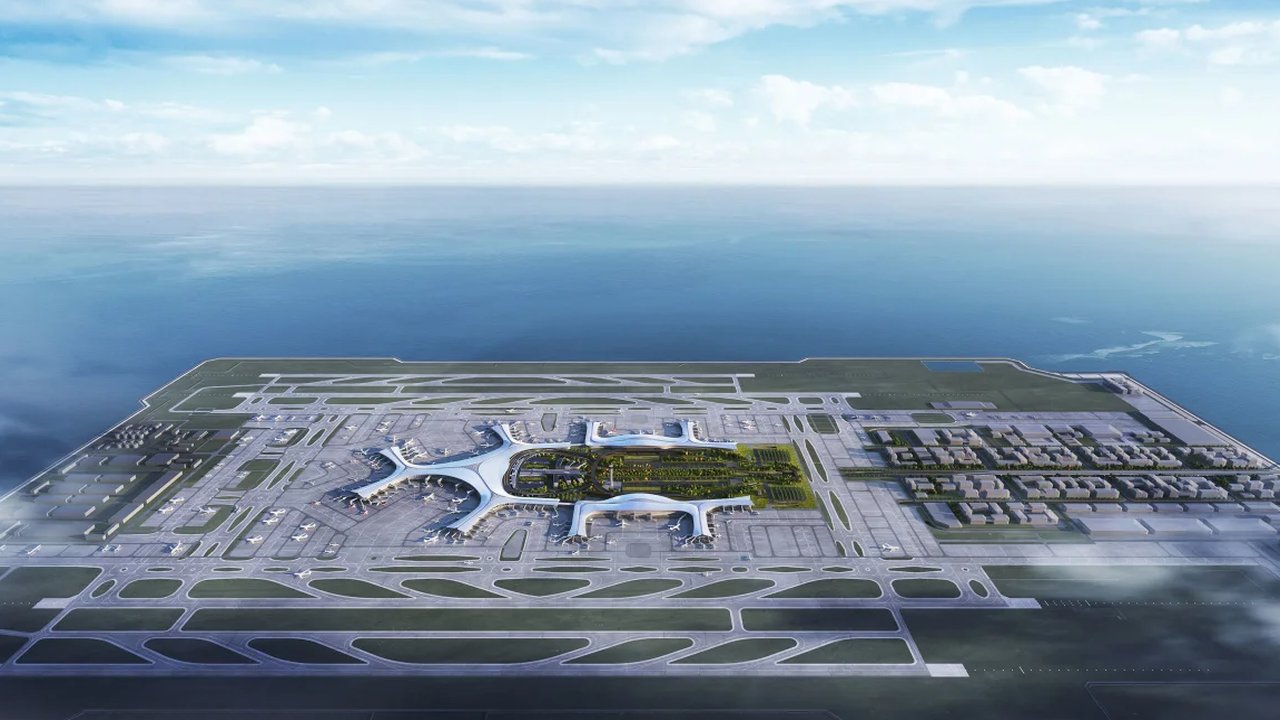


The Largest Offshore Airport in China: An Artificial Island of 20.87 km² in Dalian
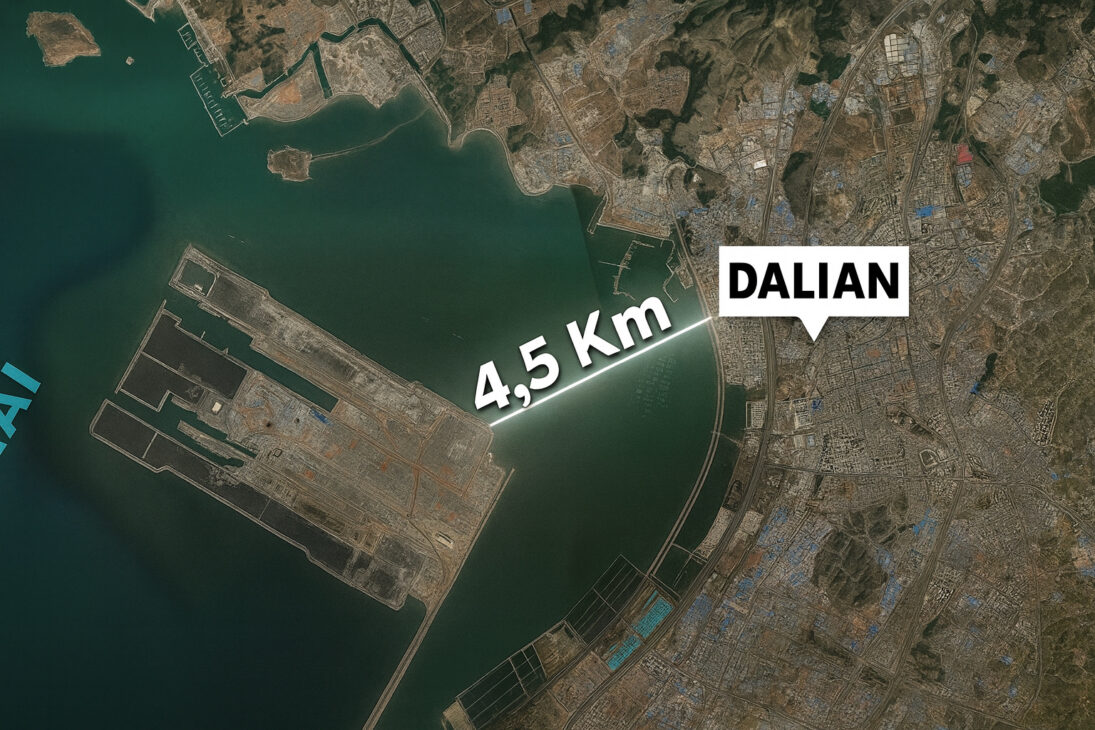
Building an airport is already a monumental task. Now imagine erecting a complete international airport over the sea, supported by a rectangular artificial island of 20.87 km². This is the challenge for China with the Dalian Jinzhouwan International Airport, under construction in the Bohai Sea, just 4.5 km from the coast of Dalian, Liaoning province.
With full operations expected by 2035 and a budget of 26.3 billion yuan (approximately US$ 4.3 billion or R$ 20 billion), the project has already moved over 187 million cubic meters of fill and has become a symbol of innovation in maritime engineering and geopolitics.
A Giant Artificial Island That Turns Into an International Airport
The idea of a new airport for Dalian emerged in the early 2000s for three central reasons:
-
A megaproject worth R$ 89 billion is advancing in Iraq and promises to change the game in global trade by creating a new corridor between Asia and Europe, reducing traditional routes and repositioning the country as a logistics powerhouse.
-
Goodbye bedside table: floating shelves become a trend in 2026 by freeing up space in the bedroom, improving circulation, bringing visual lightness, and integrating technology without taking up floor space.

-
Israel, Greece, and Cyprus signed an agreement in 2020 to transport gas from the Mediterranean to Europe via a 1,872 km pipeline, but Turkey claimed sovereignty over part of the maritime route, and the project never materialized.
-
Israel, Greece, and Cyprus signed an agreement in 2020 to transport gas from the Mediterranean to Europe via a 1,872 km pipeline, but Turkey claimed sovereignty over part of the maritime route, and the project never materialized.

- Saturation of Zhou Shuizi airport, which was already operating above capacity.
- Desire to transform Dalian into a complete international hub.
- Lack of space on solid ground for expansion.
Inspired by examples like Kansai (Japan), the project gained momentum and was approved in 2012 by the State Council of China. Construction began in 2014 but was halted due to financial issues, environmental concerns, and the coronavirus pandemic. Only in 2023 was the project resumed with new management and a more realistic timeline.
By July 2025, 94% of the island area was already formed. The massive structure measures 6.54 km in length and 3.5 km in width, surrounded by a 21 km system of dikes.
The choice of Dalian is strategic: the city is a port economic hub, serving as a connection point between mainland China, Japan, South Korea, and the North Pacific. More than just infrastructure, the offshore airport is a statement of technological and political power.
Cutting-Edge Engineering: How China Is Building an Airport Over the Ocean
Building an artificial island is not just about dumping sand into the sea. The region’s substratum is highly compressible and unstable, requiring cutting-edge solutions in geotechnical engineering.
- About 12 million prefabricated vertical drains (PVDs) were installed, accelerating pore pressure dissipation and soil consolidation.
- The project also utilized 90-ton hammers, applying impacts equivalent to 100 tons of force per meter with each strike, reaching depths of up to 13 meters.
- The peak of operations occurred in 2025, when 263,300 m³ of fill was dumped per day.
Each pile was monitored with sonic integrity and load tests, and received QR codes recording depth, soil type, and resistance, all integrated into a BIM digital platform.
Additionally, a geotechnical instrumentation network has conducted over 3.7 million readings to monitor absolute and differential settlements, pore pressures, and horizontal displacements. The data is processed in systems with predictive alerts, allowing corrections before failures occur.
This approach seeks to avoid the problems faced by Kansai, Japan, which experienced significant settlements after its inauguration.
A Terminal of Half a Million Square Meters and Four Runways for 80 Million Passengers
The passenger terminal will have 500,000 m² in a radial shape, with six “arms” of coverage. The design ensures efficiency in boarding and disembarking, keeping the average walking distance below 8 minutes.
The building will be sectorized into areas for domestic and international flights, with independent platforms allowing for future modular expansions.
When completed, the airport will feature four runways, capacity for 80 million passengers per year, and 550,000 tons of cargo movement.
Global Comparisons:
- Kansai (Japan): 10.55 km² of artificial island.
- Hong Kong International: 19.05 km² after expansion.
- Dalian Jinzhouwan: 20.87 km², surpassing both.
In terms of terminal size, it rivals Dubai’s Concourse A (528,000 m²), one of the largest in the world. Its initial capacity of 48 million passengers approaches Schiphol (Amsterdam), which received 67 million people in 2024.
More Than Transport: A Geopolitical and Scientific Milestone for China
The project goes beyond aviation. The artificial island is planned to house logistics parks and aviation and offshore climate research areas, transforming it into a platform for scientific innovation.
The work also serves as a catalyst for the urban redevelopment of Dalian’s waterfront and the expansion of integrated mobility. New train lines, metro, and elevated highways connecting the airport to the city center are planned.
Included in China’s 14th Five-Year Plan, the offshore airport is consolidating itself as a technological showcase for the country, reinforcing its leadership in mega-structures over the sea.
The Dalian Jinzhouwan International Airport is not just an airport, but a declaration from China to the world: that engineering, geotechnics, and urban planning can overcome natural barriers and create solutions on a continental scale.
And you, reader: do you believe that airports on artificial islands are the future of aviation, or do they represent environmental and economic risks that we have yet to measure?
Leave your opinion in the comments.








Attractive section of content I just stumbled upon your blog and in accession capital to assert that I get actually enjoyed account your blog posts Anyway I will be subscribing to your augment and even I achievement you access consistently fast