





 Portuguese
  English
  Spanish
  9 min of reading
  2 comments


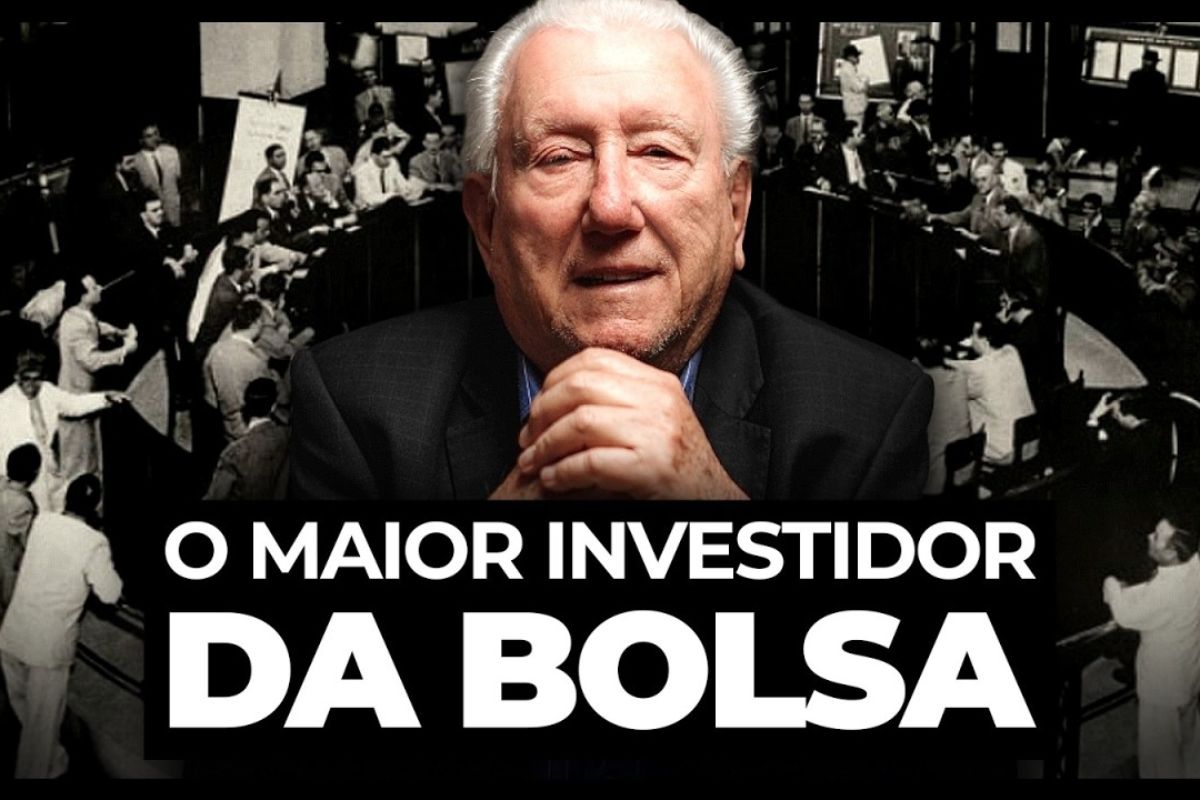


Son of a Widow Who Grew Up in a Tenement in Brás, Luiz Barsi Became a Teacher, Auditor, and Disciplined Shareholder, Accumulated a Fortune Estimated at R$ 4 Billion, Receives More Than R$ 1 Million a Day in Dividends, and Today Is Seen as the Greatest Individual Investor on the Brazilian Stock Exchange
Born on March 10, 1939, in a tenement in the Brás neighborhood of São Paulo, Luiz Barsi Filho followed an unlikely path to become the largest individual investor on the Brazilian Stock Exchange. Orphaned of his father at the age of 1, raised by his mother in a cramped workers’ village and later in a tenement with more than 30 families, he split his childhood between school and working as a shoe shiner on Avenida Rangel Pestana to help with household expenses.
Throughout the decades of 1960, 1970, 1980, 1990, and 2000, Barsi refined a simple yet radical thesis: to use dividend-paying stocks as a sort of private pension, reinvesting everything for years until passive income exceeded his salary. Graduating in Economics and Accounting in 1962, he became an auditor, owner of a brokerage, columnist for Diário Popular, accumulated nearly 3 million shares of CESP, starred in significant operations in 1979, 2008, and 2012, and today, at 86 years old, reaps over R$ 1 million per day in dividends, maintaining the billionaire profile of someone who still takes the subway through the eastern area of São Paulo.
Childhood in the Tenement of Brás and the Shoe Shiner Who Wouldn’t Give Up on His Studies

Luiz Barsi Filho came into the world on March 10, 1939, in Brás, a traditional working-class neighborhood in São Paulo. His father died when he was only 1 year old, and his mother, Maria Margarida Rui Santos Barsi, had to start over from scratch. Mother and son moved from a small house in a workers’ village on Caetano Pinto Street to the back of a large tenement in Brás, a yard shared by more than 30 families facing difficulties.
-
50 viaducts, 4 tunnels, 28 bridges, and 40 kilometers of bike paths: BR-262 in Espírito Santo will receive 8.6 billion reais for the largest engineering project in the state’s history, inspired by the Immigrant Highway in São Paulo.

-
Brazil produces too much clean energy and doesn’t know what to do with it: over 20% of solar and wind capacity was wasted in 2025 while investors flee and 509 renewable generation projects were abandoned in the last year.

-
Piauí will produce a new fuel that replaces diesel without needing to change anything in the truck’s engine and reduces pollutant gas emissions by half: truck drivers from all over the Northeast are already celebrating the news that will arrive later this decade.

-
A new Brazilian shopping center worth R$ 400 million will be built in an area equivalent to more than 4 football fields, featuring 90 stores, 5 cinemas, a supermarket, a college, and parking for 1,700 cars, potentially generating 3,000 jobs.

Maria Margarida first worked in a cigar factory and later in a cinema candy store. Money was tight, and the teenage Barsi made use of every minute of his day.
After school, he set up a spot as a shoe shiner in a building on Avenida Rangel Pestana, also in Brás, polishing customers’ shoes to supplement the household income. Even so, he did not give up on his studies, which was unusual for someone growing up in a tenement in the 1940s and 1950s.
At the age of 14, he landed his first fixed job as an office boy at an American-origin laboratory that provided services for a company that would later be acquired by Unilever.
At 15, he was hired by an accounting firm, Della Torre, marking his first job with a formal contract. Working during the day and studying at night, he paid for his own courses and laid the technical foundation that would later help him read balance sheets like few others.
From Accounting to Ownership Perspective: The Keen Eye of the Future Top Investor
After completing the technical course, Barsi enrolled at the School of Economics, Finance, and Administration of São Paulo, also in Brás. In 1962, at the age of 23, he graduated in Economics and Accounting at a time when less than 1% of the Brazilian population had a college degree.
He then began teaching accounting and working as an auditor at Rátio, analyzing balance sheets and visiting small and medium-sized companies.
It was as an auditor that he began to understand, in practice, how the gears of companies worked. On each visit, he observed the business owners and noted something that intrigued him: the entrepreneurs had a generous monthly income, often based on profit-sharing. This realization sparked a question that would change Barsi’s life: instead of being just an employee, why not become a partner, even in a small way, of the companies that made real profits?
Thus was born the decision he summarizes simply: entering the world of investors was a conscious choice, not an accident.
He started small, buying what he called almost insignificant amounts, but already guided by a central idea: if the businessman becomes wealthy with recurring profits, the shareholder thinking long-term can too.
Brokerage, Diário Popular, and the Embryo of Stocks Guarantee the Future
In the late 1960s, a regulatory shift opened new doors. In 1967, with the regulation of the National Monetary Council, brokerage firms were created and a new configuration for the stock exchange emerged. Barsi and a few partners acquired a brokerage license.
Shortly thereafter, the market evolved much faster than they had imagined, and the group sold the license for a price Barsi describes as astronomical.
In 1971, the same year he ceased to be a partner in the brokerage, he wrote his first article about the stock market in the Diário Popular newspaper.
For 17 years, he closed the Economics section every night, analyzing companies and explaining the ups and downs of the Stock Exchange to the average reader. During this time, he refined a thesis that would become a trademark of his trajectory: pension based on dividend-paying stocks.
Concerned about the future of retirement in Brazil, then managed by the INPS, Barsi delved into the numbers of the system.
He concluded that the model depended too much on the balance between contributors and retirees, and that, with smaller families and a longer life expectancy, the outcome was predictable: those retiring as executives risked ending up destitute.
Inspired by the American experience, where many workers retired based on portfolios of dividend-paying stocks, he decided to test the hypothesis in Brazil. First, he studied the multinational food company Anderson Clayton, projecting returns over 30 years.
After speaking with the company’s vice-president in Brazil and hearing that it might be sold, he turned his attention to a more predictable domestic asset: CESP, Central Electric Power of São Paulo, known for paying regular dividends.
Using 1974 figures, he reworked the study and concluded that, starting in the sixth year, the dividends themselves would pay for the purchase of new shares, transforming the portfolio into a sort of self-financing pension.
The work materialized in the article Stocks Guarantee the Future, in which Barsi advocated that investing in solid companies, reinvesting dividends for decades, was the safest way to build one’s financial future.
The 1970s and 1980s: Financial Independence Amidst Galloping Inflation
After publishing Stocks Guarantee the Future, Barsi decided to follow the thesis to the letter. Throughout the 1970s, he began buying shares of companies he considered enduring. He purchased shares of Banco do Brasil for 60 cents, shares of Klabin for 14 cents, and accumulated nearly 3 million shares of CESP, the pillar of his pension strategy.
The results appeared before he turned 40. In 1979, shortly before reaching 40, the monthly dividends were already providing a comfortable income, giving Barsi the financial independence that many only dream of achieving at the end of their lives.
The former shoe shiner from Brás had silently become an investor capable of living exclusively on the profits from his portfolio.
The 1980s would put the thesis to the test. Brazil faced inflation exceeding 110% in 1980, nearly reaching 200% in the following years, amidst successive failed economic plans. While much of the population saw their savings melt away, Barsi insisted on reinvesting dividends, turning every crisis into an opportunity to increase his stake in companies he deemed undervalued.
When CESP’s shares significantly appreciated, he decided to sell part of his position to diversify. New bets entered, such as Banco Noroeste, whose control would be sold to Santander years later.
This operation yielded Barsi one of the biggest individual gains of his career, showing that the method of reinvesting profits could also generate significant capital gains.
There were mistakes. Investments in institutions like Banco Nacional and Banco Econômico resulted in losses after the crashes in the 1990s.
Still, the strategy proved solid: isolated losses were absorbed by the weight of accumulated dividends and the absolute focus on the long term.
King of Dividends, Billion-Dollar Movements, and the Parallel with Warren Buffett
Over the years, Barsi solidified his reputation as the king of dividends and began to be referred to as the Brazilian Warren Buffett. The logic was similar to that of the American investor: to buy significant stakes in companies with resilient businesses, thinking in decades, not months.
One of the most emblematic operations of his career was the construction of a large position in Unipar. Over time, the investment grew to exceed R$ 1 billion invested in the company’s shares, turning Barsi into one of the main individual shareholders of the firm.
In 2008, he made another historic move by buying shares of Nossa Caixa for about R$ 14, betting that the São Paulo institution would be acquired by a larger bank. Months later, Banco do Brasil announced the purchase for approximately R$ 70 per share, confirming yet another accurate market reading.
In the following years, the focus remained on the sectors he always considered enduring, especially the electric sector. In 2012, when the Dilma Rousseff government announced the early renewal of concessions, the market panicked.
Shares of Eletrobras fell by more than 70%, and many investors rushed to sell. Barsi envisioned the opposite: saw a liquidation and increased his position, joking that he wanted to kiss the president, given the opportunity he believed was opening up for those thinking long-term.
When defending his investment approach, Barsi often explains: one cannot create a Petrobras, an Eletrobras, a Klabin, or a Suzano, but one can become a partner in these companies on a smaller scale. The idea of partnering with good businesses that pay regular dividends is the axis of everything.
Billionaire Wealth, Total Focus on Dividends, and the Billionaire Who Takes the Subway

Today, at 86 years old, Luiz Barsi continues doing basically what he did in the 1970s: buy stocks, reinvest dividends, and maintain the same pension philosophy. His wealth is estimated at around R$ 4 billion, all invested in the stock market. Just in dividends, his portfolio generates more than R$ 1 million per day, consolidating the image of a living legend in the Brazilian stock market and the largest individual investor on the Exchange.
Unlike many billionaires who established holding companies, offshore accounts, and sophisticated funds, Barsi keeps his investments in his own name, as an individual, just as he has always done. He often says that he doesn’t like to buy and sell frequently because his priority is to accumulate shares to increase monthly dividend income, not to profit from short-term speculation.
Staying true to this vision, he has always shown little sympathy for fixed income, which he calls “fixed loss,” and has not been swayed by real estate funds. His bet is persistent: to partner with good companies, with patience and discipline, allowing time to work in favor of the investor.
Despite his billionaire fortune, his lifestyle remains simple. Barsi lives in the eastern part of São Paulo, uses public transportation, and is frequently seen riding the subway, reinforcing the image of a billionaire who doesn’t need to flaunt anything to prove himself. To him, investing is not a sprint, but a decades-long marathon, based on consistency, reinvestment, and a deep understanding of what makes a company thrive.
And you, after learning about the journey of the largest individual investor on the Brazilian Stock Exchange, what lesson from Luiz Barsi do you intend to apply in your own financial life?










Preciso desse professor para chegar lá.
Exemplo de disciplina e determinação, e como diz o adagio, dinheiro não tolera desaforo. Com certeza, esse senhor me fez motivar mais ainda a ver a vida, em sentido amplo, como uma gestão de negócios. Vida longa ao senhor Barsi.