





 Português
  Inglês
  Espanhol
  6 min de leitura
  0 comentários


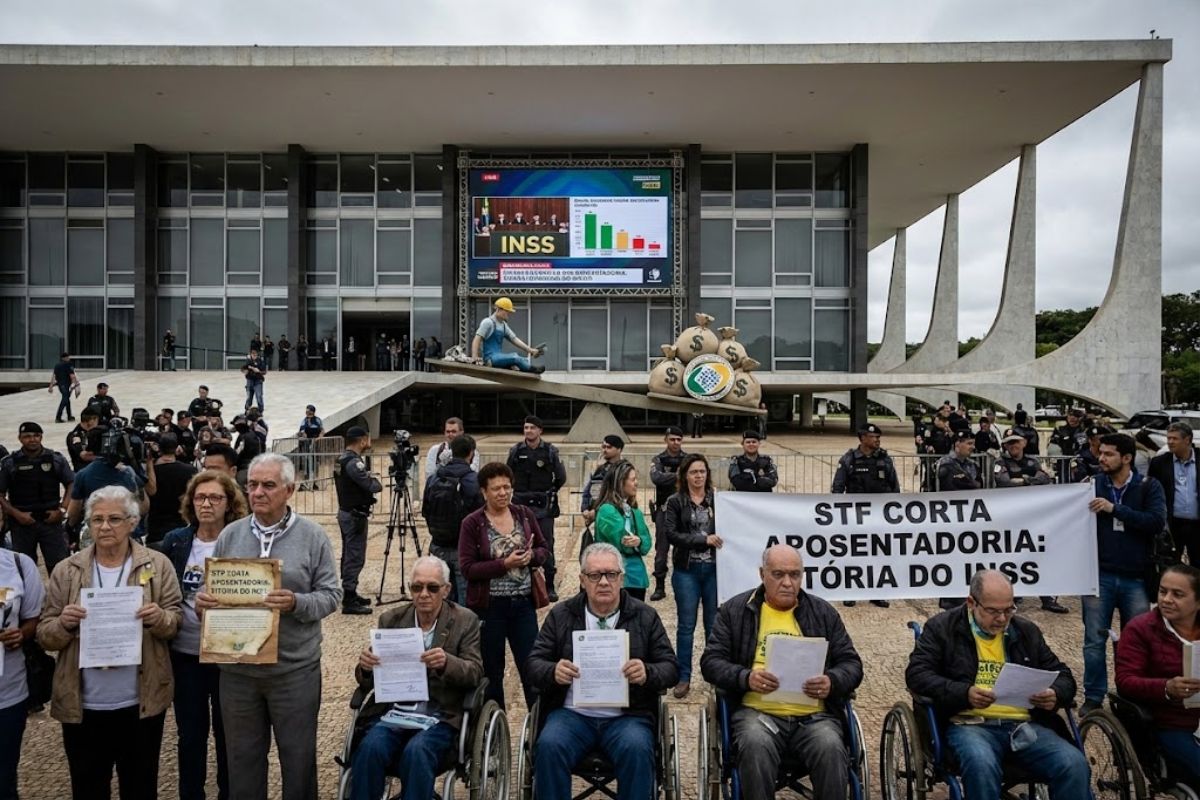
When the Trial Ends on December 18, 2025, the STF Established That Permanent Disability Retirement Will Be Calculated With 60% of the Average Plus 2% Per Year Extra, Ensuring Full Value Only in Cases of Workplace Accidents Recognized by the INSS After the Social Security Reform in Brazil.
On December 18, 2025, the Supreme Federal Court concluded the judgment of Topic 1300 and decided, by a vote of 6 to 5, to maintain the rule of the 2019 Social Security Reform that reduces permanent disability retirement in cases of serious, contagious, or incurable diseases, ensuring full benefits only when the disability results from a workplace accident.
The discussion began from an appeal by the INSS against a decision from the Federal Court of Paraná, which had ordered the payment of full benefits to an insured person. The thesis established by the STF now guides similar cases throughout the country, directly affecting those who already receive or seek permanent disability retirement after the constitutional reform.
What the STF Decided About Permanent Disability Retirement
The majority of the ministers understood that the rule created by Constitutional Amendment 103/2019 is valid and can be applied as it was designed.
-
The Senate approves a bill that criminalizes misogyny, hatred, or aversion towards women, and includes the crime in the Racism Law with a penalty of up to 5 years.

-
Chamber Approves Bill That Allows Pepper Spray for Women Over 16 and Imposes Strict Rules for Purchase, Possession, and Use as Self-Defense

-
Chamber Approves Law to Combat Leucaena, Fast-Growing Plant That Dominates Land and Threatens Native Species in Various Regions of the Country

-
Asset Division: Know What Cannot Be Divided in Case of Divorce


In practice, the STF confirmed that, as a standard, permanent disability retirement will not be paid in full when the disability originates from serious, contagious, or incurable diseases.
The plenary also reinforced that full benefits are reserved for cases of permanent disability resulting from workplace accidents, a situation expressly preserved in the text of the reform.
Two insured individuals with the same contribution average can receive very different amounts depending on the origin of the disability, which consolidates a more advantageous treatment only for victims of workplace accidents.
Narrow Vote and Division Among the Ministers
The trial ended with a narrow vote of 6 to 5 in favor of maintaining the rule.
Voting in favor of the reduction were Luís Roberto Barroso, Cristiano Zanin, André Mendonça, Nunes Marques, Luiz Fux, and Gilmar Mendes. Edson Fachin, Alexandre de Moraes, Dias Toffoli, Flávio Dino, and Cármen Lúcia were defeated, advocating for expanding the right to full value in more disability situations.
Before the conclusion, the case temporarily had a majority against the rule, when Minister Flávio Dino’s vote highlighted that the drop in income at the moment when the disability becomes permanent aggravates the vulnerability of the insured and suggested a review of benefits within 12 months, with differences paid in a single installment.
This trend was reversed in the final round of votes, which consolidated the INSS’s victory and maintained the current model of permanent disability retirement.
How the Calculation of Permanent Disability Retirement Will Be
The calculation validated by the STF maintains the formula introduced by the Social Security Reform.
Permanent disability retirement will generally be 60% of the arithmetic average of all social security contributions made since July 1994, with an increase of 2 percentage points for each year that exceeds 20 years of contribution for men and 15 years for women.
This means that only those who accumulate many years of contribution come close to 100% of the average.
Insured individuals with less time will have much lower percentages, even in cases of serious illness.
The full benefit remains restricted to situations where permanent disability results from a workplace accident, keeping this group in a differentiated position within the system.
Practical Examples of the Impact on the Benefit Value
To visualize the effect, just consider an average contribution of R$ 3,000.
A man with 20 years of contribution, following the 60% rule, would have a permanent disability retirement of R$ 1,800.
A man with 30 years of contribution would reach 80% of the average, receiving R$ 2,400.
In the case of a woman with 25 years of contribution, the calculation also reaches 80% of the average, resulting in a benefit of R$ 2,400.
The examples show how the combination of 60% plus 2% per year reduces the value compared to the previous system, which guaranteed higher percentages or full benefits in more hypotheses.
Who is Directly Affected by the STF Decision
The most affected group is that of INSS insured individuals whose permanent disability retirement results from serious, contagious, or incurable diseases.
For these cases, the STF made it clear that the benefit does not need to be full, reinforcing the logic of the reform of concentrating the full value only in cases of workplace accidents.
The decision primarily affects benefits granted after the 2019 Social Security Reform, when the new calculation came into effect.
Those who had their disability recognized before the reform remain subject to the old rules, creating a difference in treatment between insured individuals who fell ill at different times, even with similar clinical conditions.
What the Defeated Camp Argued in the Trial
The defeated ministers argued that reducing permanent disability retirement precisely when the disability becomes permanent contradicts the social protection objective of Social Security.
For this group, the drastic fall in income at the exact moment the insured person stops working permanently deepens the economic fragility of families already pressured by health expenses.
The defeated proposal included the review of disability benefits granted after the reform and the correction of values within a determined timeframe, with retroactive payment of the differences.
With the formation of a majority for maintaining the current model, this view was recorded only as a dissenting vote, without immediate practical effect on the calculation applied by the INSS.
Relation With Other Discussions of the Social Security Reform
The debate on permanent disability retirement is part of a larger set of actions contesting points of the 2019 Social Security Reform.
At the same time as it judged Topic 1300, the STF analyzed issues such as minimum age in special retirement and contributions of retired civil servants with serious illnesses, in actions that remain pending for requests for delay.
These other processes show that the architecture of the reform continues to be examined, but at this specific point, the message was clear: the cut in permanent disability retirement was deemed constitutional and will continue to apply, unless a future legislative change is approved by Congress.
What the Insured Can Do in Practice
In light of the decision, those who already receive permanent disability retirement need to verify which rule they fall under.
The first step is to check the grant letter, the type of benefit, and the date on which the disability was recognized, in addition to checking whether the origin was classified as a disease or a workplace accident.
In ongoing legal proceedings, the guidance is to follow the next steps after the establishment of the thesis, including any adjustments in lower courts.
In any scenario, the difference between disease and workplace accident becomes the key point for the final value of permanent disability retirement, which should influence the strategy of insured individuals and lawyers from now on.
In your opinion, does the current rule for permanent disability retirement fairly balance the control of Social Security spending with the protection of sick insured individuals, or should Congress intervene to expand the right to full benefits in more cases of disability?










-

-

-

-

-

11 pessoas reagiram a isso.