





 English
  Francês
  Alemão
  Italiano
  Japonês
  Norueguês
  Portuguese
  Spanish
  7 min of reading
  0 comments


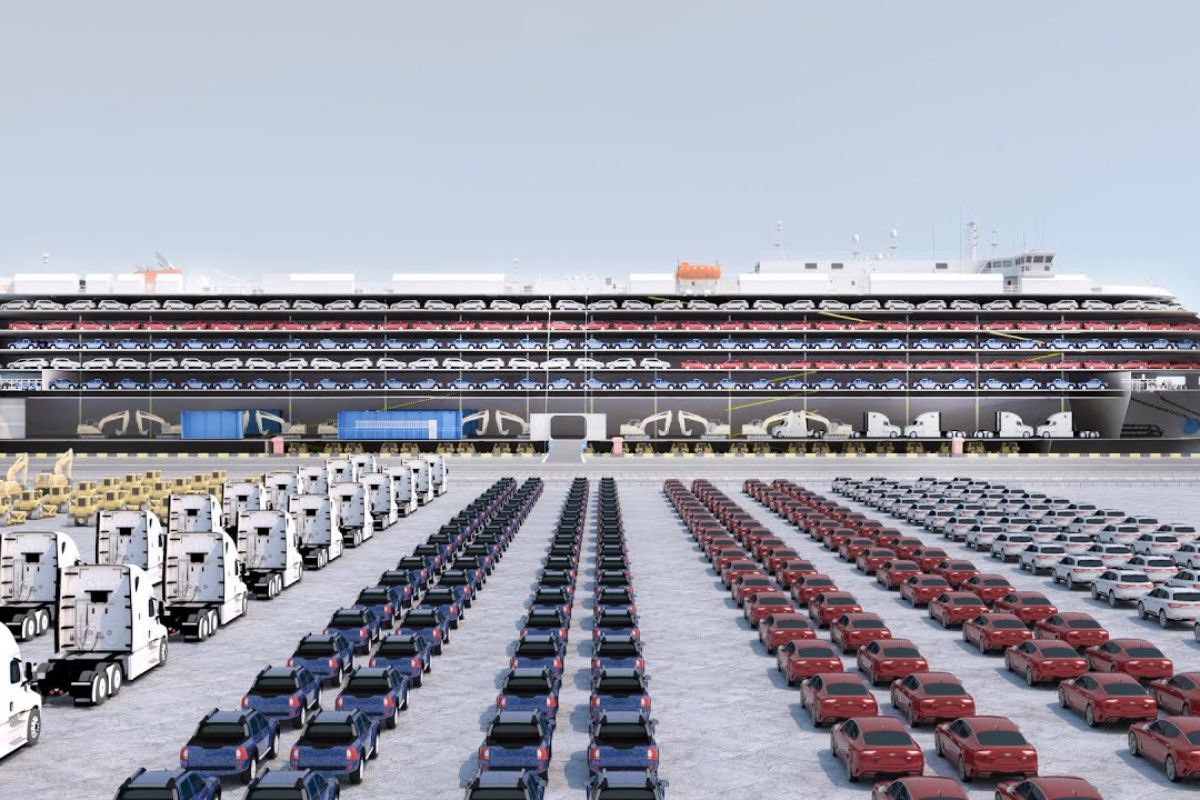
Inside the Giant Ro-Ro Ships, Mobile Decks, Hydraulic Ramps, Forced Ventilation, and CO2 Systems Form an Industrial Gear That Allows Boarding Up to 9 Thousand Cars, Controlling Weight and Smoke, and Crossing Oceans While Keeping Vehicles and Cargo Protected from Fires, Impacts, and Rough Seas During Long International Freight Journeys.
In 2025, giant Ro-Ro ships nearly 200 meters long cross oceans daily carrying thousands of cars, trucks, and machines in operations that begin long before the first vehicle ascends the stern ramp. Each port call summarizes an industrial process timed to the second, where time, weight, and safety are controlled to the centimeter.
Behind each crossing is precise logistics: height-adjustable decks, ramps that support extreme loads, intense ventilation for gases and smoke, and CO2 fire suppression systems. Inside these box-shaped hulls, the image of a common ship disappears to make way for something closer to a mobile vertical parking lot over the sea.
What Are and How Giant Ro-Ro Ships Work

The giant Ro-Ro ships derive their name from the English expression Roll on Roll off, which precisely defines the method of operation: the cargo enters and exits rolling.
-
Ocean Giant Could Change Everything: Nuclear Container Ship Project Promises to Transport 16,000 Containers Without Using Fossil Fuels
-
Hormuz Strait: Hundreds of Ships and Oil Tankers Stranded After Attacks in the Middle East
-
World’s Largest Electric Ship, China Zorrilla, Will Connect Argentina and Uruguay Across the Río de la Plata with a $200 Million Investment and Operations Planned for 2026
-
How A 20-Ton Anchor Holds 200,000-Ton Ships Even Under Extreme Winds And Why It Fails In The Deep Ocean

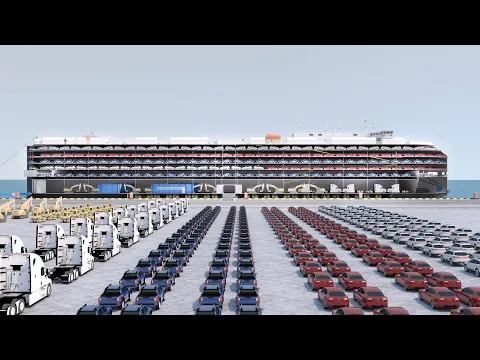
Unlike container ships, here the focus is on wheeled cargo such as cars, trucks, and construction machinery.
In the vehicle segment, this type of vessel divides into two main families.
The pure car carriers, known as PCC, carry only cars.
The PCTC models, which stands for pure car and truck carriers, are the giant Ro-Ro ships that combine automobiles, trucks, and heavy machinery in the same hull, using modular decks to accommodate very different dimensions.
A typical example described by operators is a giant Ro-Ro ship 199 meters long, capable of carrying between 6,000 and 9,000 vehicles across up to 11 cargo decks.
The box-shaped structure is not cosmetic: it maximizes internal volume, protects the cargo from wind, saltwater, and corrosion, and facilitates the internal circulation of vehicles and crews.
Mobile Decks, Giant Ramps, and Load Flexibility

The entrance to the giant Ro-Ro ships is the stern ramp, usually larger and designed to support the heaviest loads.
Many vessels also have a second side ramp, used in specific situations or at ports with distinct infrastructure.
Both are operated by winches and hydraulic motors and remain locked during navigation.
Inside, a combination of fixed ramps and movable ramps connects the different floors.
The decks 4, 6, and 8 are usually liftable decks, divided into large panels that can be hoisted with special equipment on board.
When the deck is positioned at an intermediate level, cars occupy the upper part, while trucks or larger machinery are in the lower part.
Fully raised, it releases a large opening for bulky cargo.
This design allows the same giant Ro-Ro ship to leave a port carrying compact cars, crossovers, heavy trucks, buses, and construction machinery, merely redesigning the internal heights and circulation routes.
The structural flexibility is one of the reasons that make this type of vessel central to the global vehicle supply chain.
Intense Ventilation for Exhaust Gases and Smoke

Inside a closed hull, thousands of combustion engines running simultaneously produce toxic gases.
Therefore, the giant Ro-Ro ships rely on a robust forced ventilation system to maintain air quality at safe levels.
Each deck has dedicated ducts connected to axial fans.
Some ducts provide fresh air, while others extract contaminated air, creating a continuous flow that removes exhaust gases, fuel vapors, and any smoke.
In many designs, supply fans are concentrated more towards the bow, while exhaust fans are positioned more towards the stern, forming a pathway for air circulation throughout the ship.
There are also reversible fans, installed in intermediate areas, that can reverse the flow direction in case of operational or emergency needs.
In environments where cars are maneuvered with the engine running, without efficient ventilation, gas concentrations could quickly reach dangerous levels, making this system as critical as engines and radars.
Fire Suppression Systems with CO2 in Closed Decks
Each vehicle on board carries fuel in its tank, which turns the interior of the giant Ro-Ro ships into a potential fire risk environment.
Therefore, the safety design combines detection, escape routes, and a centralized fire suppression system with carbon dioxide.
A specific room houses CO2 cylinders connected by pipelines that run throughout the cargo decks.
In case of uncontrolled fire, the system is activated to flood the affected compartment with CO2, reducing the available oxygen and smothering the flames. This strategy is only possible because the decks are closed and can be isolated by fire doors.
At the same time, clearly marked escape routes guide crew members and any inspection technicians to quickly evacuate the area, which is essential in crowded decks where movement between cars is limited.
The compression of cargo favors transport capacity but requires careful planning for evacuation.
Loading, Securing, and Weight Distribution
The boarding cycle in giant Ro-Ro ships follows an order designed for stability and efficiency.
The larger vehicles enter first, occupying central areas and lower decks. Smaller cars and light utility vehicles come later, filling the remaining spaces and the upper decks.
Each car is parked in a precise position and secured with straps fastened at specific points on the floor, which have factory-prepared holes for this type of securing.
The vehicles are positioned very close to each other but firmly secured, so they don’t shift in rough seas or during sharp maneuvers.
Weight distribution is calculated to avoid two issues: trim, when the ship becomes heavier at the bow or stern, and list, when it tilts to one side.
Heavier loads are placed lower and more centrally, while lighter cars are moved up to the upper decks. If imbalances still exist, water ballast tanks are adjusted, filling or emptying compartments to correct the ship’s attitude.
This resource, however, is used with caution.
Over-reliance on ballast increases stresses on the structure over time, so the best practice is to plan loading so the ship leaves port as balanced as possible, reducing the need for subsequent corrections.
Engines, Power, and the Transition to Cleaner Fuels
Below the vehicle decks, the giant Ro-Ro ships concentrate the mechanical heart of the operation in the engine room.
Here lie the main engine, diesel generators, steering gear, fresh water tanks, fuel oil tanks, compressed air systems, and water treatment facilities.
A control room coordinates parameters like pressure, temperature, engine speed, and fuel consumption, while ballast and service tanks are monitored in real time.
In case of failure in the main system, an emergency generator activates, installed in a high position to maintain lighting, communication, and vital equipment functioning.
In many recent designs, part of the fleet is transitioning from heavy fuel oil to LNG.
Liquefied natural gas reduces emissions and pollutants, but requires bulky cryogenic tanks, which take up space previously dedicated to cargo.
This creates a delicate equation between transport capacity, operating costs, and compliance with environmental regulations.
Life Onboard and Command Areas
While vehicles occupy most of the hull’s volume, the crew of the giant Ro-Ro ships lives in a superstructure located on the upper decks.
This area includes the command bridge, accommodations, offices, meeting rooms, infirmary, gym, pantries, kitchen, dining rooms, and recreational areas.
The captain’s cabin is usually located just behind the helm, allowing quick access to the bridge in emergency situations.
Side walkways connect the command areas to the external maneuver zones, where mooring points, lifeboats, and marked positions for helicopter support during hoisting or rescue operations are located.
Even onboard a cargo-focused ship, technical inspection routines, abandon drills, fire-fighting training, and checks of ventilation and CO2 form part of the crew’s daily routine, which needs to maintain safety standards on every voyage, regardless of occupancy or route.
Floating Parking Lots That Support the Automotive Industry
When a ship reaches the end of the loading line, with decks full and vehicles locked in place, the image is akin to a gigantic multi-story parking lot over the sea.
The difference is that this “floating parking lot” must withstand waves, winds, and long days of navigation with no margin for structural errors or security failures.
In practice, much of the global flow of new cars depends on these giant Ro-Ro ships.
Without mobile decks, heavy ramps, ventilation designed for thousands of engines, and CO2 systems ready to be activated, large-scale transport between continents would be slower, costlier, and riskier.
Knowing how the giant Ro-Ro ships that transport the world’s cars from one continent to another work inside, would you have the courage to board your own vehicle on such an ocean crossing?









-

Uma pessoa reagiu a isso.