





 Portuguese
  English
  Spanish
  4 min of reading
  0 comments


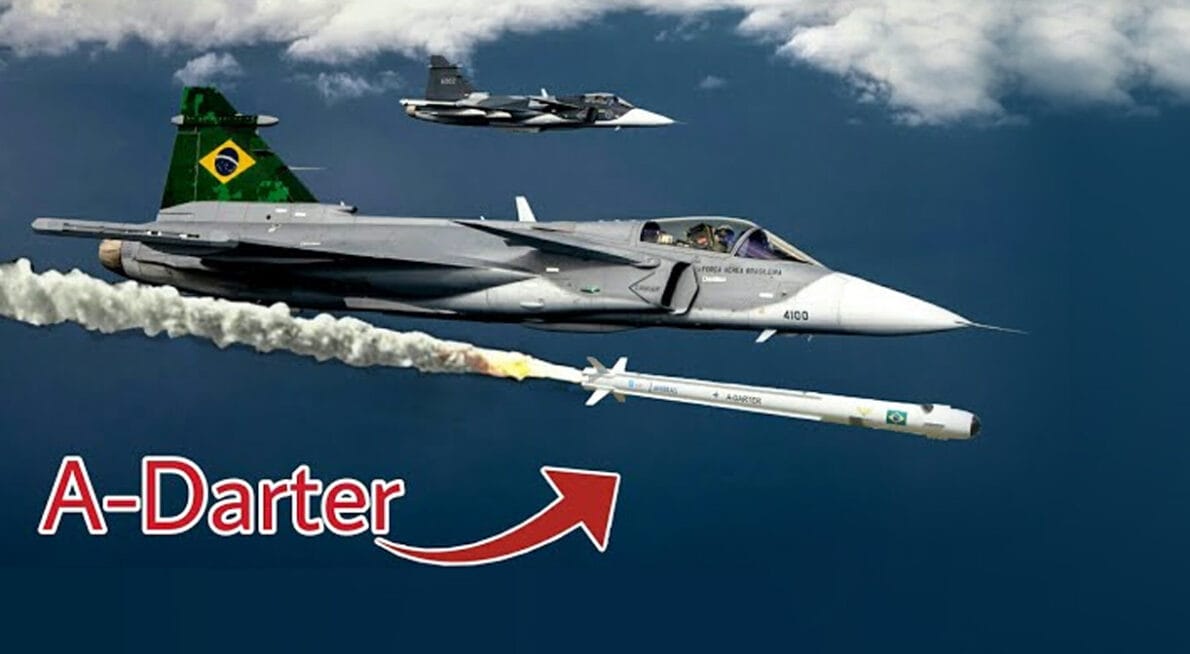
Get Ready for a Revolution in Air Defense That Promises to Change the Balance of Power in the Skies: The A-Darter Missile, Resulting from Collaboration Between Brazil and South Africa, Is About to Enter Operation.
The cooperation between Brazil and South Africa in the creation of a high-tech missile has drawn the world’s attention.
The A-Darter, a short-range air-to-air missile, emerged from a binational partnership with ambitious promises to strengthen air defense and put both nations on the map of cutting-edge military technologies.
Since the signing of the project in 2006, the path taken by the A-Darter has been filled with challenges, including delays, lack of funding, and the bankruptcy of involved companies. However, the dream of seeing this powerful weapon in action is still alive.
-
While Brazil wants to end the 6×1 work shift, the president of Argentina wants 12 hours for his workers, increasing political tension in the country.

-
The village where two rivers run side by side without mixing in Santarém and Alter do Chão reveals some of the most beautiful freshwater beaches on the planet.
-
Mars is accelerating, and scientists have discovered that the planet’s day is getting shorter, revealing surprising signs of internal activity.

-
Artemis 2 is set to launch on April 1 at 7:24 PM to orbit the Moon with four astronauts, but a class X solar flare and coronal mass ejection could interfere with communications and threaten the launch.


A Technological Milestone in the Defense Industry
As explained by the YouTube channel Top Militar LHB, the A-Darter is a short-range air-to-air missile developed in collaboration between the Brazilian Air Force (FAB) and the South African Air Force, aimed at equipping Gripen C/D and F-39 Gripen E/F fighters with the highest available military technology.
Launched in 2006, the project aimed not only to create a 5th generation missile but also to promote technology transfer between the two countries, allowing Brazil to acquire know-how in areas where South Africa already had more experience.
With 2.98 meters in length and weighing 90 kg, the A-Darter is impressive in terms of technological capabilities. Equipped with thrust vectoring system and lock-on after launch capability, the missile can hit targets that are even behind the launching aircraft.
This means that in close-range aerial combat, the A-Darter has superior maneuverability, as well as being able to evade sophisticated electronic countermeasure and self-defense systems of enemy aircraft.
“The A-Darter represents a technological milestone in the defense industry,” stated a representative from ARMSCOR, the South African state-owned company responsible for managing the project.
ARMSCOR, along with Denel Dynamics, another South African company, led the industrialization of missile production, while Brazilian companies such as Opto Eletronica, Avibras, and Mectron were essential in developing missile components.
Financial and Logistical Challenges for the Development of the A-Darter
However, financial and administrative challenges have become significant obstacles. In 2015, the South African Air Force tried to expedite the process by ordering 41 operational missiles and 21 training ones in advance, but chronic resource shortages prevented deliveries from happening as planned.
According to the South African Ministry of Defense, the financial situation of the involved companies and state funding issues were the main reasons for the delays.
Despite setbacks, the A-Darter project did not stop. In 2019, a successful test demonstrated the missile’s capabilities, when a South African Gripen D managed to destroy a Skua target, a test drone, in a simulated combat scenario.
This success led to type certificates being issued by the Brazilian (IFI) and South African (DSI) certification authorities, indicating that the missile was ready for the industrialization phase.
However, the lack of industrial progress continued to be a problem until 2024. In March of this year, ARMSCOR announced a significant advancement: Denel Dynamics received a financial boost of almost 4.4 billion rand, allowing the resumption of important projects, including the A-Darter.
The new revised contract includes the delivery of 21 training missiles and 41 operational ones for the South African Air Force, with the first four expected in December 2024.
| Characteristics | Details |
|---|---|
| Origin | Brazil and South Africa |
| Type | Short-Range Air-to-Air Missile |
| Generation | 5th Generation |
| Purpose | Air Defense, Close Combat (Dogfight) |
| Length | 2.98 Meters |
| Weight | 90 Kg |
| Speed | Mach 3 |
| Range | Approximately 15 Km |
| Payload Factor | 100 g |
| Total Investment | US$ 254 Million (approximately US$ 77 million from Brazil and US$ 177 million from South Africa) |
| Current Status | In Industrialization Phase, with Delivery Expected in December 2024 |
Future Perspectives and International Collaboration
According to Top Militar LHB, in parallel, Brazil is also doing its part. The Brazilian Air Force (FAB) decided to acquire German Iris-T missiles in 2021 as a temporary solution, while waiting for the completion of the A-Darter project.
According to experts, this decision aims to ensure that FAB’s F-39 Gripen E/F fighters remain equipped with state-of-the-art missiles until the A-Darter is available. FAB is also providing technical advice to Denel, which may accelerate the integration of the missile into Gripen fighters.
However, the way forward is still not completely clear. While Denel has secured sufficient funding to proceed, ongoing execution and collaboration among all parties involved are crucial for the program’s success.
The question of when FAB will acquire its own batch of A-Darter missiles remains open, but Brazil’s interest in ensuring maximum technology transfer remains evident.
Additionally, SIATT, a Brazilian company, has the potential to replace Mectron, which faced financial difficulties, in producing missile components for Brazil.
This replacement could strengthen Brazil’s participation in the project, justifying the investment of US$ 77 million in public resources from the country.
The ability to produce missiles domestically is viewed as crucial for national security, providing technological and strategic independence.
The prospect of 100% Brazilian production of A-Darter missiles, with full technology transfer, is a goal that FAB may seriously consider.
This autonomy in production not only ensures national sovereignty but also boosts the Brazilian defense sector, creating jobs and fostering innovation.
The successful completion of the A-Darter project could redefine the air defense industry for both countries, showing that international cooperation can yield valuable results even in the face of adversities. However, it remains to be seen if the challenges that still persist can be overcome in time.









-

Uma pessoa reagiu a isso.