





 Portuguese
  English
  Spanish
 6 min of reading
  1 comment


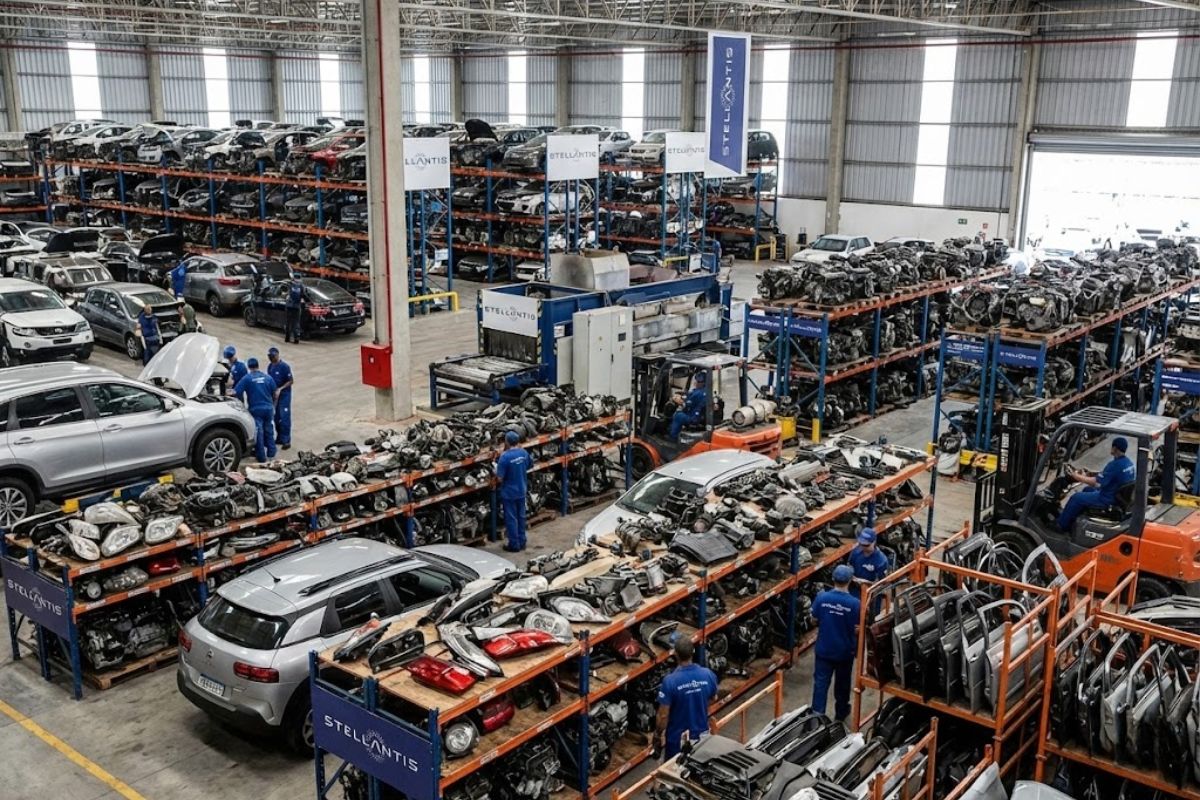

In One Hundred Days, The Official Stellantis Scrapyard Transforms The Circular Vehicle Dismantling Center AutoParts Into A Reference, Dismantles 370 Vehicles, Sells Tracked Used Parts, Recycles Materials And Tests A Circular Economy Model In The Automotive Supply Chain
On December 16, 2025, four months after its inauguration in August, the official Stellantis scrapyard in Osasco completed 100 days of operation with 370 cars dismantled and a structure designed to dismantle over 8,000 vehicles per year in the São Paulo metropolitan area. During this period, the center has already channeled thousands of components and practically tested an industrial model in which the vehicle manufacturer directly enters the used parts market.
Installed in an area of 3,000 m², the Circular Vehicle Dismantling Center AutoParts currently holds about 4,000 parts in stock, having already received over 6,000 items throughout the first 100 days. The purpose of the official Stellantis scrapyard is to provide a productive and tracked destination for vehicles that would be destroyed, recycle materials, and create a new business front in circular economy within the automotive group itself.
Structure Of The Official Stellantis Scrapyard In Osasco

Located in Osasco, in Greater São Paulo, the official Stellantis scrapyard was conceived as a vehicle dismantling center with standardized industrial operation.
-
For R$ 32,000, a brand new Hyundai car is a rival to the Kwid with a 1.2 engine producing 82 hp, 6 airbags as standard, multimedia with wireless Android Auto, up to 391 liters in the trunk, and a refreshed look for 2026 in India.
-
He bought a new car in 1983, locked it in the barn in 1988, and no one opened the door for 38 years until the family discovered what was stored inside and realized it looked like something out of a movie.
-
A 250cc motorcycle that can reach 560 km with a 14-liter tank, features disc brakes on both wheels and is among the most well-known in Brazil.

-
Man finds over 200 rare cars abandoned on a lot and tries to do the impossible in 8 hours with a surprise at the end.

The 3,000 m² warehouse houses separate areas for decontamination, dismantling, sorting, storage, and shipping of parts, as well as administrative spaces and quality control.
The projected capacity is more than 8,000 cars per year, which, if the current pace of 370 vehicles dismantled in 100 days is maintained, indicates scope for expanding the flow of incoming vehicles.
Part of the processed cars is owned by Stellantis itself, coming from testing, internal fleets, and units that, under previous conditions, would simply be destroyed.
By concentrating this volume in a single location, the official Stellantis scrapyard creates a controlled environment to reuse components, direct materials to recycling, and comply with legal requirements for large-scale vehicle dismantling.
Volumes Of Used Parts And Sales Channels In One Hundred Days
Since the beginning of operations, more than 6,000 parts have already passed through the stock of Circular AutoParts, with about 4,000 items currently available.
Of that total, more than 1,600 parts have already been sold, in a model that combines physical points and digital sales channels, in addition to partner retailers in the auto parts sector.
According to the company, 34% of the parts are sold through physical channels and 66% through digital channels, which shows that the official Stellantis scrapyard is structured to serve mechanics, retailers, and end consumers searching for guaranteed used components.
The declared goal is to gradually expand this base, with plans for a dedicated e-commerce site for Circular AutoParts.
By leveraging the group’s infrastructure and partner network, the official Stellantis scrapyard tests a model where the manufacturer positions itself also as a supplier of used parts, occupying space traditionally dominated by independent scrapyards.
Recycling Of Materials And Measurable Environmental Results
The operation is not limited to selling parts.
In one hundred days, the official Stellantis scrapyard records concrete results in the recycling of materials.
There were 246 tons of steel and aluminum recycled, 16 tons of plastic reused, and 1 ton of copper recovered, figures that express the scale of dismantling in just a few months of activity.
According to the circular economy area, 100% of the materials from the dismantled vehicles are reused, including fluids, oils, fuels, and metallic raw materials such as steel, iron, aluminum, copper, and other precious metals.
This total utilization reduces waste disposal to landfills, decreases environmental risks, and reinforces the industrial nature of the project.
The vehicles arriving at the official Stellantis scrapyard are initially directed to the decontamination area, where all fluids and potentially polluting residues are removed.
Only after this stage do the cars proceed to the dismantling line, avoiding leaks and environmental impacts in the Osasco area and surroundings.
Jobs Created And Investment In The Circular Economy
The implementation of the official Stellantis scrapyard required an investment of R$ 13 million and resulted in the creation of 150 direct jobs, distributed among dismantling technicians, inspection specialists, logistics personnel, inventory, customer service, administration, and quality control.
These jobs are added to the indirect positions related to the vehicle transportation chain to the center, partner companies for material recycling, and parts resale.
The project reinforces the idea of circular economy applied to the automotive industry, where end-of-life vehicles are treated as a source of components and raw materials, not just scrap.
For the group, the official Stellantis scrapyard also serves as a laboratory to test processes, operational standards, and tracking systems that can be replicated in other units or countries if the model is deemed successful in economic, environmental, and regulatory terms.
Step By Step Of Dismantling And Traceability Of Parts
In practice, the vehicles arrive at the official Stellantis scrapyard mainly through auctions or internal fleets and follow a standardized flow.
Upon arrival, the cars are registered and linked to a dismantling wallet issued by an approved supplier, which can include up to 49 groups of parts with complete traceability.
The first technical stage is decontamination, where oils, fuels, and other residues are removed, reducing environmental risks and ensuring safe working conditions.
Next, the vehicles proceed to the dismantling line, where specialized technicians inspect the general condition of the vehicle and each component.
The parts in good condition are separated for reuse or remanufacturing, while damaged materials are directed to recycling.
Before going to market, each reusable part undergoes cleaning with biodegradable products and receives individual identification, with technical classification, market value, and a traceability label issued by the DMV.
This label ensures the legal provenance of the component and allows verification of its origin in case of inspection.
Every dismantled vehicle is recorded in proprietary systems, which store information about the origin car, who performed the dismantling, and where each set of parts was directed.
In addition to meeting the requirements of regulatory bodies, Stellantis uses an internal coding and quality control system to organize inventory and track the history of each item that leaves the official Stellantis scrapyard.
Next Steps And Expansion Potential Of The Model
With only four months of operation and 100 days of effective activity, the official Stellantis scrapyard in Osasco has already consolidated a stock of thousands of parts and measurable results in recycling and job creation.
The proposal to launch its own e-commerce tends to expand the reach of components, connecting the center directly to workshops and consumers across the country.
If the dismantling pace is increased to approach the maximum capacity of over 8,000 cars per year, the scale of recycling steel, aluminum, plastic, and copper should also grow, as should the impact on the supply of legal used parts.
The experience may influence the behavior of other automotive groups and pressure the traditional scrapyard market to adapt to stricter standards of traceability and environmental control.
In a scenario where vehicle repair costs are sensitive for consumers and fleet operators, the official Stellantis scrapyard positions itself as part of a broader strategy of circular economy and after-sales, with the potential to alter the dynamics of the used parts market in the coming years.
In your opinion, if this official Stellantis scrapyard model proves economically viable, should other automakers create similar used parts and recycling centers in Brazil, or should the role of reusing vehicles remain concentrated in existing independent scrapyards?









Bom dia
você terias a peça Travessa superior painel frantal C3/2008