





 Portuguese
  English
  Spanish
  3 min of reading
  12 comments


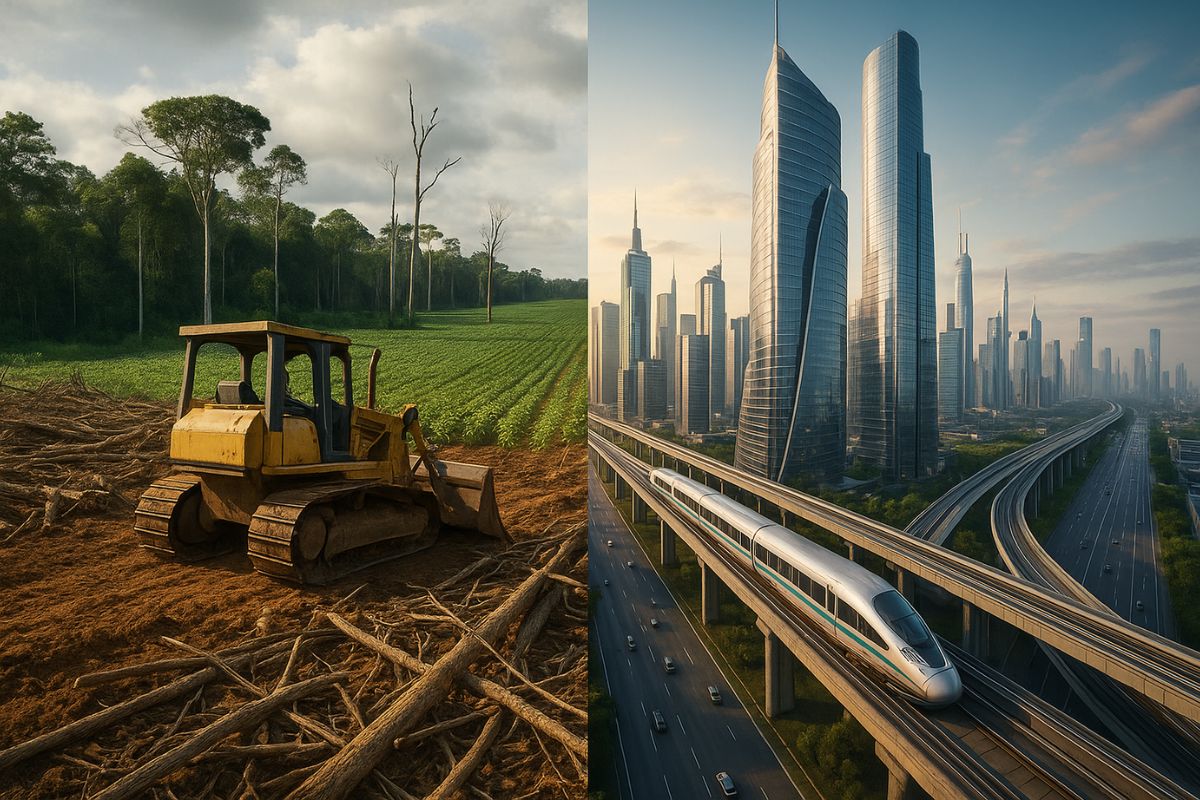


Even in the “Best Case” Scenario for Agriculture — Soy + Corn Taking All of the Legal Amazon — the Per Capita Income Would Only Go from US$ 10 Thousand to US$ 16 Thousand; a High-Tech City of 500 km² Would Yield US$ 9 Trillion and Bring Brazil to US$ 52 Thousand Per Person.
The debate about Brazil’s economic future is often divided between advocates of agribusiness and those calling for greater investment in technology. A study presented by Daniel Uchoa from the Investland channel directly confronts this view by showing that even in the extreme scenario of total deforestation of the Amazon for soy and corn, the wealth generated would be less than that of a single planned high-tech city of 500 km².
How Much Would It Be Worth to Turn the Amazon into Soy and Corn?
The numbers are impressive at first glance but lose strength in comparison. According to projections, with soy at US$ 400 per ton and productivity of 360 t/km², occupying the 5 million km² of the Legal Amazon would generate US$ 720 billion per year. If corn is included, the total would reach US$ 1.3 trillion annually, something around US$ 6 trillion in a decade.
Still, this scenario would raise Brazil’s per capita income from about US$ 10 thousand to only US$ 16 thousand, a level far from developed countries. The calculation highlights a crucial point: more planted area does not automatically mean more prosperity.
-
50 viaducts, 4 tunnels, 28 bridges, and 40 kilometers of bike paths: BR-262 in Espírito Santo will receive 8.6 billion reais for the largest engineering project in the state’s history, inspired by the Immigrant Highway in São Paulo.

-
Brazil produces too much clean energy and doesn’t know what to do with it: over 20% of solar and wind capacity was wasted in 2025 while investors flee and 509 renewable generation projects were abandoned in the last year.
-
Piauí will produce a new fuel that replaces diesel without needing to change anything in the truck’s engine and reduces pollutant gas emissions by half: truck drivers from all over the Northeast are already celebrating the news that will arrive later this decade.

-
A new Brazilian shopping center worth R$ 400 million will be built in an area equivalent to more than 4 football fields, featuring 90 stores, 5 cinemas, a supermarket, a college, and parking for 1,700 cars, potentially generating 3,000 jobs.


The Weight of Added Value: The Provocation of the “High-Tech City”
The same study proposes a reverse exercise: to imagine a technological industrial city of 500 km², inspired by the model of TSMC, a semiconductor giant. Based on the productivity of this reference, the hub would yield US$ 9 trillion per year — enough to add US$ 42 thousand to the national per capita income, bringing Brazil to US$ 52 thousand per person, equivalent to wealthy countries.
The comparison illustrates the difference between adding hectares of commodities and multiplying value with innovation. In weight terms, the contrast is even more evident:
- 1 kg of gold ≈ R$ 583 thousand
- 1 kg of iPhone ≈ R$ 21.5 thousand
- 1 kg of soy ≈ R$ 2.20
Agriculture Is Vital, but Not Sufficient
The study does not diminish the relevance of agribusiness, which guarantees foreign exchange, jobs, and exports, with solid scientific basis in institutions like Embrapa. But it emphasizes that soy and corn alone cannot sustain the necessary leap in development.
Countries often cited as agro-exporting models, such as Australia and New Zealand, have manufacturing production per capita far superior to Brazil’s: +155% and +216% in nominal values, respectively. In terms of purchasing power parity, these numbers still exceed Brazil by +60% and +125%.
What Brazil Needs to Decide
The central message is clear: the Amazon is worth more standing, allied with high-tech industry, than transformed into monoculture. Economic complexity is the engine of development. This requires consistent industrial policy, public-private integration, and heavy investment in innovation — without giving up the strength of agriculture, but using it as a base to leverage higher value sectors.
Brazil has two paths: rely solely on soy and corn or combine agribusiness with technological hubs capable of multiplying national wealth.
And you, do you believe that Brazil’s future should follow agricultural expansion or the creation of high-tech cities? Leave your opinion in the comments and participate in this debate about which model can truly transform the country.








Leiam o livro, não verás país nenhum.
Uma ****, sem fundamento nenhum porque se esquece do princípio da subsistência, monocultura é ruim em qualquer aspecto, sem contar que com a Amazônia derrubada os recursos hidricos desapareceriam, inviabilizando esse plano macabro, 2° ponto: com uma área tao grande com monoculturas o preço despencaria, por a demanda global ja ter equilíbrio, se fosse algo tão crucial, os maiores compradores(os chineses) estariam comprando a safra 24/25 dos eua, o que nao estao fazendo e ta la parado, às pragas, nao tem outro grande comprador, lei da oferta e demanda.
3° ponto: existem muito mais áreas que podem ser usandas em que nao ha florestas nativas em pé (vide Google maps)
E sobre uma cidade high-tech, quais industrias se estabilizariam pra manter essa utopia genérica bostil, afianal, hj ja se tem o polo industrial de Manaus, que aos poucos esta acabando por volatilidade dos mercados.
Essa postagem parece uma provocação sobre ética, moralidade e respeito ao ecossistema, esse é o ultimo post que leio desse site que a cada dia esta mais controverso e partidario, nunca vi defesa de refinarias nacionais, produção nacional. Gostava mais quando falavam de concursos.
Come um kilo de iPhone