





 Portuguese
  English
  Spanish
  4 min of reading
  0 comments


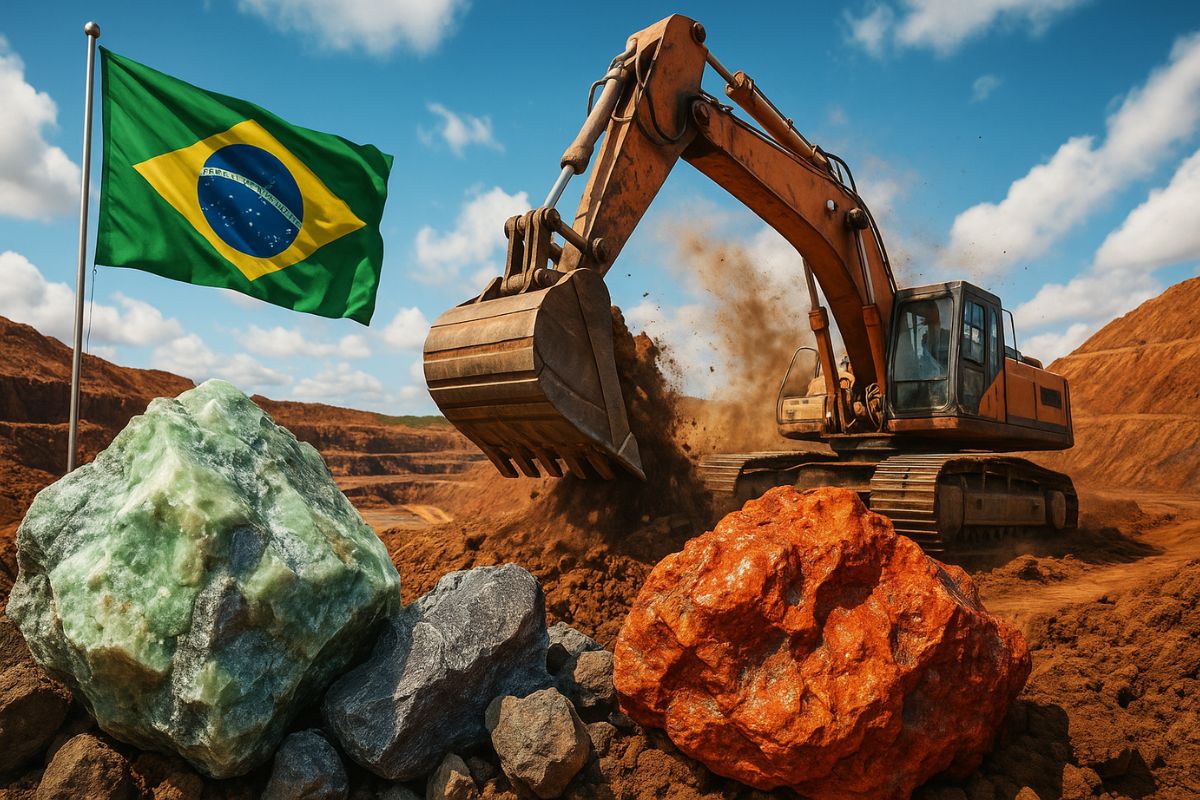
The Director of BNDES Luciana Costa Asserted That the Country Is Among the World Leaders in Giant Reserves of Critical Minerals, Such as Lithium, Copper, and Rare Earths, but It Still Lacks Financing, Incentives, and Regulatory Safety to Develop the Sector.
According to information gathered by the portal Folha de S. Paulo, the Director of Infrastructure, Energy Transition, and Climate Change at BNDES, Luciana Costa, stated that Brazil is among the countries with giant reserves of critical minerals, essential for the energy transition, but it still exploits its potential very little.
According to her, the country needs to create more attractive economic and regulatory conditions to unlock investments and transform its mineral potential into real growth.
Luciana highlighted that the high cost of money in Brazil and the absence of long-term financial instruments hinder the viability of large mineral projects, especially those linked to lithium, copper, and rare earths, which are increasingly contested in a global decarbonization and electrification scenario.
-
Larger than entire cities in Brazil: BYD is building a 4.6 km² complex in Bahia with a capacity for 600,000 vehicles per year, but the discovery of 163 workers in conditions analogous to slavery has shaken the entire project.

-
With an investment of R$ 612 million, a capacity to process 1.2 million liters of milk per day, Piracanjuba inaugurates a mega cheese factory that increases national production, reduces dependence on imports, and repositions Brazil on the global dairy map.

-
Brazilian city gains industrial hub for 85 companies that is equivalent to 55 football fields.

-
Peugeot and Citroën factory in Argentina cuts production by half and opens a layoff program for more than 2,000 employees after Brazil drastically reduced purchases of Argentine vehicles.


Brazil Among the Global Leaders in Strategic Minerals
According to Luciana Costa, Brazil ranks among the four countries with the largest reserves of critical minerals on the planet, alongside Australia, China, and Canada.
She cited the presence of rare earths, copper, lithium, and high-grade iron ore as competitive differentials that place the country in a strategic position in the global race for sustainable raw materials.
The director emphasized, however, that the utilization of this potential is still in its early stages. “We have a lot of reserves and exploit very little.
We need to create the conditions for the sector to grow safely and attractively for private capital,” she stated.
According to her, BNDES has been working to boost sustainable exploration through financial instruments and partnerships with strategic companies.
Financing and Incentivized Debentures as a Motor for Expansion
Luciana advocated for the use of incentivized debentures as an essential tool to expand long-term financing in the mineral sector.
The instrument that grants Income Tax exemption to investors is being evaluated by the government for projects linked to critical minerals.
“As the cost of money is very high in Brazil, investing in mining, which is a long-cycle and high-risk sector, becomes challenging.
We need to create the conditions to attract investment,” she declared.
The director emphasized that the tax exemption on infrastructure debentures has been decisive for the advancement of logistics and energy projects in recent years and argued that the same model should be applied to green mining.
Fund for Critical Minerals and the Role of BNDES
Recently, BNDES launched, in partnership with Vale, a fund aimed at companies in the early stages of exploration of critical minerals.
The initiative seeks to foster startups and emerging mining companies that can operate with clean technologies and low environmental impact practices.
Luciana Costa stated that the bank has a decisive role in this process, acting not only as a financier but also as a driver of public policies and innovation.
For her, Brazil can become a global reference in sustainable mining if it aligns the sector with the energy transition agenda.
“I completely agree with President Lula: Brazil must pay significant attention to mining. It is a sector that can generate growth and position the country as a global supplier of green inputs.”
Challenges to Attract Capital and Unlock the Sector
Despite the potential, the director acknowledges that the sector faces obstacles that go beyond financial costs.
Issues such as slow environmental licensing, legal uncertainty, and lack of logistical integration still deter international investors.
For Luciana, the agenda of global energy transition opens an opportunity that the country cannot afford to waste.
“Critical minerals are the heart of the new green economy. Brazil has the resources, but it needs the right environment to transform them into wealth and sustainable development,” she affirmed.
The statements from the director of BNDES reinforce the importance of transforming Brazil’s geological potential into a long-term economic strategy.
With giant reserves of critical minerals and a growing international demand for green inputs, the country can consolidate itself as a global protagonist in the energy transition, as long as it manages to align policy, capital, and sustainability.
And you, do you think Brazil is prepared to leverage its mineral reserves and become a green power, or is there still a lack of strategic vision to transform this potential into real development? Leave your opinion in the comments; we want to hear from those closely following the Brazilian energy and mineral sector.








-

Uma pessoa reagiu a isso.