





 English
  Francês
  Alemão
  Italiano
  Japonês
  Norueguês
  Portuguese
  Spanish
 5 min of reading
  0 comments


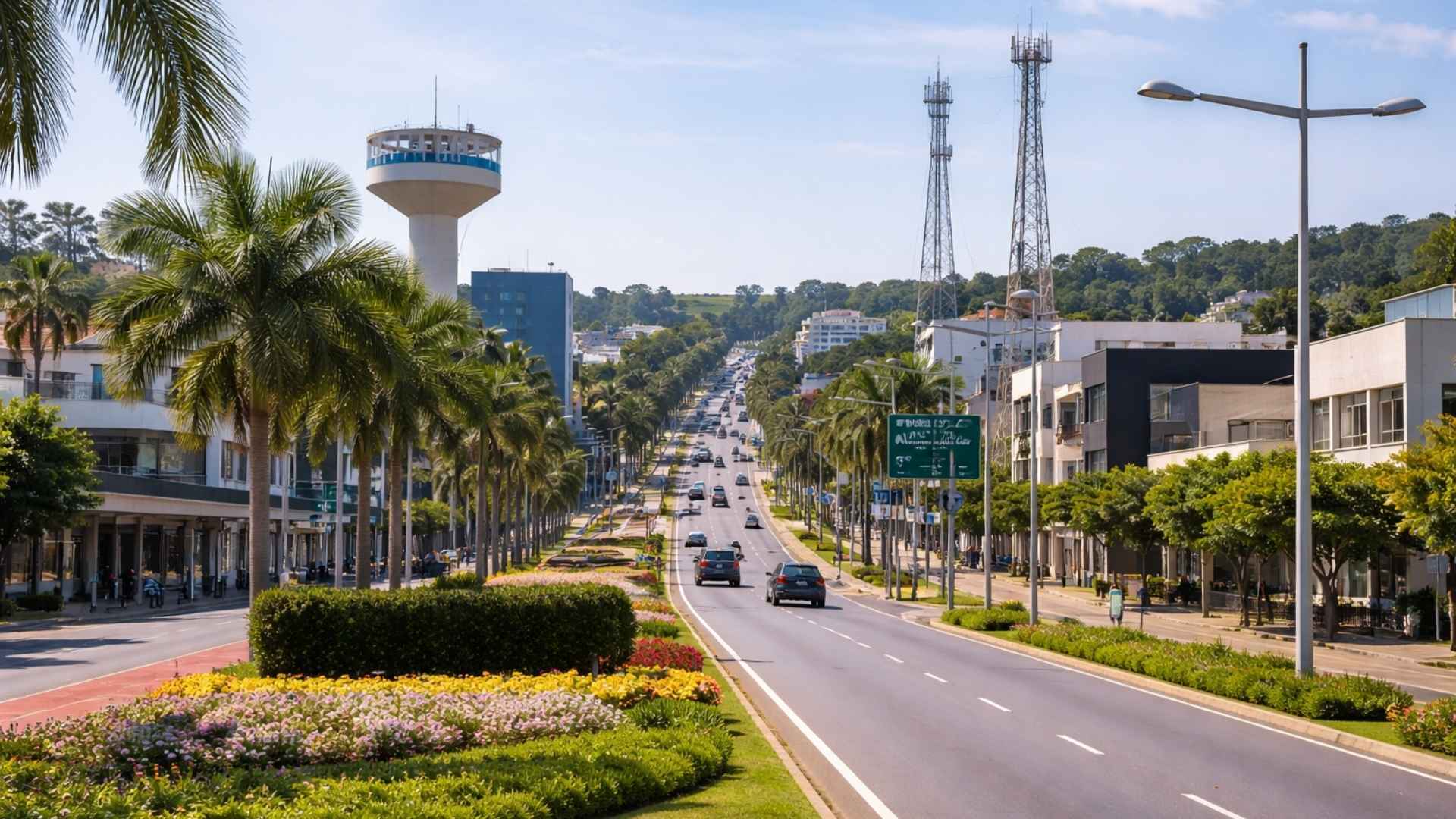
The municipality in the interior of São Paulo gained national projection by leading its population range in the ranking of smart cities, highlighting education, urban planning, economy, sanitation, and connectivity. The result reinforces the visibility of Jaguariúna outside the Campinas region and increases interest in its urban development model.
Jaguariúna, in the interior of São Paulo, has consolidated its presence among the highlights of urban development in the country by leading, for the fourth consecutive year, the segment of cities with 50,000 to 100,000 inhabitants in the Connected Smart Cities Ranking.
The performance was accompanied by relevant positions in areas directly linked to the daily lives of the population, such as Education, Urban Planning, and Economy, and increased the national exposure of a municipality that had 59,347 residents in the 2022 Census and 141.391 km² of territorial area, according to IBGE.
Connected Smart Cities Ranking highlights Jaguariúna
The result cannot be explained by a single indicator or by an isolated technological showcase.
-
Explorers find Roman treasure trapped between rocks on the seabed for nearly 1,600 years and reveal a desperate attempt to hide 53 gold coins during the invasions of the Empire.

-
Archaeologists discover Roman vase buried for over 2,000 years with more than 175 intact gold and silver coins, revealing a desperate strategy to protect wealth during the collapse of the Empire.

-
With 241 meters, 48 thousand tons, and a structure designed to accompany aircraft carriers at sea, the Chinese ship that refuels fleets in motion was born to push Beijing away from the coast and has become the hidden gear of its naval projection.

-
With 27,800 tons, 230.8 meters in length, and space for 18 helicopters, the Canberra class functions as a floating amphibious airbase and gives Australia the capability to operate at sea for more than 45 days.


The logic of Connected Smart Cities is broader and crosses data on infrastructure, public services, urban planning, and the economic environment to measure the development capacity of municipalities.
In the 2024 edition, the study evaluated 74 indicators in 656 Brazilian cities with more than 50,000 inhabitants, distributed across 11 thematic axes, including mobility, urban planning, environment, technology and innovation, economy, education, health, security, entrepreneurship, governance, and energy.
Within this universe, Jaguariúna appeared not only as the best positioned among cities of similar size but also as 11th in the overall ranking and 7th in the Southeast segment.
Additionally, it ranked 2nd in Education, 3rd in Urban Planning, and 6th in Economy, indicating that the good placement did not depend on a single strong point.
The advancement reinforces the understanding that medium-sized cities can gain space when they manage to transform urban structure and management into results comparable to those of larger centers.
Sanitation, 5G, and broadband help explain the result
An important part of this trajectory appears in the infrastructure data highlighted by the ranking itself.
Jaguariúna records 100% piped water, 98.2% coverage in sewage collection, and 73% treatment of collected sewage, in addition to 83% coverage of residential waste collection, based on information from the National Sanitation Information System.
In a survey that seeks to relate urban quality and service delivery capacity, this set helps sustain the city’s position among the best-rated in the country in its category.
Connectivity also appeared as a differentiator.
The study records an average speed of 80.82 Mbps in contracted broadband connections and 99% 5G coverage in the municipality.
These numbers do not only function as technological data but as an indication of the material base available for economic activities, digital services, business operations, and the population’s access to a more integrated urban network.
In rankings of this type, the weight of connectivity increases when accompanied by urban structure and consistent social indicators.
Education and economy sustain national prominence
In education, Jaguariúna had one of the most significant results in the 2024 edition.
According to Connected Smart Cities, 97.6% of high school teachers have higher education, the Ideb score in the final years of public education is 6, the dropout rate in the 1st year of public high school is 2.7%, and investment in education reaches R$ 2,753 per inhabitant.
The combination of these indicators helps explain the second national place in the axis, as the ranking considers both performance and school retention and the capacity to sustain public policies in the area.
The economic segment, in turn, reinforces the understanding of a city with diversified productive activity.
The ranking indicates that 93% of local jobs are outside the public sector, there was a 2.8% growth in the number of jobs in 2024, and a 14.1% increase in the number of companies during the analyzed period.
The survey also reports that 22.4% of the formal workforce is in the information and communication technology sector and notes the existence of an incubator for companies focused on innovative businesses.
This scenario gains another dimension when compared to IBGE data.
The institute reports that the per capita GDP of Jaguariúna was R$ 247,373.54 in 2023, a high number even within the interior of São Paulo and relevant to contextualize the municipality’s presence among the highlights of the economic axis.
Although the ranking is not limited to income, the local economic strength helps to understand why the city frequently appears in discussions about investment capacity, business dynamism, and service offerings.
Medium city surpasses larger centers in urban visibility
Part of the interest generated by Jaguariúna comes precisely from the contrast between its population size and the position it has achieved on the national stage.
The municipality is not part of the group of capitals or large metropolises that usually concentrate visibility when it comes to urban innovation.
Still, it has managed to maintain leadership in its population range for four consecutive editions, which reduces the chance of the result being read as a point fluctuation and reinforces the perception of administrative continuity and stability of indicators.
The methodology of the ranking helps to understand this movement.
As the comparison uses standardized secondary sources and equivalent segments for all evaluated municipalities, absolute size ceases to be the only relevant factor.
What counts more is the efficiency of urban structure, service coverage, quality of educational indicators, economic environment, and the capacity for articulation between different areas of management.
In this format, medium-sized cities with consistent fiscal bases, planning, and services can compete for space with much more populous centers.
Regionally known for its proximity to Campinas and the presence of industrial and service activities, Jaguariúna already had economic relevance in the interior of São Paulo.
What Connected Smart Cities did was expand this framing, placing the city in a national showcase more associated with the idea of a smart and connected municipality.
The performance in sanitation, connectivity, education, and the labor market helps explain why the name has begun to circulate more strongly outside the region and why the city has firmly entered the radar of rankings on urban development.






Seja o primeiro a reagir!