





 Portuguese
  English
  Spanish
  4 min of reading
  0 comments


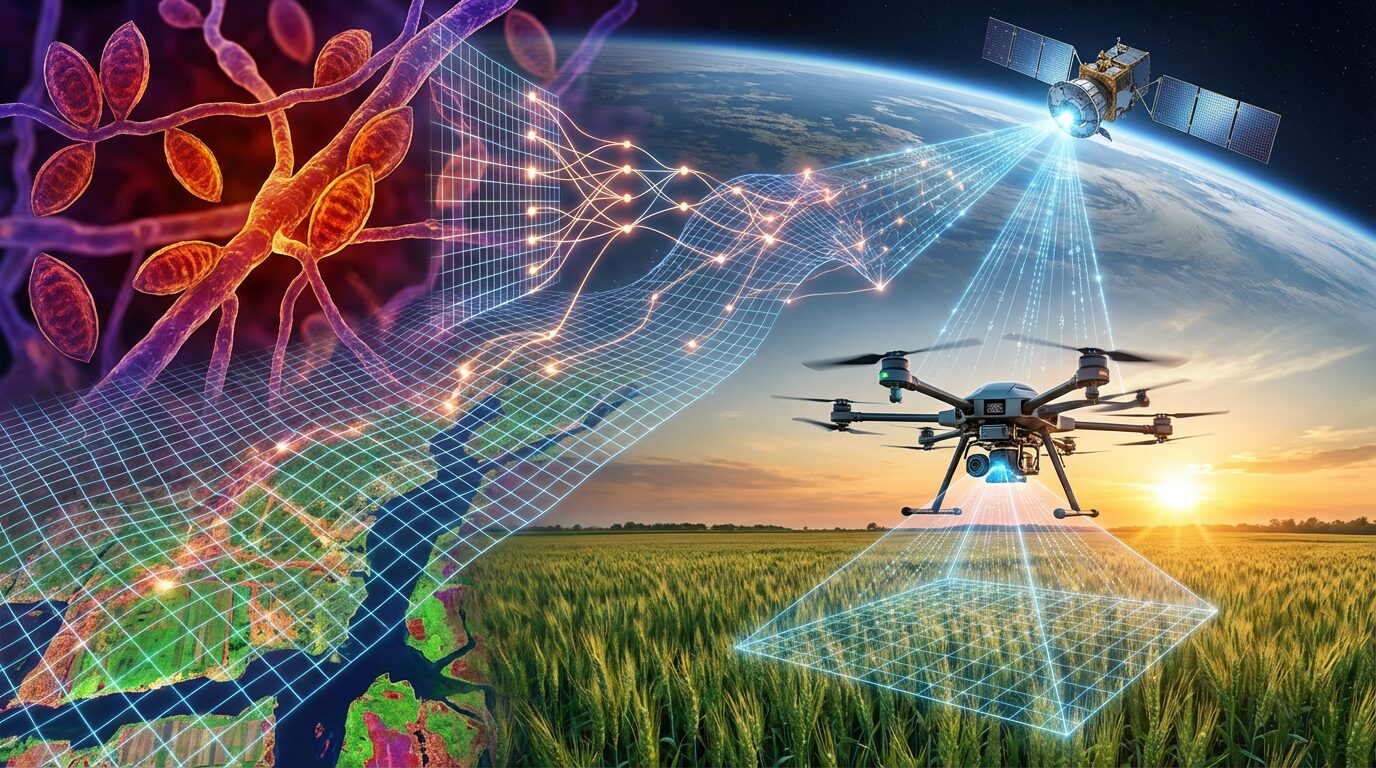
Scientists in Russia Validate a Method for Detecting Plant Diseases Still Without Visible Symptoms. Hyperspectral Images and Artificial Intelligence Promise to Monitor Crops by Satellites and Drones with Greater Accuracy.
Researchers from the Advanced Engineering School “Digital Engineering” at the Saint Petersburg Polytechnic University, in Russia, in partnership with the National Institute of Plant Protection, developed a method to identify diseases in agricultural crops in the early stage. The technique combines hyperspectral images and artificial intelligence to detect changes that are invisible to the naked eye, allowing for a quicker response in the field.
The results were demonstrated in the case of wheat rust, one of the most damaging diseases for cereals. The study used 864 hyperspectral images of healthy and infected plants, providing a solid basis for evaluating the performance of the algorithms.
According to the Ministry of Science and Higher Education of Russia, the information about the progress was published on the ministry’s official portal. The outlet TV BRICS also reported on the research, reinforcing the credibility and potential application of the method in precision agriculture.
-
Motorola launched the Signature with a gold seal from DxOMark, tying with the iPhone 17 Pro in camera performance, Snapdragon 8 Gen 5 that surpassed 3 million in benchmarks, and a zoom that impresses even at night.

-
Satellites reveal beneath the Sahara a giant river buried for thousands of kilometers: study shows that the largest hot desert on the planet was once traversed by a river system comparable to the largest on Earth.

-
Scientists have captured something never seen in space: newly born stars are creating gigantic rings of light a thousand times larger than the distance between the Earth and the Sun, and this changes everything we knew about stellar birth.

-
Geologists find traces of a continent that disappeared 155 million years ago after separating from Australia and reveal that it did not sink, but broke into fragments scattered across Southeast Asia.

The authors emphasize that the solution paves the way for remote monitoring systems by satellite and drones, capable of covering large areas with lower costs and greater agility. The proposal aims to reduce losses, guide management, and optimize the use of inputs in crops.
Method Based on Hyperspectral Images and AI Allows Seeing Invisible Changes and Surpassing Limits of Common Remote Approaches
The challenge of traditional remote methodologies is the lack of sufficient detail in conventional images to diagnose problems early. Hyperspectral sensing, on the other hand, collects signatures in hundreds of narrow bands, capturing subtle physiological changes in plants before any visible symptoms.
Using machine learning algorithms, the researchers process this data to separate patterns of healthy and infected plants. According to the Russian Ministry, this combination increases diagnostic sensitivity and anticipates interventions, favoring rapid pathogen control.
Test with Wheat Rust Validates the Proposal with 864 Images of Healthy and Infected Plants in Challenging Conditions
In the demonstration, the team used 864 hyperspectral images of wheat samples, covering scenarios with and without wheat rust infection. The volume and variety of data helped train and test the models robustly, providing statistical support for the results.
Researcher Aleksandr Fedotov from the Advanced Engineering School “Digital Engineering” highlighted the crucial role of data preparation in performance. “The key factor for the effectiveness of the method was not the complexity of the models, but the proper preparation of the data, which allows machine learning algorithms to accurately distinguish healthy plants from infected ones, even under adverse conditions,” he explained.
According to the Saint Petersburg Polytechnic University, the curation and balancing of samples, along with the treatment of noise, were decisive for accuracy. This care makes the system more resilient to variations in lighting, humidity, and phenological stages, which are common in real agricultural environments.
By targeting wheat rust, scientists chose a pathogen with high economic impact and widespread geographical distribution. Validation in this pathogen strengthens the perspective of extending the method to other diseases and crops, as long as a representative collection of spectral signatures is obtained.
According to information released by the Ministry of Science and Higher Education of Russia and reported by TV BRICS, the methodology is ready for transfer to operational pipelines. The next step involves standardizing sensors, collection protocols, and updating routines for the models to ensure stable performance in the field.
Applications in Satellites and Drones Can Scale Monitoring and Reduce Losses in Precision Agriculture
The technology opens the door for systems that integrate drones and satellites into the early diagnosis of diseases. Drones provide fine spatial resolution over specific plots, while satellites cover extensive areas and allow continuous monitoring throughout the entire harvest.
In practice, producers and cooperatives can identify early hotspots and act locally, reducing the use of pesticides and operational costs. Early analysis also protects productivity, preventing outbreaks from advancing uncontrolled and compromising the harvest.
For large-scale adoption, experts suggest consolidating data flows, calibrating equipment, and training teams to interpret spectral maps. With continuous validation and extensions to other pests and crops, the method tends to integrate into the precision agriculture ecosystem, bolstering food security and sustainability.
The topic divides opinions and opens up debate on investment priorities in the field. The bet on satellites and drones should come accompanied by training and infrastructure so as not to exclude small producers. What do you think, are hyperspectral technologies and AI the best way to face diseases in crops, or are there missing policies to ensure broad and fair adoption? Leave your comment and join the conversation.








-

Uma pessoa reagiu a isso.