





 Portuguese
  English
  Spanish
  6 min of reading
  0 comments


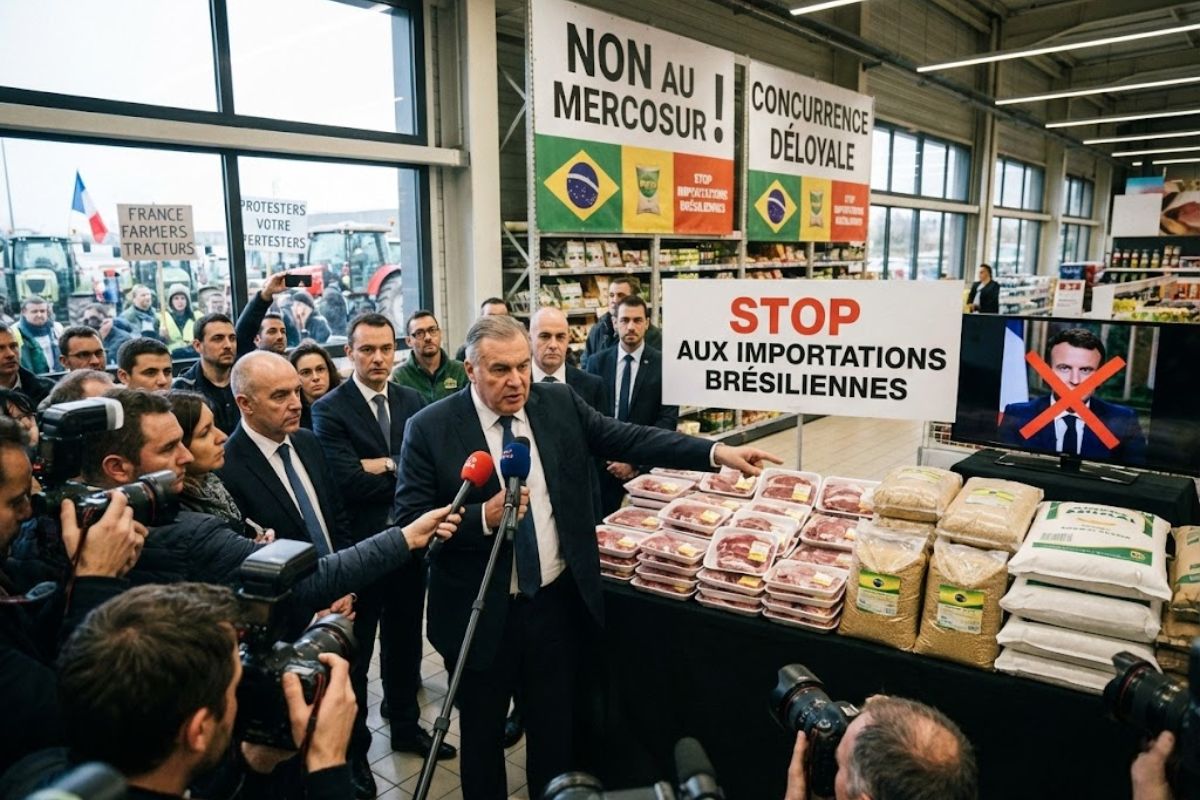
President of Cooperatives U, Owner of the Largest Supermarket Chain in France, Promises to Boycott Beef, Sugar, Rice, Honey, and Soy from Mercosur If EU Mercosur Agreement Advances, Calls Shein Treaty of Unfair Competition and Pressures Macron in the European Parliament and French Senate This Week in Brussels and Paris
On December 16, 2025, as the negotiations for the free trade agreement between the European Union and Mercosur were nearing completion, the president of Cooperatives U, the fourth largest supermarket chain in France, announced that it would boycott South American products if the treaty comes into force, rekindling the debate over the bargaining power of France’s largest supermarket chain and other giants of the European food retail sector in the face of the agricultural crisis.
On the same Tuesday, December 16, 2025, the European Parliament approved safeguard measures to try to limit the agreement’s impact on European farmers, while heads of state from the 27 EU countries were preparing to discuss the text on December 18 in Brussels, and European and South American leaders were aiming for a signing on December 20, 2025, during the Mercosur summit in Foz do Iguaçu, turning the EU Mercosur dossier into the centerpiece of an open agricultural war between European producers and exporters from the South American bloc.
CEO of Cooperatives U Threatens to Boycott Beef, Soy, Sugar, and Honey from Mercosur

The announcement came from Dominique Schelcher, CEO of Cooperatives U, a group that includes cooperative supermarkets and ranks as the fourth largest supermarket chain in France.
-
A new Brazilian shopping center worth R$ 400 million will be built in an area equivalent to more than 4 football fields, featuring 90 stores, 5 cinemas, a supermarket, a college, and parking for 1,700 cars, potentially generating 3,000 jobs.

-
Larger than entire cities in Brazil: BYD is building a 4.6 km² complex in Bahia with a capacity for 600,000 vehicles per year, but the discovery of 163 workers in conditions analogous to slavery has shaken the entire project.

-
With an investment of R$ 612 million, a capacity to process 1.2 million liters of milk per day, Piracanjuba inaugurates a mega cheese factory that increases national production, reduces dependence on imports, and repositions Brazil on the global dairy map.
-
Brazilian city gains industrial hub for 85 companies that is equivalent to 55 football fields.


In an interview with RMC and BFMTV, he stated that “we will not purchase these products if they arrive in France”, referring to South American imports that would be facilitated by the EU Mercosur agreement.
According to Schelcher, the chain will not buy products from South America when French equivalents are available on the shelves.
The threat directly targets beef, sugar, rice, honey, and soy from Mercosur, sectors that appear as evident beneficiaries from the South American side of the treaty.
By putting the boycott on the table, the leader tries to use the commercial weight of France’s largest supermarket chain and other major chains as a pressure tool against the advancement of the agreement.
Mercosur Compared to Shein and Accused of Unfair Competition

In the same interview, Schelcher described Mercosur as “a Shein of unfair competition”, in a direct reference to the Chinese e-commerce platform, often criticized for aggressive pricing practices and pressure on competitors.
For him, the problem is not the existence of treaties, but the fact of allowing the entry of less regulated products into a market where European farmers are subjected to stricter environmental and sanitary standards.
The executive argues that, by imposing heavy standards on French producers while simultaneously allowing the arrival of goods with fewer restrictions, Brussels creates a framework of unfair competition that weakens local agriculture and distorts prices on the shelf.
In this discourse, France’s largest supermarket chain is cited as a symbol of a retail sector that would be under pressure to prioritize national products, even in the face of agreements that expand the supply of imported items.
EU Mercosur Agreement Favors European Industrial Exports and Brazilian Agro
The original text of the EU Mercosur treaty was structured to favor European exports of cars, machinery, wines, and distilled beverages, opening more space for the European Union’s industry in South America.
In return, the agreement facilitates the entry of South American beef, sugar, rice, honey, and soy into Europe, precisely the products that most concern French farmers and a significant part of the EU agro sector.
From the perspective of Brazilian agro and the other Mercosur countries, the treaty represents an opportunity to increase the presence of agricultural commodities in a high purchasing power market, pressuring the current price and quota structure.
It is this expansion of space for Brazilian beef and soy, among other products, that fuels the discourse of “agricultural war” in France and intensifies the reaction of supermarket chains and rural unions.
European Parliament Approves Safeguards, but French Resistance Continues
On the eve of the final decisions, the European Parliament approved a package of enhanced safeguards, designed to limit the impact of the EU Mercosur agreement on the bloc’s farmers.
The expectation in Brussels was that these additional guarantees would facilitate the vote by heads of state and government of the 27 EU countries, scheduled for December 18, 2025, despite the explicit resistance from France and Italy.
Still, Paris is working to delay or block the text.
The previous Sunday, the French government had officially requested the postponement of the signing of the pact, which European and South American leaders wished to finalize on December 20, 2025, during the Mercosur summit in Foz do Iguaçu.
The offensive by supermarket chains, such as Cooperatives U, adds to this political pressure, raising the cost of a potential French approval of the treaty.
French Senate, Parties, and Far Right Align Against EU Mercosur
Internally, the French political class has practically unified against the agreement.
The Senate approved a resolution asking the government to refer the matter to the Court of Justice of the European Union to try to halt the procedure adopted by the European Commission, considered potentially incompatible with EU treaties.
Although the resolution is not binding, it sends a clear signal that the majority of the Senate wants to see the text blocked.
In the National Assembly, a similar resolution, presented by the radical left party France Unsubmissive, had also been approved at the end of November, without direct legal effect, but reinforcing the political opposition to the treaty.
The leader of the National Rally, Marine Le Pen, again demanded that Emmanuel Macron “say no” to the agreement, stating that the survival of French agriculture and, by extension, the sovereignty of the country is at stake, amidst the escalated agricultural war with Mercosur.
Role of Germany, Italy, and the European Commission in the Final Stretch
As Paris toughens its stance, the president of the European Commission, Ursula von der Leyen, maintains the intention to travel to Brazil to conclude discussions and sign the agreement, counting on the active support of Germany.
Berlin and the Commission are pressuring Rome, as the head of the Italian government, Giorgia Meloni, is seen by diplomats as the leader who “holds the keys” to the dossier, able to unlock or bury the process.
Behind the scenes, MEPs state that if the pact is not signed quickly, it risks becoming compromised, given the convergence of resistance in various national parliaments and the European electoral calendar.
In this context, the reaction of large retail groups, including France’s largest supermarket chain and the fourth largest, which is Cooperatives U, feeds the perception that the political cost of the treaty is rising faster than the promised economic gains.
Protests by Farmers and Escalation of the Franco South American Agricultural War
The retail offensive adds to months of mobilization by French farmers, who took to the streets on October 14, 2025, in Paris, against the EU Mercosur agreement.
Posters and tractors occupying avenues summarized the fear of income loss in the face of cheaper beef and grains from Mercosur.
For these producers, the treaty amplifies inequalities between a hyper-regulated European countryside and South American competitors subjected to different standards.
By labeling Mercosur as “Shein of unfair competition,” the president of Cooperatives U seeks to align with rural discourse, projecting the image of a nationalist retail sector that refuses to buy products deemed unfair to local farmers.
In practice, the boycott threat serves as a political message directed at Macron, Brussels, and block partners, at a time when beef, soy, and sugar from Brazil are at the center of the dispute.
In your view, the threat from Cooperatives U and the pressure from the largest supermarket chain in France and other major chains should lead Macron to definitively bury the EU Mercosur agreement, or will the boycott remain just a discourse amid the agricultural war between Europe and Mercosur?








-

-

-

6 pessoas reagiram a isso.