





 Portuguese
  English
  Spanish
  6 min of reading
  0 comments


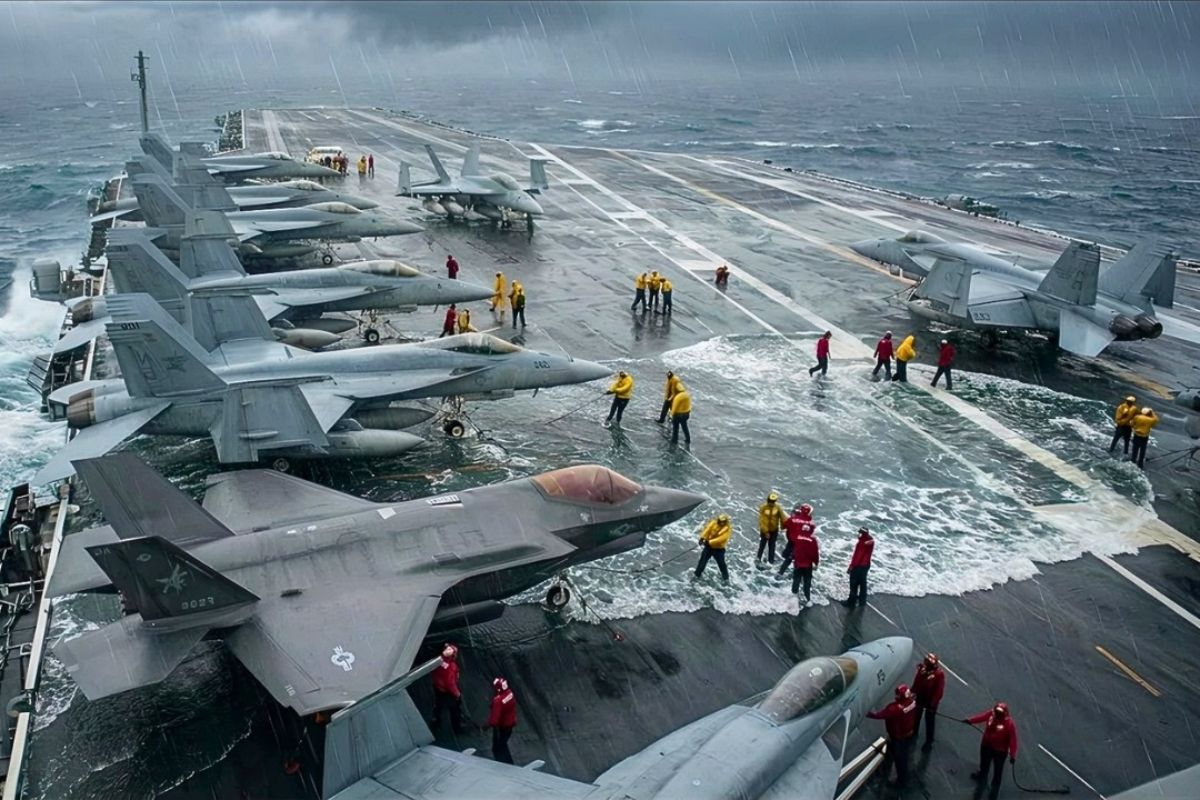
In An Aircraft Carrier, More Than 60 Jets Valued in Billions Face a Storm on a Deck That Rises, Tilts and Drags Chains, While the Hangar Becomes Partial Shelter and Each Steel Link Decides If the Operation Remains Intact or Ends in a Million-Dollar Loss in the Sea in Brutal Seconds Too Much.
An aircraft carrier looks like an armored airbase, but during a storm it transforms into an unstable runway surrounded by wind, saltwater, and tons of metal under tension. This is when the deck stops being just an operational area and starts functioning as a lifeline for jets worth fortunes.
The risk is not only in open sea nor only in the force of the wind. It arises from the sum of the ship’s movement, the weight of the aircraft, pressure on the moorings, and the need to act without delay. Part of the jets goes down to the hangar, part remains on the deck, and any failure small enough to seem insignificant can turn into an irreversible loss in a matter of seconds.
Before the Storm, the Aircraft Carrier Already Enters Containment Mode
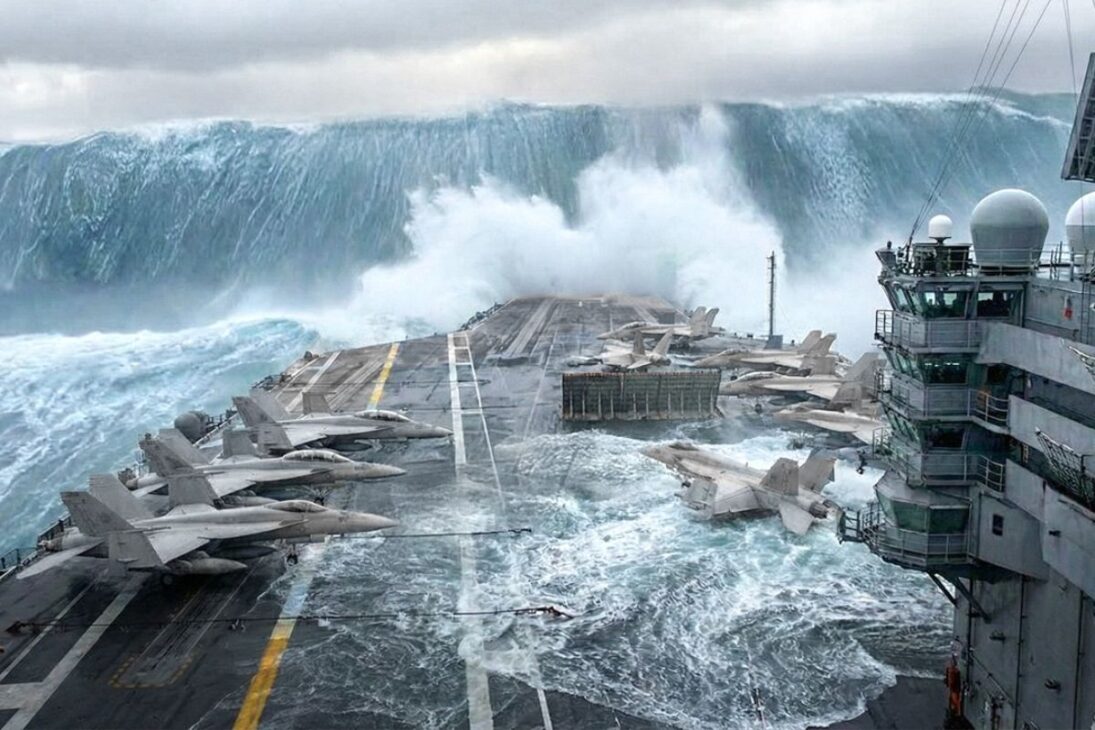
The most important phase begins before the storm hits the ship. In an aircraft carrier, each aircraft has a defined position, and nothing is loose or improvised. As soon as the jets land and shut down their engines, the containment process begins. The wings are folded to reduce impact area, the brakes are locked, and heavy short steel chains come into play, attached to multiple reinforced points on the deck. At this stage, the goal is not flight speed, but pure resistance.
-
China accelerates global science and may surpass the United States in 2 years with increased public investment, continuous growth, and direct impact on the global technological competition.

-
Scientific studies indicate that drought may be strengthening a much greater silent threat: more resistant superbugs.

-
Man builds functional 5-meter submarine in his garage using gas cylinders, PVC pipes, and a refrigerator motor, and navigates with the vessel on a lake in Colombia.
-
Millions of people have been eating yam for centuries without knowing that this humble tuber contains a compound called diosgenin, which scientists have now discovered can improve memory and help control blood sugar levels.

Under normal conditions, some moorings may suffice. When there is a storm warning, the number increases, sometimes doubling or tripling. The deck stops functioning as a runway and starts being treated as a containment surface against the ocean. This changes the crew’s behavior, the pace of checks, and the ship’s priority. What seemed like aerial routine turns into mechanical survival procedure.
This preparation exists because the problem does not come from a single gust of wind. The real danger appears when lateral force, vertical oscillation, and drag act simultaneously. An aircraft carrier does not face only heavy rain; it deals with a platform that rises and falls while carrying dozens of large aircraft in a limited space.
Therefore, every chain, every angle, and every fixation point must function redundantly. If one mooring loses tension, another immediately takes the load. The system is designed so that a small variation does not turn into an immediate disaster, but it only works when the discipline of the procedure remains intact.
The Hangar Is the Main Shelter, But Does Not Eliminate the Risk
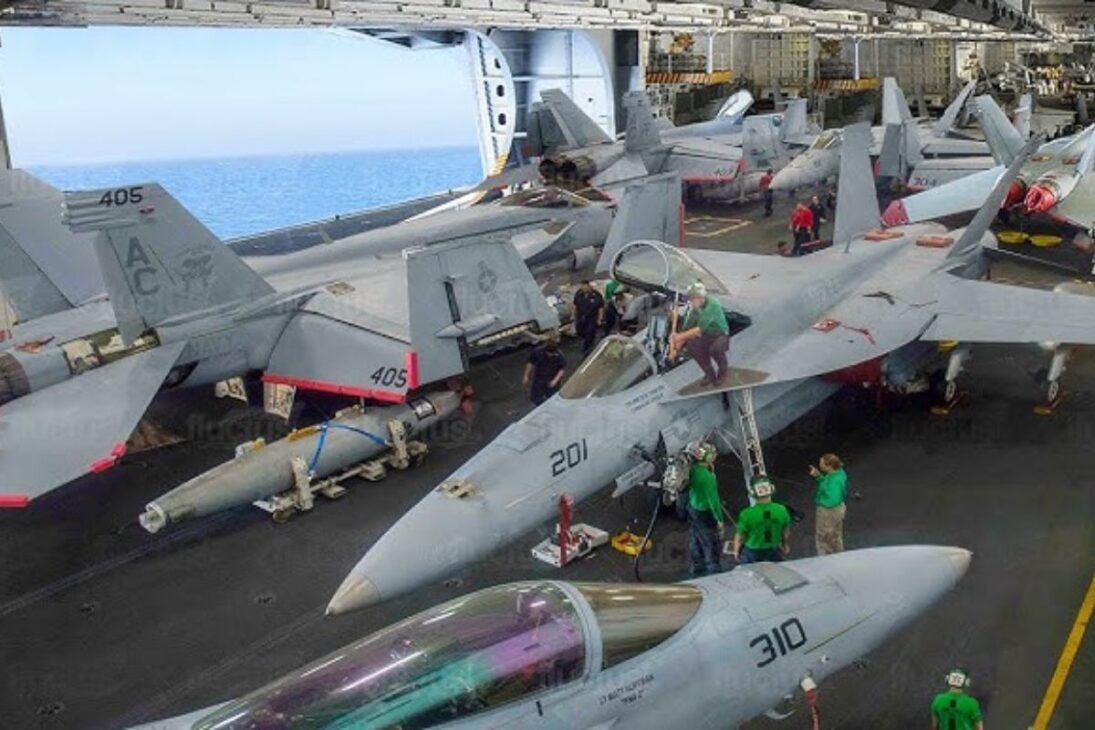
When the storm truly approaches, the priority shifts from securing on the deck to removing as much as possible from the surface. This is when the giant elevators of the aircraft carrier come into action, taking the jets to the hangar. This space functions as a floating bunker: closed, protected from direct wind and rain, with internal divisions made by steel doors that isolate different sectors. Moving the aircraft down is not comfort; it is a drastic reduction of exposure.
Even so, the hangar does not guarantee absolute safety. Saltwater remains a threat, as it corrodes components, penetrates systems, and accelerates wear. An open panel or a poorly checked seal can destroy electronics and turn partial protection into a loss of millions. That is why each cabin is sealed, every access is checked, and every compartment is treated as a sensitive area. The hangar’s shielding only works if human verification does not fail.
The problem is that not all jets fit down there. An aircraft carrier transports a large number of aircraft, and the capacity of the hangar is limited. This means that during a storm, part of the onboard aviation continues on the deck, secured only by steel, fixation geometry, and constant crew effort.
This is the point where the ship’s balance becomes more delicate. The hangar reduces total exposure, but does not solve everything. What remains on the deck concentrates disproportionate risk, as each remaining aircraft becomes a block of tens of tons under the constant action of wind and sea movement.
When the Deck Becomes the Last Line Between the Jet and the Sea Floor
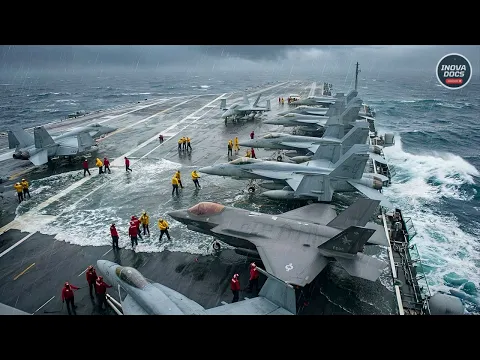

With the sea heavier and the wind stronger, the deck enters the critical phase. The chains cease to be additional reinforcement and become the last barrier between the jets and the ocean. Each aircraft receives moorings forward, backward, and sideways, with no slack and no room for error. The crew navigates the wet runway, with the ship tilted, to check tension, wear, and alignment. At this moment, resistance depends as much on steel as on the exact repetition of the procedure.
A single jet can weigh over 30 tons. In an aircraft carrier, this needs to be multiplied by several aircraft distributed at the same time on a surface that rises and falls with the waves. The effort does not come only from below, as if it were simple static weight. It also comes from the side, in the form of push, jolt, and constant drag. The deck begins to concentrate hundreds of millions of dollars in machines supported on a platform that never stops moving.
That is why the ship also needs to maintain proper behavior. It turns into the wind and maintains speed not for operational comfort, but for stability. If the aircraft carrier loses that relative stability, the pressure on the chains changes, the alignment of the aircraft deteriorates, and the safety margin quickly disappears. What seemed like a simple runway reveals its real function: to be an active containment structure in an extreme environment.
That is why the difference between crossing a storm without losses and seeing a plane disappear into the sea is not luck. It lies in procedure, redundancy, and quick response. On the deck, any carelessness stops being small the moment the ocean decides to take its toll.
The Real Case That Showed How a Faulty Link Brings Down an Entire System
In 2022, this limit became evident in the Mediterranean. During a storm, violent winds and strong waves hit a U.S. Navy aircraft carrier. In the middle of an operation inside the hangar, a jet being towed came loose. In seconds, a Super Hornet valued at around 70 million dollars was pushed off the USS Harry S. Truman and fell into the sea. There was no missile, no combat, no explosion. There was a failure under pressure.
The aircraft sank quickly and descended nearly 3,000 meters to the bottom of the Mediterranean. This episode changes the reading of the entire system because it proves that an aircraft carrier does not lose jets simply because the storm is strong. It loses aircraft when a protection chain fails to function as it should, whether due to communication, procedure, towing, or fixing. The ocean comes into the process only when human defense has already been breached.
This is the hardest point of the embarked naval operation. Billions can withstand hurricanes intact when each detail is respected. But the system does not allow for relaxation, because it was designed precisely to operate without a wide margin. The hangar provides significant protection, the deck secures the rest, and the ship adjusts to survive. However, all of this depends on a continuous link between engineering and execution.
In the end, what sinks is not just an expensive machine. What sinks is the illusion that technology alone solves everything. An aircraft carrier carries extreme military power but remains subjected to wind, sea, and human error. The difference between crossing the storm and producing wreckage on the ocean floor often lies in a detail too small to attract attention until it is too late.
An aircraft carrier survives the storm not because it defies physics, but because it transforms deck, hangar, chains, and crew into a single containment system. The jets remain on board when every step has been designed to function under maximum pressure and when no one treats the procedure as a formality.
In your opinion, is the most critical point of this operation on the exposed deck, in the crowded hangar, or in the human factor that connects all of this?







-

Uma pessoa reagiu a isso.