





 Portuguese
  English
  Spanish
  3 min of reading
  0 comments


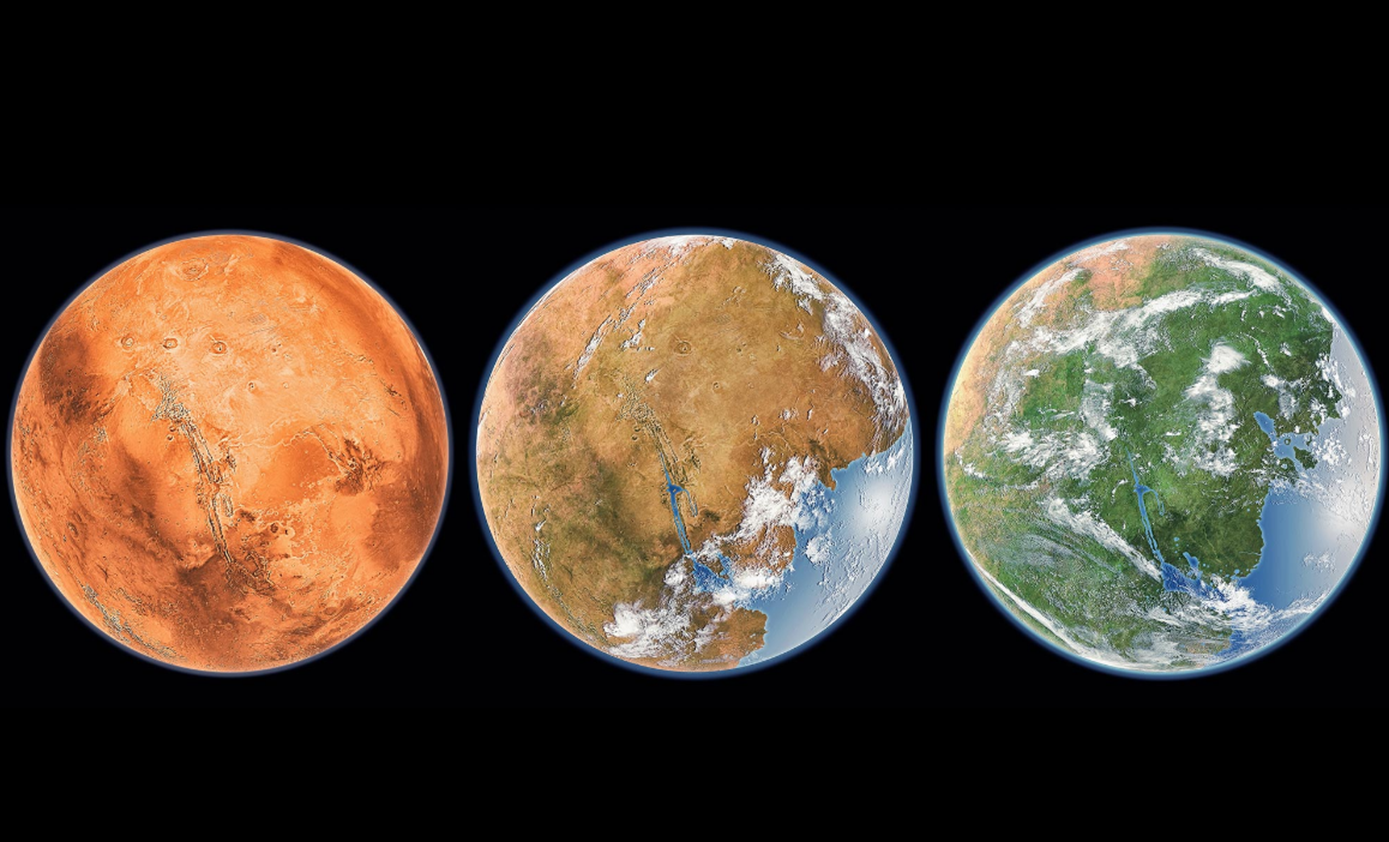
Study Revisits The Possibility Of Terraforming Mars, Analyzing Scientific Advances And The Challenges To Turn The Planet Into A Habitable Environment.
Transforming Mars into a new home for humanity has ceased to be just a theme of science fiction.
Now, a group of scientists revisits this idea based on recent advances in planetary science, biotechnology, and space engineering.
They assess the feasibility of warming the planet, enriching its atmosphere, and installing life support systems.
-
Motorola launched the Signature with a gold seal from DxOMark, tying with the iPhone 17 Pro in camera performance, Snapdragon 8 Gen 5 that surpassed 3 million in benchmarks, and a zoom that impresses even at night.

-
Satellites reveal beneath the Sahara a giant river buried for thousands of kilometers: study shows that the largest hot desert on the planet was once traversed by a river system comparable to the largest on Earth.

-
Scientists have captured something never seen in space: newly born stars are creating gigantic rings of light a thousand times larger than the distance between the Earth and the Sun, and this changes everything we knew about stellar birth.

-
Geologists find traces of a continent that disappeared 155 million years ago after separating from Australia and reveal that it did not sink, but broke into fragments scattered across Southeast Asia.

The study, published in the journal Nature Astronomy, was conducted by researchers from Pioneer Research Labs and the University of Chicago. It describes the first steps needed to initiate a possible terraforming process for Mars.
First Detailed Assessment In Decades
According to Nina Lanza, a planetary scientist at Los Alamos National Laboratory and co-author of the paper, there hasn’t been a study so focused on the practical feasibility of transforming Mars since 1991. “Believe it or not, no one has really cared about the feasibility of terraforming Mars since 1991,” she stated.
Since then, research has significantly advanced in areas such as geoengineering, Mars science, launch capabilities, and bioscience.
These advances motivated the group to resume the debate, now with a more realistic view of the challenges and possibilities.
How To Transform Mars
For Mars to become habitable, it would be necessary to increase its temperature and thicken its atmosphere.
The first step suggested by the researchers involves the use of genetically modified microbes. They would perform photosynthesis, gradually producing oxygen.
With the accumulation of oxygen, it would be possible to maintain liquid water on the surface and, eventually, support more complex life forms.
However, the path would not be simple or quick. Many challenges must be considered before any practical attempts.
Challenges And Risks Of The Process
The scientists emphasize that, before proceeding, it is necessary to carefully assess the technical requirements, costs, and risks associated with terraforming Mars.
“Before we can evaluate whether warming Mars is worth it, compared to the alternative of leaving Mars as an untouched wilderness, we need to confront the practical requirements, the costs, and the potential risks,” the authors wrote.
Currently, research seeks to better understand Mars’ water reserves, its carbon dioxide supply, and soil chemistry.
These pieces of information are essential to evaluate if the planet has the basic resources for the proposed transformation.
The scientists claim that new techniques could raise the planet’s average temperature by several degrees in a few decades.
However, this increase would depend on a deeper understanding of the physical, chemical, and biological limits involved.
Martian Technology With Terrestrial Application
In addition to benefits for space exploration, the researchers highlight that the technologies developed for terraforming Mars could also bring advantages to Earth.
Innovations such as drought-resistant crops, efficient soil remediation, and improved ecosystem modeling could be applied on the home planet.
“Research on terraforming Mars provides a vital testing ground for planetary science, potentially validating theories or exposing knowledge gaps,” the authors stated. Even if large-scale terraforming does not materialize, the scientific advancement would be valuable.
The authors conclude that there is still much to be discovered before any concrete actions can be taken. “We don’t even know what is physically or biologically possible. … If people can learn to terraform a world like Mars, this could be the first step toward destinations beyond.”








Seja o primeiro a reagir!