





 Portuguese
  English
  Spanish
  6 min of reading
  0 comments


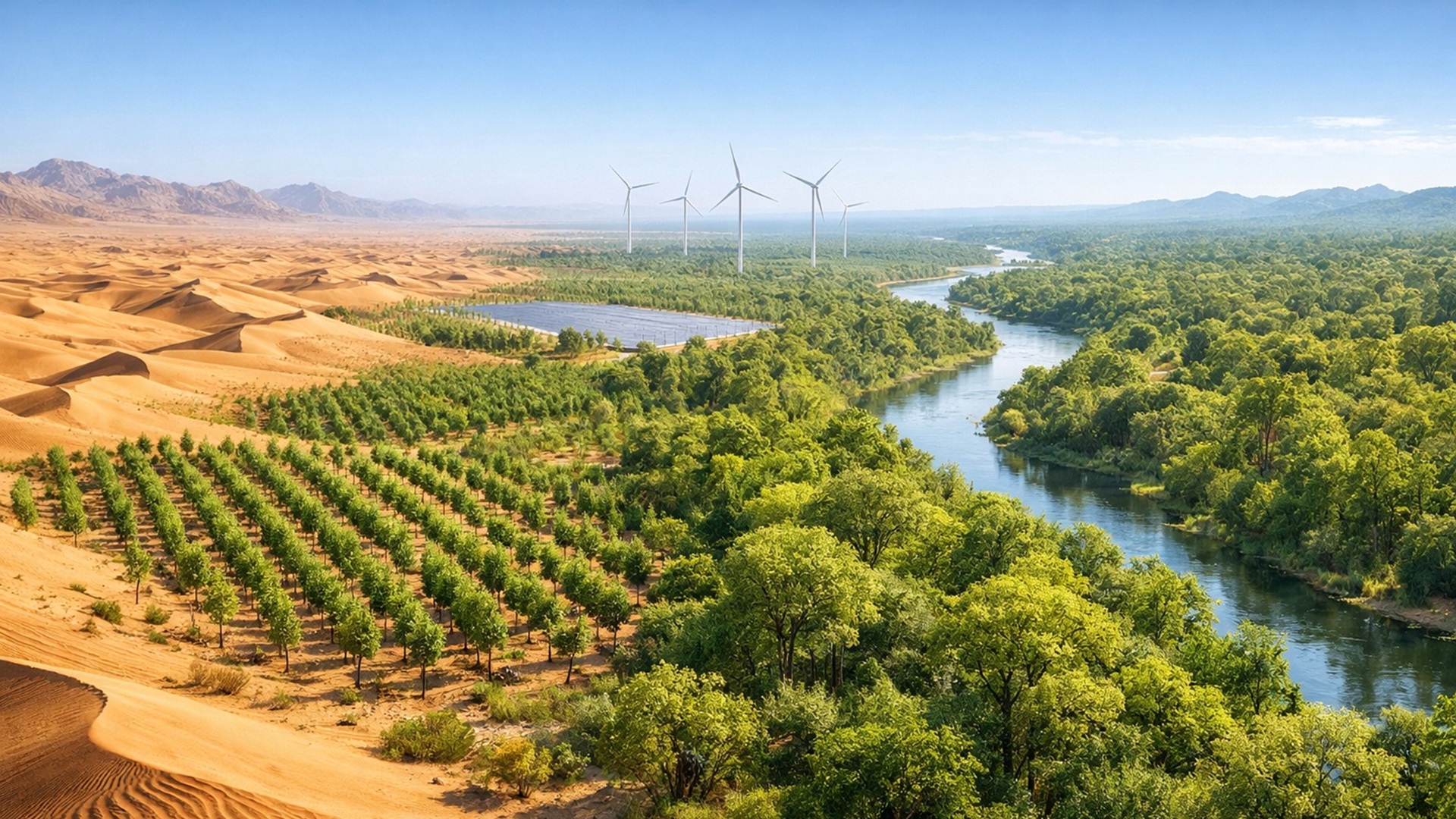
The Hypothesis of Turning the Sahara Into Forest Involves Reforestation in an Area of About 9.2 Million km², Estimated Planting of Up to 920 Billion Trees, Annual Consumption of 4.3 Trillion m³ of Water, and Potential Impacts on Global Climate, Carbon Capture, and Even the Ecological Balance of the Amazon
The possibility of transforming the Sahara into forest raises a debate about scale, resources, and global impacts. Covering 9,200,000 km², the largest hot desert on the planet surpasses the area of the largest tropical forests and would require gigantic environmental and energy interventions.
The Sahara occupies an estimated area of 9,200,000 square kilometers, a size larger than that of the planet’s largest tropical forest. The Amazon rainforest covers about 5,300,000 square kilometers, while the Congo forest, the second largest in the world, occupies approximately 1,700,000 square kilometers.
These comparisons illustrate the scale involved when discussing the possibility of transforming the Sahara into forest. If it were a country, the African desert would rank among the largest on the planet, with a size similar to nations like the United States, China, and Canada.
-
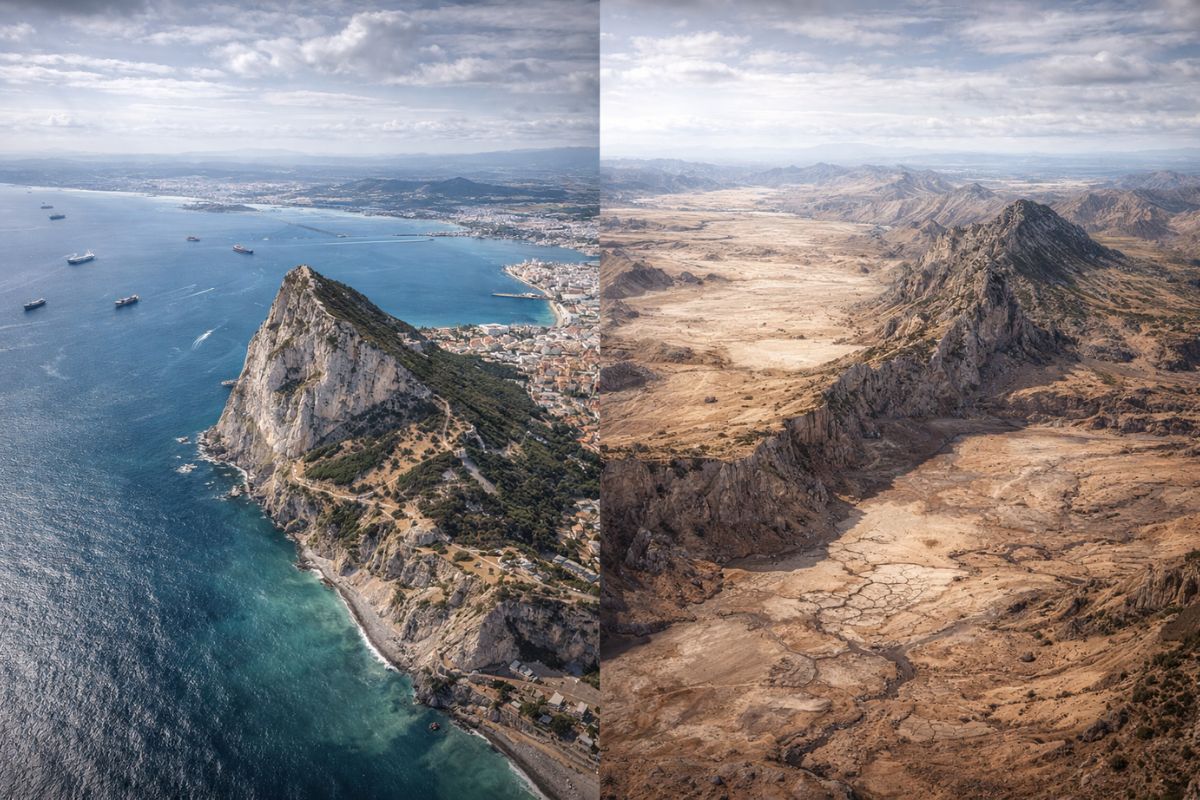
A new study suggests that the Strait of Gibraltar may disappear because the rocks beneath it are triggering a subduction process that could reshape the entire Atlantic Ocean in the next 20 million years.
-
There is a little-known function that allows you to earn a salary in dollars working from home without knowing anything about programming, and Brazilians are already making up to R$ 35,000 per month organizing inventories and routes for American companies.

-
China has deployed over 1,400 fishing boats in formation, creating a barrier of 320 kilometers at sea, and the whole world wants to know if this is fishing, military exercise, or a message of war.

-
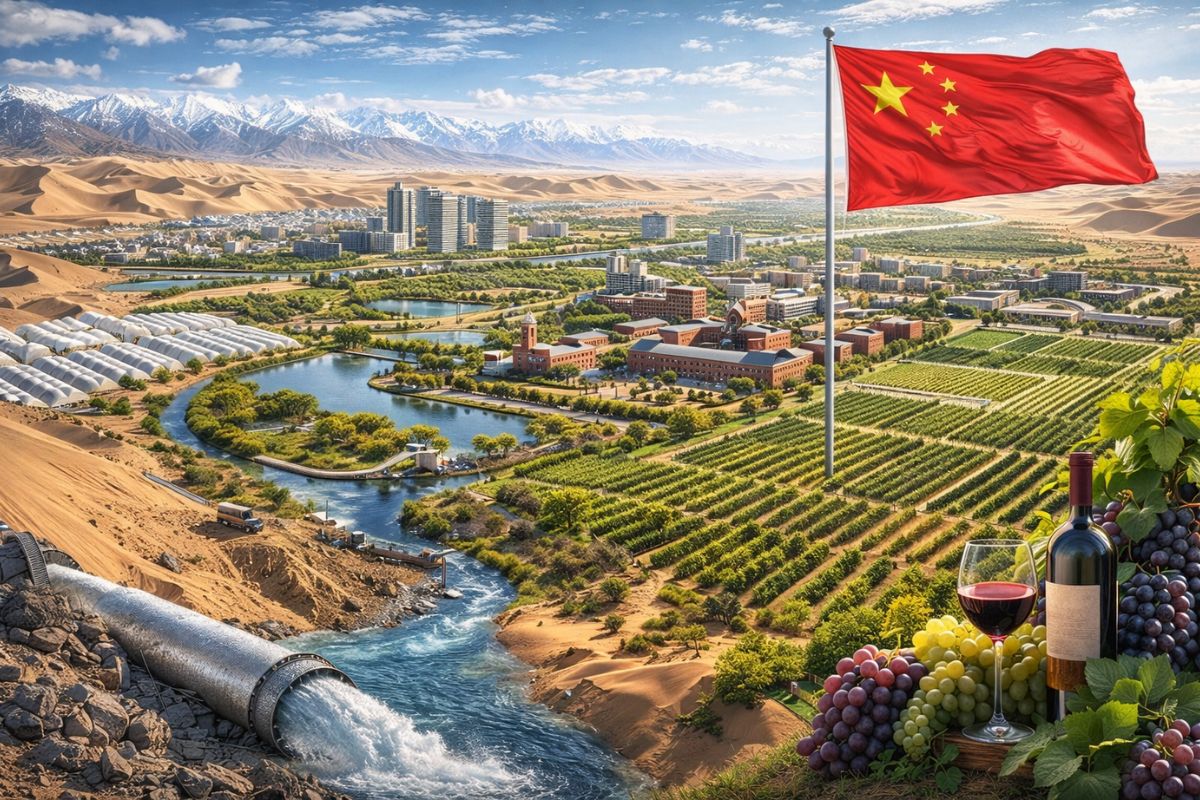
Where there was only sand and wind at 40 degrees, China built a megacity of 500,000 inhabitants with farms, wineries, and universities in the middle of the desert using melted glacier water from hundreds of kilometers away.

Reforestation Experiments Inspire Debates on Turning the Sahara Into Forest
Reforestation projects in arid areas have already been attempted in different parts of the world. One example is the Gobi Desert, shared between Mongolia and China, considered the sixth largest desert on the planet, covering approximately 1,300,000 square kilometers.
The Gobi advanced into Chinese territory at a rate of 3,600 square kilometers per year. This process destroyed pastures and agricultural areas, forcing entire communities to abandon their lands and causing estimated economic losses of nearly 50 billion dollars annually.
To halt this expansion, the Chinese government launched in 1978 a project known as the Great Green Wall. The initiative consists of a series of forest barriers designed to reduce wind force and prevent the advance of desertification.
The program is expected to reach about 4,500 kilometers in length when completed, with an approximate goal by 2050. By 2009, more than 500,000 square kilometers had already been covered by trees, forming the largest artificial forest in the world.
Currently, the project reduces desert encroachment by approximately 2,000 square kilometers per year. Additionally, the planted trees help absorb carbon dioxide throughout the region.
Despite the results, the program received criticism related to groundwater consumption and low species diversity planted. In 2000, for example, around one billion trees died in the Chinese region of Ningxia.
Estimated Time to Turn the Sahara Into Forest Would Take Thousands of Years
If the recovery rate observed in China were applied to the Sahara, the process of transforming the Sahara into forest would take about 4,600 years. This calculation considers an annual recovery of approximately 2,000 square kilometers of desertified land.
The challenge becomes even greater when considering that China has more economic resources and a much larger population than the African countries surrounding the Sahara Desert.
In Africa, a similar project has also been launched to contain the advance of desertification. This is the Great Green Wall of the Sahel, conceived in 2007 to restore degraded areas in the transition region between the Sahara and the savanna.
The Sahel stretches horizontally across ten African countries and suffers from the continuous expansion of the desert. The initiative aims to cover approximately 1,000,000 square kilometers with trees by the year 2030.
As of 2023, however, only 18% of the project had been completed. The limited progress is attributed to delays, failures in coordination, and unfulfilled funding promises among participants.
The countries in the region have not allocated significant own resources to the project and rely on external funding. Therefore, the expectation of completing the plan by 2030 is considered unlikely.
Infrastructure Needed to Transform the Sahara Into Forest Involves Billions of Trees
The process of transforming the Sahara into forest requires careful selection of species adapted to the subtropical climate. The trees need to be perennial, fast-growing, and economically viable for timber or other products.
Among the species considered suitable are eucalyptus, known for its rapid growth and use in timber, paper, and essential oil. Other options include pines and acacia species such as Acacia mangium and Acacia auriculiformis.
Theoretically, about 100,000 trees could be planted in each square kilometer. Applying this density to the total area of the Sahara, the desert could support approximately 920 billion trees.
This number illustrates the magnitude of the operation needed to create a forest across the region. The implementation would require massive infrastructure for planting, maintenance, and irrigation over thousands of kilometers.
Water, Energy, and Climate Impacts Enter the Calculation of Turning the Sahara Into Forest
A forest of this size would require about 470 millimeters of water per year to sustain itself. This volume corresponds to approximately 4.3 trillion cubic meters of water annually.
A possible source could be the Nubian aquifer system, located beneath the Sahara and shared by Egypt, Libya, Sudan, and Chad. This underground reservoir covers about 2,500,000 square kilometers and contains approximately 150,000 cubic kilometers of water.
If used entirely, the aquifer could irrigate the forest for about 35 years. The problem is that this water is non-renewable, meaning it would be permanently depleted after that period.
Another alternative discussed is the desalination of seawater. This technology has reduced its energy consumption over the decades, from about 20 to 30 kWh per cubic meter in 1970 to approximately 3 kWh today.
However, the Sahara has an average altitude of about 450 meters, requiring additional energy to pump the water inland. The total consumption would reach approximately 5.5 kWh per cubic meter.
To provide the 4.3 trillion cubic meters required, about 23,650 TWh of energy would need to be generated. Considering an average cost of 10 cents per kWh, the water alone would represent about 2.365 billion dollars, not including infrastructure.
Global Environmental Impacts Include Carbon, Temperature, and Fertilization of the Amazon
If the Sahara were to turn into forest, the local effects would include reduced temperatures due to increased soil moisture. This phenomenon would favor cloud formation and increased regional rainfall.
However, replacing a light desert with a dark forest would alter the so-called surface albedo. This change would reduce the reflection of solar radiation and could increase the global temperature.
Some studies estimate that the reforestation of the Sahara could raise global temperatures by about 0.12 °C by 2100. These calculations, however, do not fully consider the effects of cloud formation in the region.
On the other hand, the new forest could capture between 6 and 12 gigatons of carbon dioxide per year over a century. This volume represents between 16% and 33% of annual global emissions.
Another relevant factor involves the relationship between the Sahara and the Amazon rainforest. Sands transported by winds from the desert provide essential minerals that fertilize the soils of the Amazon.
Without this flow of nutrients, aquatic and terrestrial plants in the Amazon region could be affected. Consequently, animals that depend on these ecosystems would also suffer impacts.
Studies also indicate that the Sahara was green about 5,000 years ago during the African humid period. This shows that the region once presented very different environmental conditions than today.
Still, any project to transform the Sahara into forest involves complex natural systems and difficult-to-predict consequences. The magnitude of the intervention would require detailed assessments of climatic, ecological, and social effects on a global scale.









-

-

-

-

7 pessoas reagiram a isso.