





 Portuguese
  English
  Spanish
  4 min of reading
  0 comments


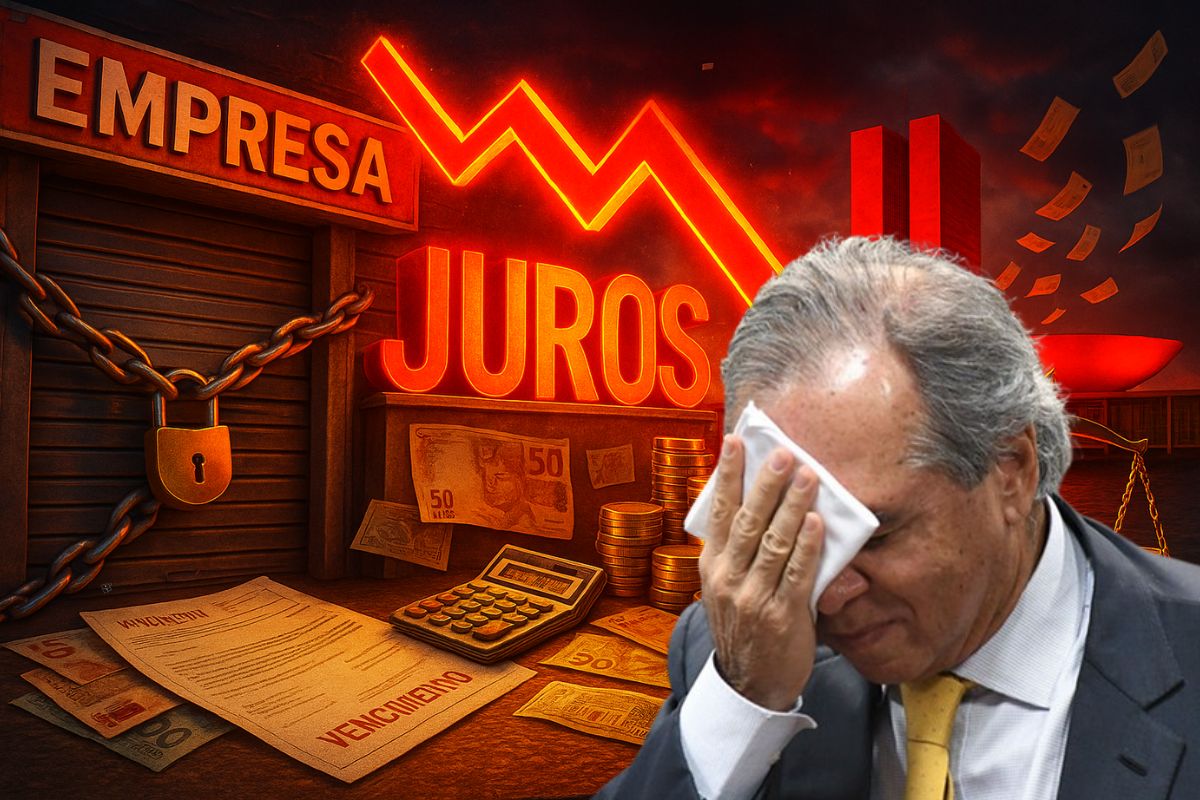
Historic Alert Exposes How Fiscal Imbalance, Not the Central Bank, Is the Real Villain Behind the High Interest Rates Suffocating Businesses in Brazil
Economist Paulo Guedes made a strong warning in 2025: the high interest rates that are destroying businesses in Brazil do not originate from the Central Bank, but from the uncontrolled public spending of the federal government. According to him, the monetary authority merely reacts to an unbalanced fiscal scenario, functioning as “a mirror”. If the government overspends, interest rates rise; if there is fiscal discipline, they naturally fall.
This accusation, mentioned by Paulo Guedes, highlights a historical problem: the Brazilian State spends more than it collects, offloading the costs onto society and strangling the productive sector. According to the economist, this mechanism is responsible for preventing sustainable growth and suffocating small, medium, and large businesses in Brazil.
Who Is the Economist and Why Is He Speaking Out?
The specialist recalled his trajectory to justify his analysis.
-
Brazilian city gains industrial hub for 85 companies that is equivalent to 55 football fields.

-
Peugeot and Citroën factory in Argentina cuts production by half and opens a layoff program for more than 2,000 employees after Brazil drastically reduced purchases of Argentine vehicles.

-
A Brazilian city gains a factory worth R$ 300 million with the capacity to process 200 thousand tons of wheat per year, a mill of 660 tons/day, silos for 42 thousand tons, and an industrial area of 276 thousand m².

-
Havan will leave the shopping mall in Blumenau to inaugurate something that the chain has never done before: a megastore in half-timbered style in the Historic Center of the city, which is expected to be completed in May and change the landscape of local retail.


As a young man, during the 1980s, he witnessed the hyperinflation that eroded the savings of Brazilians, with rates of up to 5,000% per year.
He recalls that economic plans like Cruzado and Collor failed because they only tackled symptoms without addressing the fiscal root cause.
With the Real Plan in 1994, there was monetary stabilization, but the country became dependent on high interest rates to contain uncontrolled spending.
The result was always limited growth and businesses in Brazil frequently suffocated by expensive credit.
How Much Do Interest Rates Weigh On Businesses in Brazil?
Paulo Guedes emphasized that the cost of financing for Brazilian entrepreneurs is among the highest in the world.
This makes investments unfeasible, discourages innovation, and creates barriers even for profitable businesses.
According to him, it is not the Central Bank that “kills” businesses in Brazil, but the government, by insisting on spending more than it can.
He argues that if the State balanced its accounts, the country would have naturally lower interest rates, which would allow for business expansion, job creation, and attraction of foreign capital.
Where Does Brazil Err in International Comparisons?
In the economist’s view, the Brazilian model concentrates power and resources in Brasília since the colonial period.
He compares this to the United States, which were born from the bottom up, from the 13 colonies against abusive taxes from England.
In Brazil, on the other hand, the tax burden reaches 34% to 35% of GDP, compared to an average of 25% in emerging countries, yet the return in public services is poor.
The contrast is evident in the data: medical and police emergencies are responded to in three minutes in the U.S. versus days of waiting in Brazil; 60,000 to 70,000 homicides annually in the country, a “total absurdity” that reveals the State’s inability to protect lives.
Why Is the Criticism Historical?


Guedes’s speech is grounded in decades of experience in the financial system.
He has observed the evolution of the market, which previously only tried to survive inflation and later began to finance the growth of companies like Natura and Localiza.
He also emphasized the importance of modern practices like independent audits and corporate governance, which are essential to preparing businesses in Brazil for global competition.
For him, this transformation shows that the private sector has the ability to reinvent itself, but it depends on a more efficient State that does not consume resources in unproductive areas and acts where it is indispensable: security, justice, and property protection.
According to the economist, it is still worthwhile to venture into business, but the Brazilian business environment is inherently hostile.
High interest rates, heavy taxes, and bureaucracy create constant barriers.
The solution lies in reforms that balance public accounts, reduce the size of the State in deficit areas, and strengthen its presence in essential sectors.
Only with this structural change will it be possible to create a healthy environment for entrepreneurs and businesses in Brazil, capable of sustaining economic growth and quality of life for the population.
And you, do you believe that high interest rates are really a consequence of public spending and not of the Central Bank? Do you think this scenario can change in the coming years? Leave your opinion in the comments — we want to hear from those who live this in practice.










-

-

5 pessoas reagiram a isso.