





 Portuguese
  English
  Spanish
  3 min of reading
  0 comments


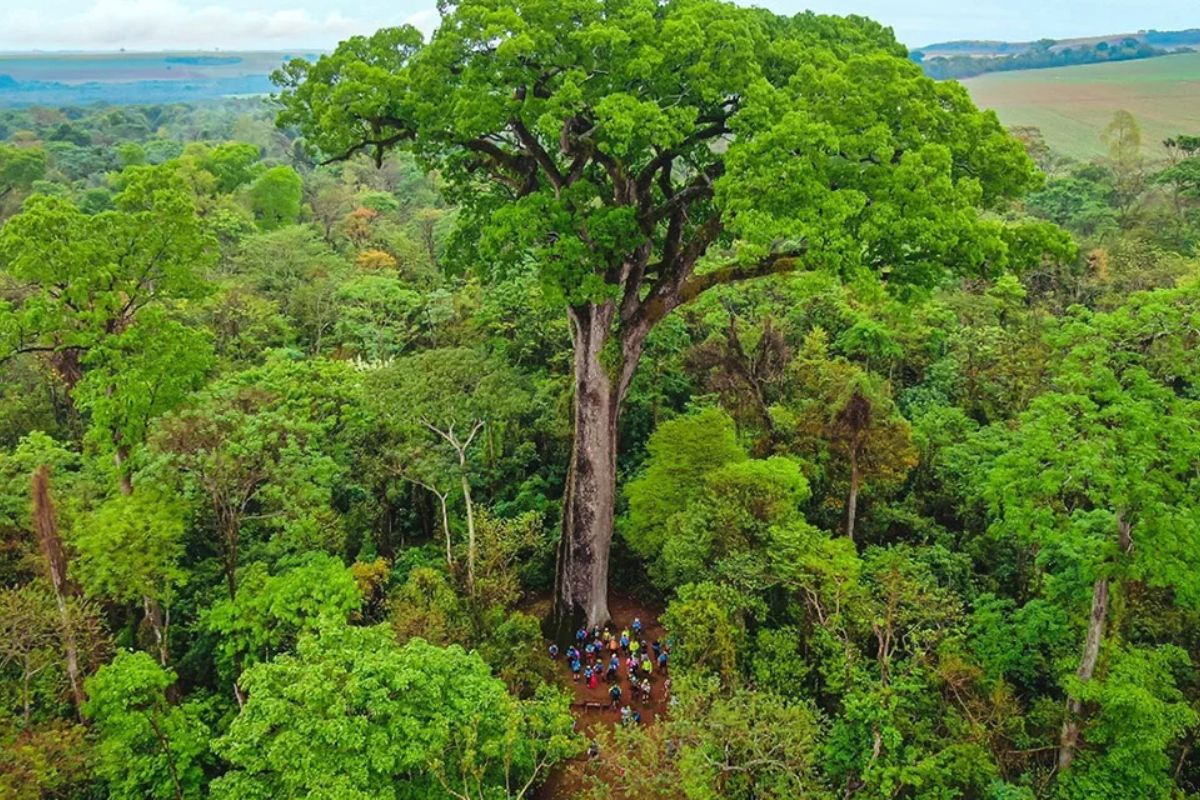
Meet the ‘Patriarch of the Forest’, a Living Monument of Nature, and Understand How It Survived All Phases of Our Country’s History.
When Pedro Álvares Cabral landed in Brazil in 1500, a colossal tree in what is now the state of São Paulo was already an elder, around 2,500 years old. While the Roman Empire rose and fell, while the pyramids of Egypt were being built, this tree was already sinking its roots into the earth.
This living monument exists to this day. It is a jequitibá-rosa known as “The Patriarch of the Forest”, considered the oldest tree in Brazil. But how can scientists be so certain about the age of a living being that has witnessed 3 millennia of history? The answer lies in a fascinating combination of biology and physics.
The Living Monument: Where It Is and Who Is the Oldest Tree in Brazil?
The Patriarch is a specimen of species Cariniana legalis (jequitibá-rosa), located in the Vassununga State Park, in the municipality of Santa Rita do Passa Quatro (SP). Its numbers are impressive:
-
Friends have been building a small “town” for 30 years to grow old together, with compact houses, a common area, nature surrounding it, and a collective life project designed for friendship, coexistence, and simplicity.

-
This small town in Germany created its own currency 24 years ago, today it circulates millions per year, is accepted in over 300 stores, and the German government allowed all of this to happen under one condition.

-
Curitiba is shrinking and is expected to lose 97,000 residents by 2050, while inland cities in Paraná such as Sarandi, Araucária, and Toledo are experiencing accelerated growth that is changing the entire state’s map.

-
Tourists were poisoned on Everest in a million-dollar fraud scheme involving helicopters that diverted over $19 million and shocked international authorities.


- Estimated Age: Approximately 3,025 years.
- Height: About 40 meters, equivalent to a 13-story building.
- Trunk Circumference: Approximately 16 meters.
It is considered by many researchers to be the oldest living being in Brazil and one of the oldest in South America.
The Time Machine of Nature: How Do Scientists Know the Exact Age?

Determining the age of such an ancient tree without cutting it down is a significant challenge of engineering and science. The most well-known method, counting the growth rings in the trunk (dendrochronology), is unfeasible for a living tree with such a wide trunk. Therefore, scientists use a more sophisticated technique: carbon-14 dating.
The process works like this:
- Sample Collection: Using a special probe, researchers take a small, thin sample from the tree’s core (the innermost and oldest part of the trunk), without causing significant harm to its health.
- Laboratory Analysis: Carbon-14 is a radioactive isotope present in all living beings. After an organism dies, it begins to decay at a constant and known rate. By measuring the amount of carbon-14 that still remains in the core sample, which is the “dead” part of the tree, scientists can accurately calculate how long ago that part of the tree was formed.
It was through this technique that the impressive age of over 3,000 years for the Patriarch was determined.
The Engineering of Longevity: Why Does a Jequitibá Live for Millennia?
The ability of a jequitibá-rosa like the Patriarch to live for so long is the result of an extremely efficient “biological engineering”:
Slow Growth: Slow-growing trees tend to produce much denser and more resilient wood.
Defense Compounds: The jequitibá produces tannins and other chemical substances that naturally protect it from attacks by termites, fungi, and other parasites.
Compartmentalization Capacity: When it suffers damage (such as a fallen branch or a lightning strike), the tree does not “heal” the wound like an animal. It isolates the damaged area, creating chemical barriers to prevent rot from spreading to the rest of the trunk, and continues to grow around the injury.
A Witness to World History

To give a sense of the age of the Patriarch, consider what was happening in the world when it was just a small seedling:
~1000 B.C. (Birth): King David ruled Israel; the Mayan civilization began to flourish in Central America; the Trojan War, immortalized by Homer, had happened just a few centuries ago.
~Year 0 (1,000 years old): The Roman Empire was at its peak under Augustus; Jesus Christ was born in the Middle East.
~1500 A.D. (2,500 years old): Cabral’s caravels reached Brazil; Leonardo da Vinci was painting the Mona Lisa in Italy.
Visiting the Patriarch of the Forest is not just an ecological tour; it is a journey through time and a lesson in resilience, a direct contact with a living being that is, in itself, a chapter of the planet’s history.
What do you find more impressive: a 3,000-year-old engineering marvel (the pyramids) or a living being of the same age? Comment!










Seja o primeiro a reagir!